
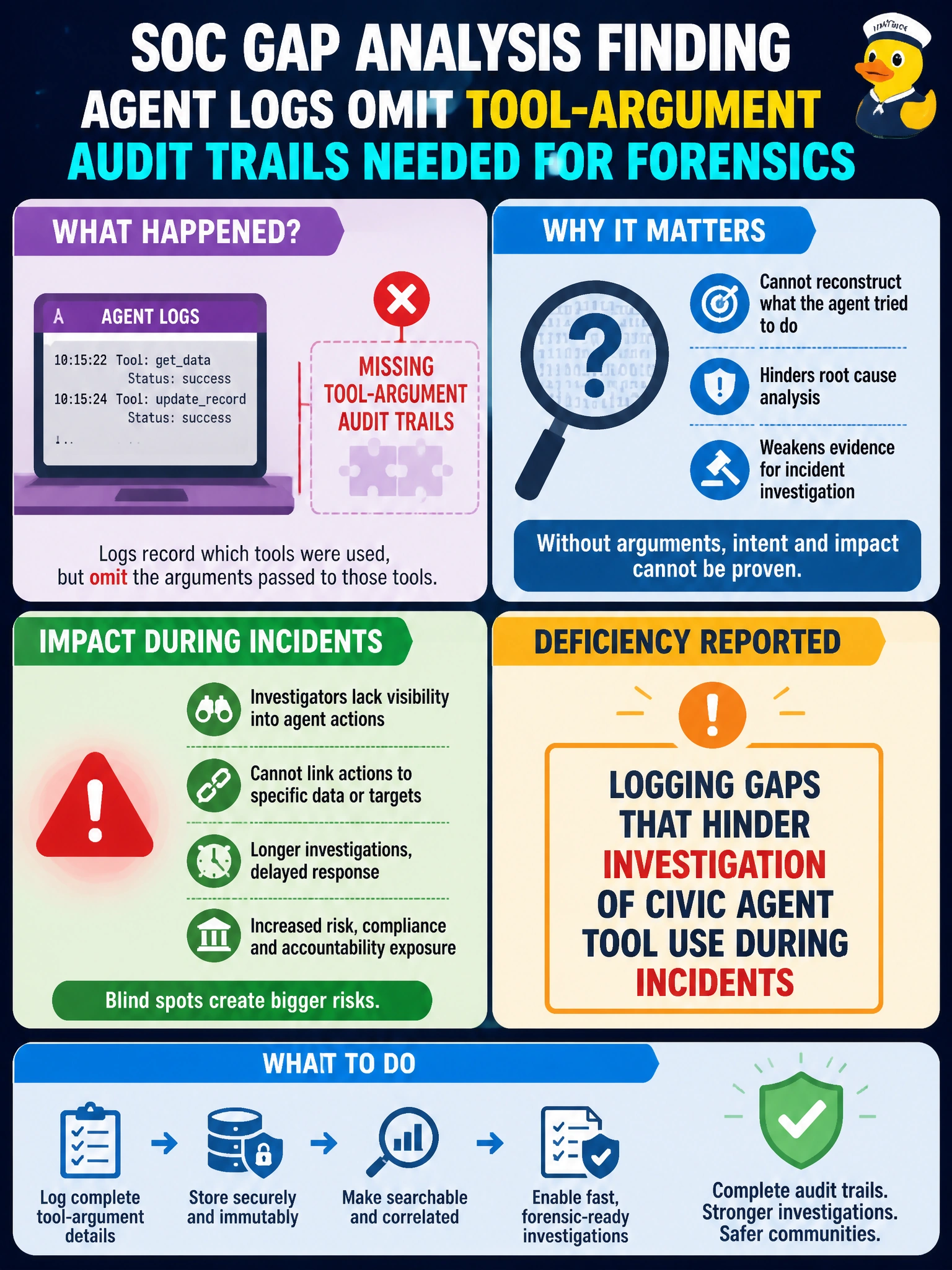
SOC gap analysis finds agent logs omit tool-argument audit trails needed for forensics. What deficiency is reported?
Select an answer to reveal the explanation.
Short Explanation
No tool-argument logs means forensics is flying blind after an agent incident. Fix the audit trail—delayed SIEM ingestion won't reconstruct who called which API.
Full Explanation
SOC gap analysis that finds agent logs omit tool-argument audit trails needed for forensics reports logging gaps that hinder investigation of civic agent tool use during incidents. Investigating agent incidents requires durable logs of tool names, arguments, actors, timestamps, correlation IDs, and outcomes so analysts can reconstruct who caused which municipal side effect after the chat session ends. Missing argument trails leave responders unable to prove data exfiltration, unauthorized fee changes, malicious escalations, or accidental bulk actions when only high-level chat text remains. Delayed SIEM ingestion only concerns ingestion speed, missing encryption controls only concern log protection at rest, and incomplete mapping of civic agent identities to authorized tool permission scopes only governs authorization; none of them reconstruct the omitted tool-argument audit trail needed for civic agent forensics. Exam items contrast SOC comfort with auditability; choose logging gaps that hinder agent investigation. Caveat: argument logs may contain sensitive resident data and must be access-controlled, encrypted at rest, and retained per policy without being so aggressively redacted that investigations become impossible. Operational check: execute a known tool call in a test incident and verify SIEM or audit storage retains tool name, bounded arguments, actor identity, and result code suitable for timeline reconstruction.