
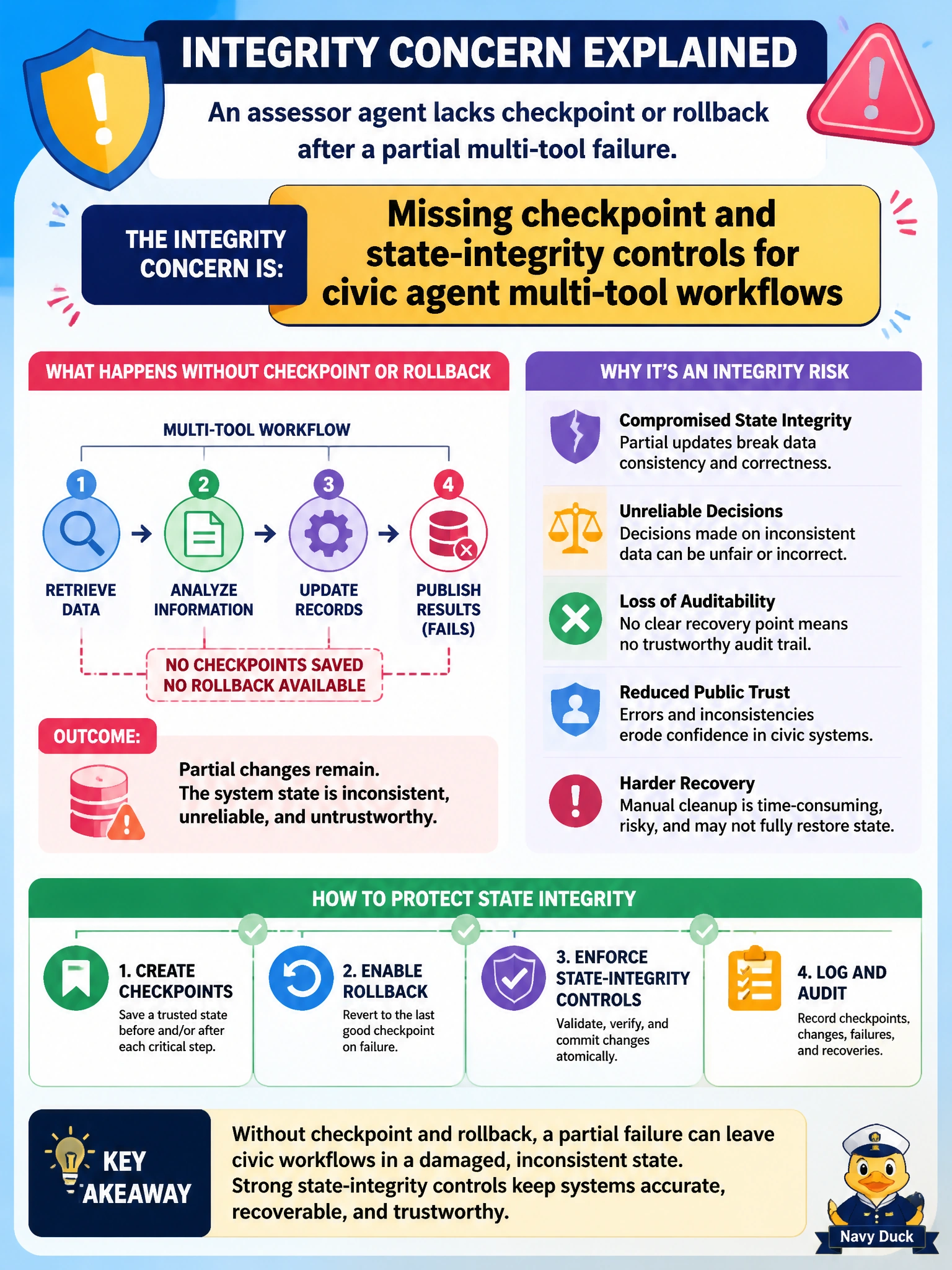
An assessor agent lacks checkpoint or rollback after a partial multi-tool failure. What integrity concern is that?
Select an answer to reveal the explanation.
Short Explanation
Half-finished tool chains with no rollback are like a form stuck mid-stamp—state integrity is gone. Add checkpoints; incomplete output validation for chained tool responses won't roll back your partial state.
Full Explanation
An assessor agent that lacks checkpoint or rollback after a partial multi-tool failure raises a missing checkpoint and state-integrity controls concern for civic agent multi-tool workflows. Multi-tool civic workflows that update cases, finances, permits, or records need checkpoints and rollback so a failure mid-chain does not leave inconsistent, half-applied state that staff cannot safely reconcile. Without those controls, retries can double-charge residents, orphan tickets, mark inspections complete while dependent writes never landed, or strand approvals in conflicting systems. Choosing incomplete output validation for chained tool responses in assessment workflows, gaps in decision logging and traceability for multi-step assessor agent actions, or drifted access scoping for cross-tool invocation in civic federated assessment pipelines does not restore transactional integrity for agent tool chains. On the exam, partial multi-tool failure without recovery maps to state-integrity and checkpoint gaps. Caveat: checkpoints must be durable and correlated across external systems the agent touches; an in-memory flag lost on process crash is not a real recovery point and will fail under realistic outages. Operational check: force a failure after the first successful tool write in a lab workflow and verify the platform detects partial state, blocks further side effects, and can roll back or compensate to a consistent case record.