
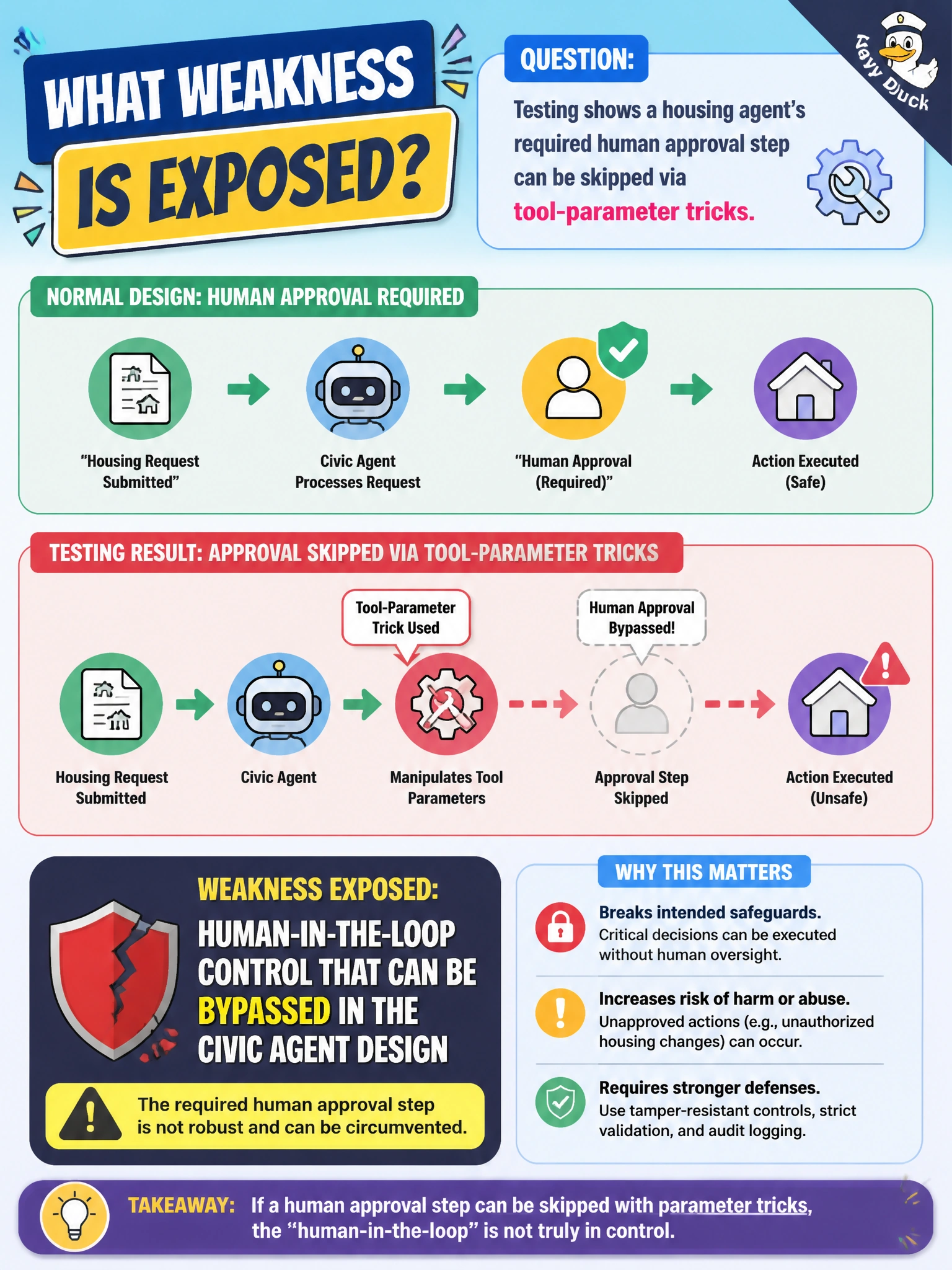
Testing shows a housing agent's required human approval step can be skipped via tool-parameter tricks. What weakness is exposed?
Select an answer to reveal the explanation.
Short Explanation
If a parameter trick skips the human gate, that approval box is only painted on. The gate needs enforcing in the control path itself, not just logged elsewhere.
Full Explanation
Testing that shows a housing agent's required human approval step can be skipped via tool-parameter tricks exposes human-in-the-loop control that can be bypassed in the civic agent design. Human-in-the-loop is only effective if the approval gate is enforced in the control path—server-side, after parameter validation—not merely suggested in prompts or optional UI flags the model can omit. Parameter tricks such as null approver IDs, forged preapproved booleans, or race conditions that complete privileged housing actions without a real human decision mean the control is cosmetic. Assessments should treat bypassable human-in-the-loop as a high-severity integrity defect. An incomplete audit trail for housing approvals makes it harder to prove after the fact that an approval happened, but it doesn't address whether the step itself can be skipped in real time. Loose input validation on resident address fields is a data-quality concern for the intake form, not the control that lets the agent execute privileged actions without a human decision. Insufficient output filtering of eligibility summaries could leak details in a response, but it has nothing to do with whether the approval gate upstream can be bypassed. None of the three restores enforceable, server-side approval; pick bypassable human-in-the-loop even when audit, validation, or filtering gaps are also present. Caveat: logging an approval after the fact is not the same as blocking execution beforehand. Operational check: craft tool calls that omit or spoof approval fields in an authorized test and confirm the platform rejects the action with no state change to case benefits, placements, or records.