
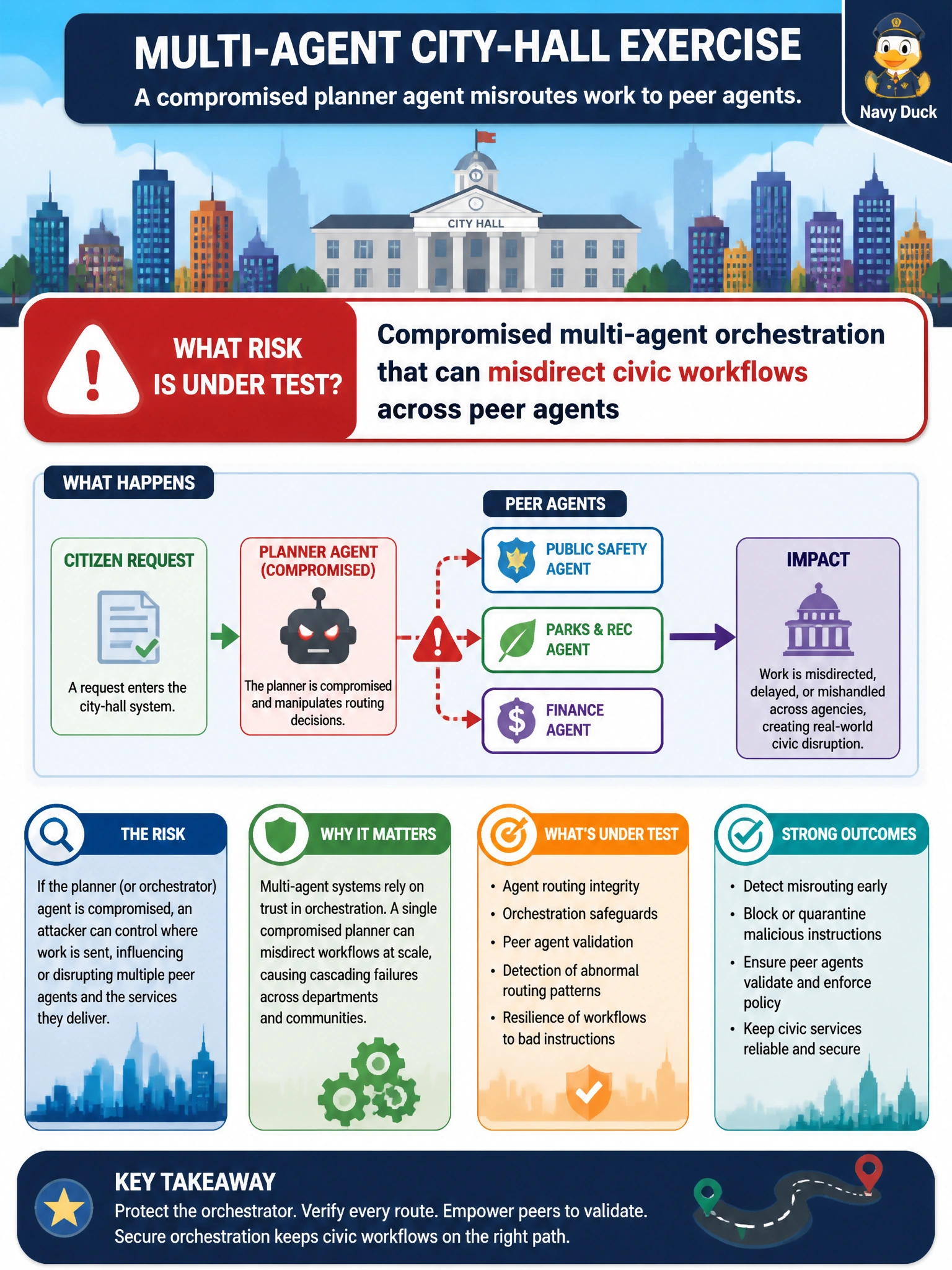
In a multi-agent city-hall exercise, a compromised planner agent misroutes work to peer agents. What risk is under test?
Select an answer to reveal the explanation.
Short Explanation
When the planner bot sends work to the wrong peer agents, the whole orchestra is following a bad conductor. That's compromised multi-agent orchestration risk.
Full Explanation
In a multi-agent city-hall exercise where a compromised planner agent misroutes work to peer agents, the risk under test is compromised multi-agent orchestration that can misdirect civic workflows across peer agents. Planner or orchestrator components often hold routing authority; if they are poisoned, hijacked, or prompt-injected, they can send tasks to the wrong specialists, skip review agents, or create loops that bypass policy. That class of risk is systemic: one bad planner can amplify damage across many capable peers that individually appear well scoped. Authorized tests validate authentication between agents, integrity of routing plans, and monitoring for anomalous handoff graphs. Unauthenticated citizen input handling deals with injected instructions at the intake layer, not with a compromised planner misrouting tasks among peer agents. Overprivileged tool access concerns what peer agents can execute after receiving a task, not the planner's routing authority that sends work to the wrong peers. Delayed delegation audit logging slows retrospective review, but it does not describe the live misrouting of civic workflows by a hijacked planner. Exam distractors highlight adjacent security gaps while the correct concept is multi-agent routing integrity under compromise. Caveat: hardening only worker agents is insufficient if the planner remains an unauthenticated or over-trusted single point of failure. Operational check: inject a malicious routing instruction into the planner in a lab graph and verify peer agents reject unauthorized handoffs, alert on anomalous topology, and leave an auditable trail of refused tasks.