
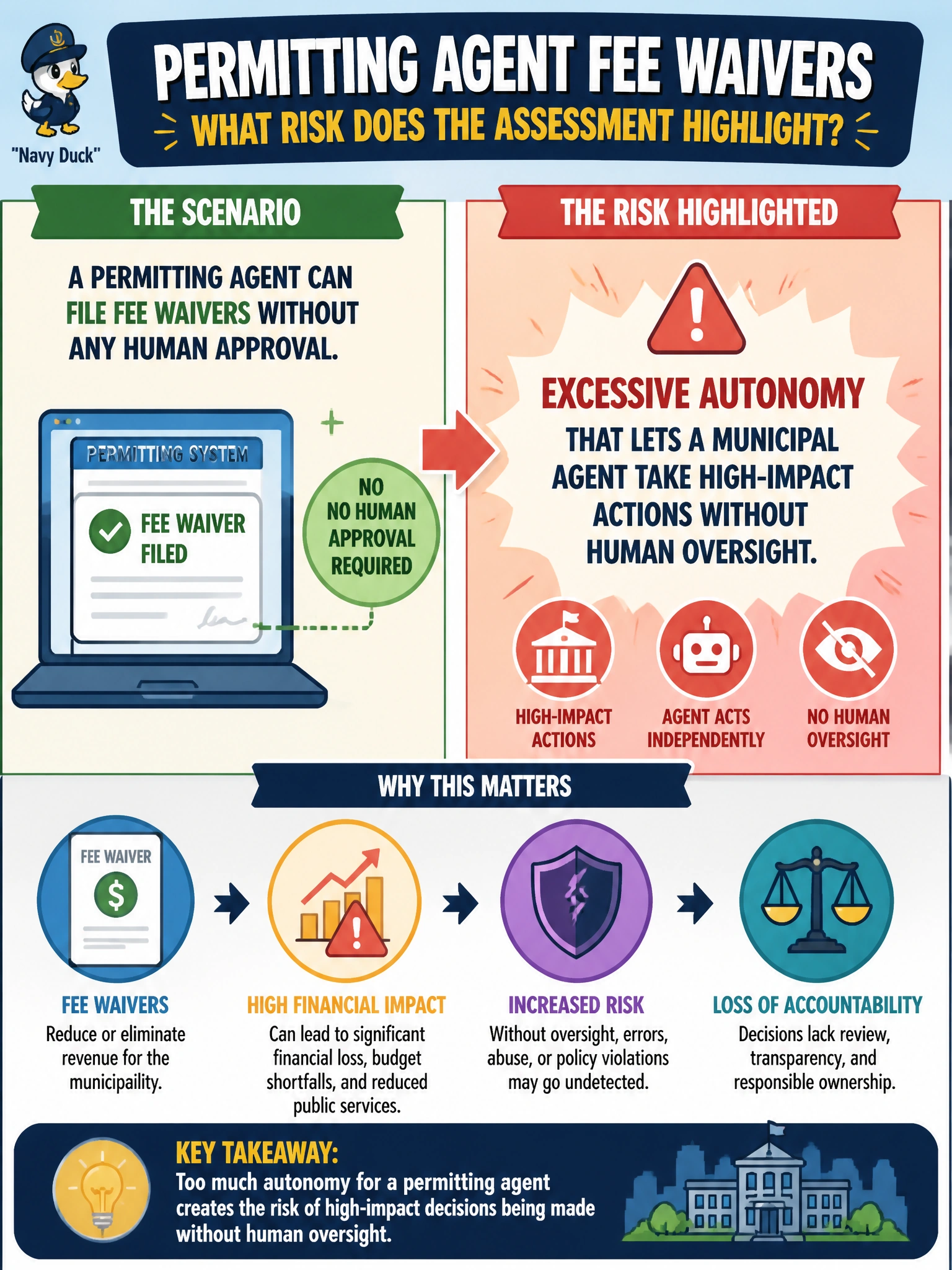
A permitting agent can file fee waivers without any human approval. What risk does the assessment highlight?
Select an answer to reveal the explanation.
Short Explanation
A bot that can waive fees solo has too much rope—excessive autonomy. High-impact civic actions need a human gate, not just sparse audit logs.
Full Explanation
A permitting agent that can file fee waivers without any human approval highlights excessive autonomy that lets a municipal agent take high-impact actions without human oversight. Fee waivers, license grants, and similar actions carry financial and legal consequences; agent designs that allow unilateral execution create integrity and abuse risk even if the model usually behaves. Assessments look for missing human-in-the-loop gates, absent dual-control, and insufficient authorization binding between the chat identity and the privileged tool. Remediation typically adds mandatory approval workflows, amount thresholds, and immutable audit of who—human or agent—requested and who approved the waiver. Unrestricted tool access to external invoice data, inadequate input validation on parcel identifiers, or sparse audit logging for compliance review may be concerns, but they do not capture the highlighted risk of a municipal agent taking high-impact actions without human oversight. On COASP exams, excessive agency is the concept when bots can complete high-impact civic actions solo. Caveat: not every micro-action needs a human click—over-gating low-risk lookups creates shadow processes—so calibrate human-in-the-loop to impact, irreversibility, and regulatory requirements. Operational check: attempt a fee-waiver tool call in a non-production test tenant and confirm the platform refuses completion until a designated human approver records an authenticated decision.