
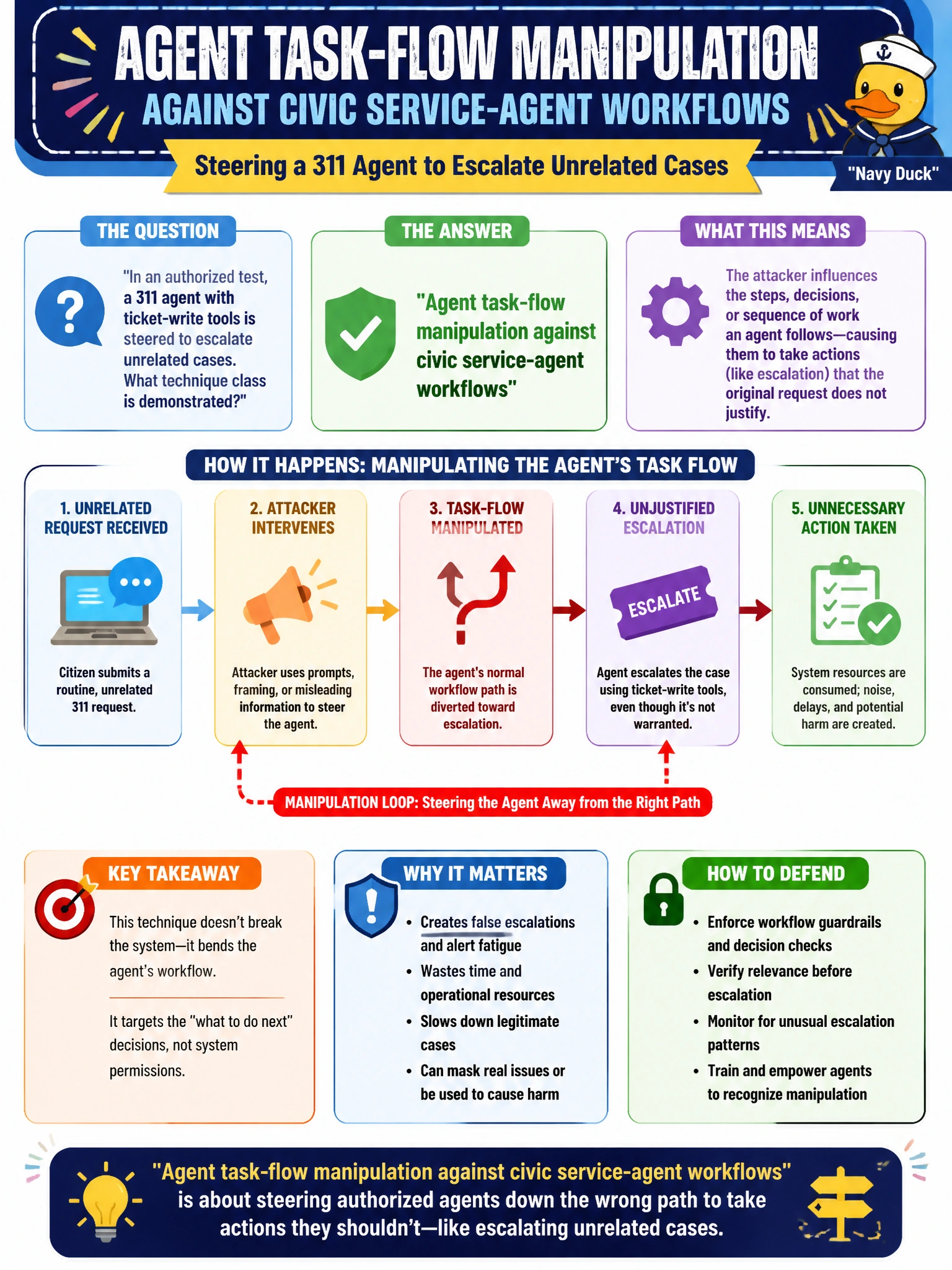
In an authorized test, a 311 agent with ticket-write tools is steered to escalate unrelated cases. What technique class is demonstrated?
Select an answer to reveal the explanation.
Short Explanation
Steering the ticket bot to escalate the wrong cases is task-flow manipulation—someone bent the agent's to-do list. That's an agent abuse class, not FAQ data leaks, authentication bypass, or ticket flooding.
Full Explanation
Steering a 311 agent that has ticket-write tools into escalating unrelated cases demonstrates agent task-flow manipulation against civic service-agent workflows. Language-controlled agents with side-effecting tools can be coaxed to change priorities, reassign queues, or escalate tickets outside the requester's legitimate scope when task planners and authorization checks are weak. The abuse class is not simple chat toxicity; it is misuse of the agent's procedural control over municipal workflows, which can create false emergencies, bury real ones, or harass staff through the ticketing system. Purple-team findings should document the natural-language path, the tools invoked, missing authorization gates, and impact on service levels. Sensitive data exposure through 311 FAQ retrieval responses, privilege escalation via 311 resident authentication bypass, or denial-of-service through high-volume 311 ticket submission flooding do not harden agent task schemas or approval rules. Exam questions frequently contrast cosmetic call-center changes with agent workflow abuse—select task-flow manipulation. Caveat: some escalations are legitimate accessibility or safety overrides; controls must distinguish authorized policy exceptions from unconstrained natural-language coercion of the planner. Operational check: in an authorized test, attempt to escalate an unrelated case via dialogue alone, capture tool calls, and verify that role checks, case-ownership rules, or human approval block the write.