
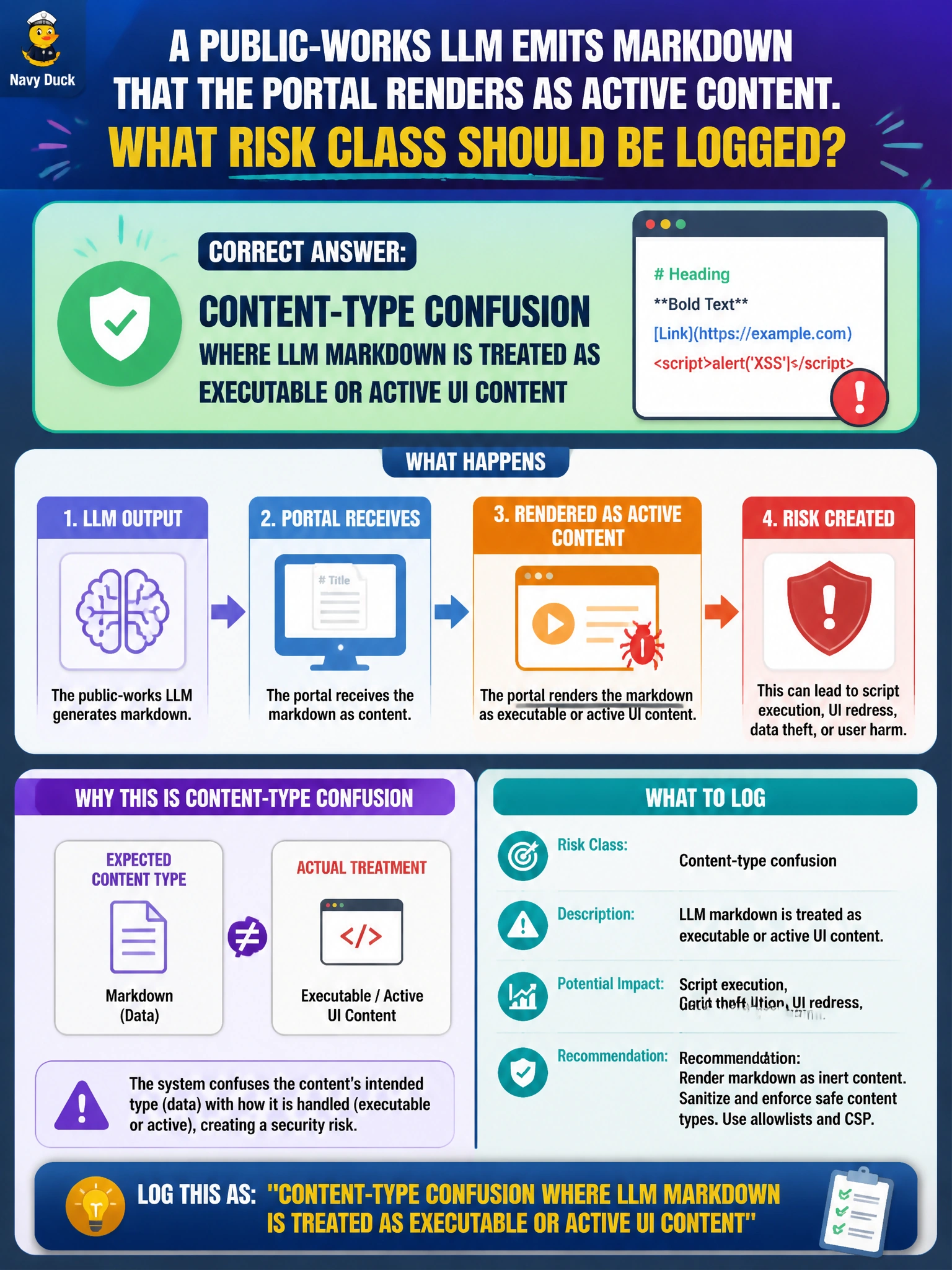
A public-works LLM emits markdown that the portal renders as active content. What risk class should be logged?
Select an answer to reveal the explanation.
Short Explanation
When you see markdown render as live page content, that's content-type confusion because the portal trusted model text too much. Log that class and fix the rendering pipeline, since training-data poisoning, model hallucination, or prompt disclosure don't explain active markdown and won't close the execution path.
Full Explanation
When a public-works LLM emits markdown that the portal renders as active content, the risk class to log is content-type confusion where model markdown is treated as executable or active UI content. Municipal portals that trust assistant output as safe markup can turn headings, links, HTML fragments, or embedded scripts into live page behavior, creating XSS-like effects without a traditional injectable endpoint in application code. Proper handling treats LLM output as untrusted data: encode or sanitize for the destination context, disable dangerous markdown features, and never let model text select content types that execute. Logging the finding under content-type confusion or improper output handling drives the right remediation owners—frontend rendering policy and assistant output filters—rather than vague model-hallucinated tickets. Training-data poisoning where tainted portal documents alter model behavior at training time, model hallucination where the chatbot invents inaccurate public-works procedures, and prompt disclosure where system instructions leak into public chatbot responses are different risk classes; none of them describes the portal rendering model markdown as executable or active UI content, so logging any of them would miss the output-handling flaw and leave the active-content path intact. On the exam, map symptoms of markdown becoming live UI to output-handling and content-type risk, not facilities aesthetics. Caveat: sanitizers must match the actual renderer because Markdown-to-HTML libraries differ; a filter that strips script tags but allows javascript URLs or raw HTML blocks still leaves an active-content path. Operational check: inject benign-looking markdown with links, HTML, and event-handler patterns in an authorized test and confirm the portal displays inert text without executing or navigating unexpectedly.