
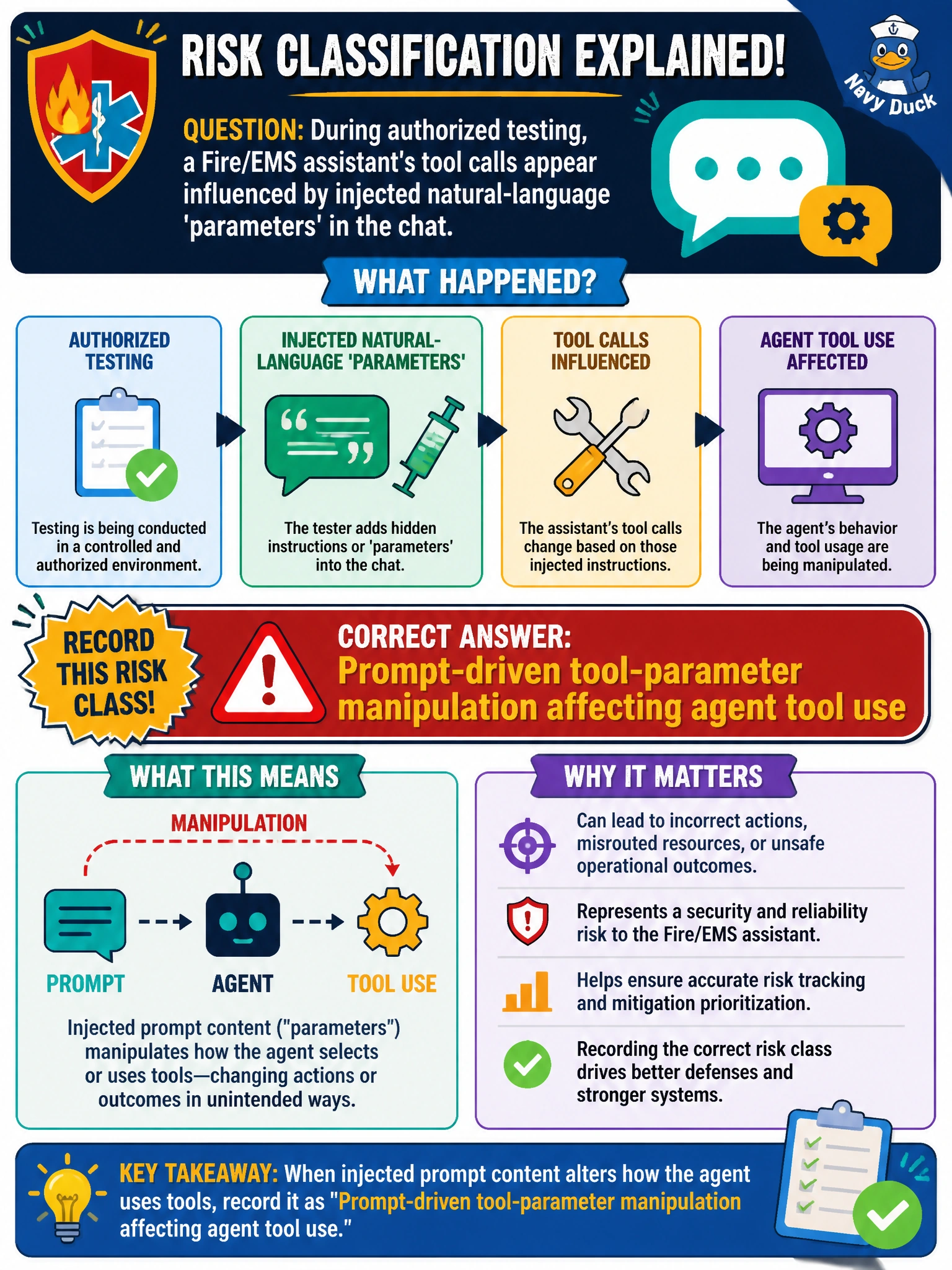
During authorized testing, a Fire/EMS assistant's tool calls appear influenced by injected natural-language 'parameters' in the chat. Which risk class should be recorded?
Select an answer to reveal the explanation.
Short Explanation
When chat text starts writing the tool's dial settings, you've got prompt-driven parameter manipulation—scary for EMS lookups. Log the risk class as tool-parameter manipulation—not model hallucination, training-data poisoning, or system-prompt disclosure.
Full Explanation
If a Fire/EMS assistant's tool calls appear influenced by injected natural-language 'parameters' in chat during authorized testing, the risk class is prompt-driven tool-parameter manipulation affecting agent tool use. Free-form language mapped into tool arguments creates a channel where adversarial text can alter lookups, destinations, filters, or actions the agent executes. For EMS-adjacent civic agents, that class is high priority because tool misuse can affect operational data retrieval and downstream workflows. Model hallucination producing inaccurate dispatch guidance is a generation reliability issue, not a case of natural-language text steering tool arguments. Training data poisoning shaping baseline emergency model behavior is a model-development issue, not a risk class for this finding—the stem is asking what happened to the tool call, not how the model was trained. System prompt disclosure revealing developer instructions is a confidentiality issue with the agent's instructions, unrelated to whether chat text is being mapped into tool parameters. Exam caveat: record the risk as tool-parameter manipulation and impact potential; do not treat the finding as a license to publish live exploit strings that force harmful real-world tool calls. Operational check: schema-validate and allow-list tool arguments, separate user text from parameter binding, require confirmation for sensitive tools, log argument sources, and retest with injected parameter-style phrases against Fire/EMS assistant tools in a sandbox.