
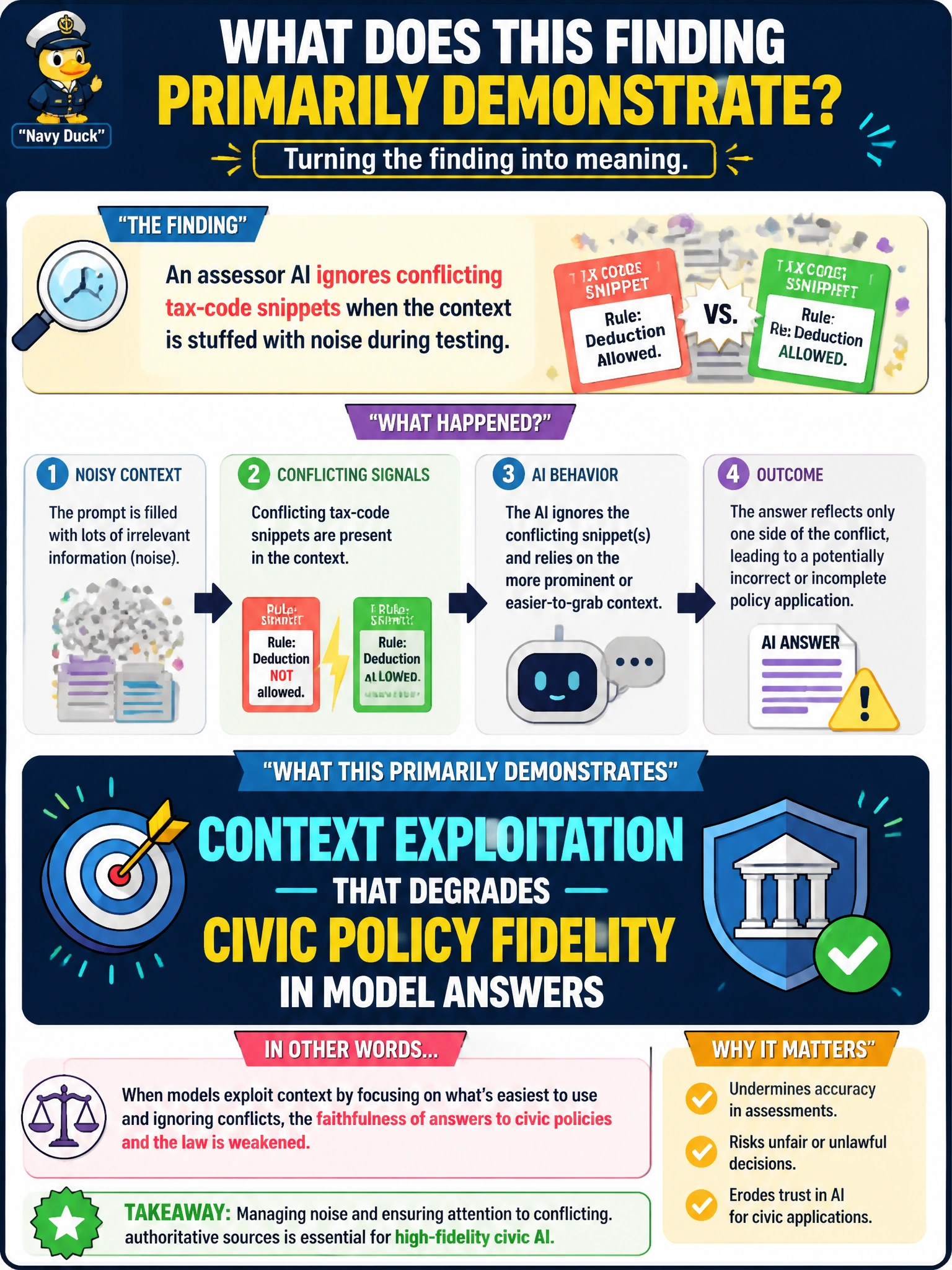
An assessor AI ignores conflicting tax-code snippets when the context is stuffed with noise during testing. What does that finding primarily demonstrate?
Select an answer to reveal the explanation.
Short Explanation
Stuff the context with noise and watch the tax-code answer go wobbly—that's context exploitation hurting policy fidelity. Civic bots have to keep the real rules visible, not drown them.
Full Explanation
When an assessor AI ignores conflicting tax-code snippets because the context is stuffed with noise during testing, the finding primarily demonstrates context exploitation that degrades civic policy fidelity in model answers. Flooding the window can displace, dilute, or underweight authoritative policy text so the model misses binding rules residents and staff rely on. Correct interpretation ties the failure to context integrity and instruction priority, which matter acutely for property-tax and similar high-stakes civic guidance. Measurement error from inconsistent tax-code versioning across test prompts is a data-quality problem, not evidence that stuffed noise is what degrades policy fidelity. Retrieval failure that limits access to authoritative civic guidance sources describes a different breakdown; here the relevant snippets were in context but drowned out by noise. Blaming calibration drift that shifts confidence scoring on policy compliance tasks misidentifies the issue; the finding is about context exploitation, where noise crowds out authoritative text regardless of confidence calibration. Exam caveat: degraded fidelity may appear as confident but wrong guidance rather than an obvious crash; assessments should score correctness against authoritative snippets under noise, not only refusal behavior. Operational check: pin and re-inject authoritative tax-policy segments each turn, limit untrusted context bulk, monitor when answers omit cited code sections, and retest stuffing scenarios after context-budget and ranking controls are applied.