
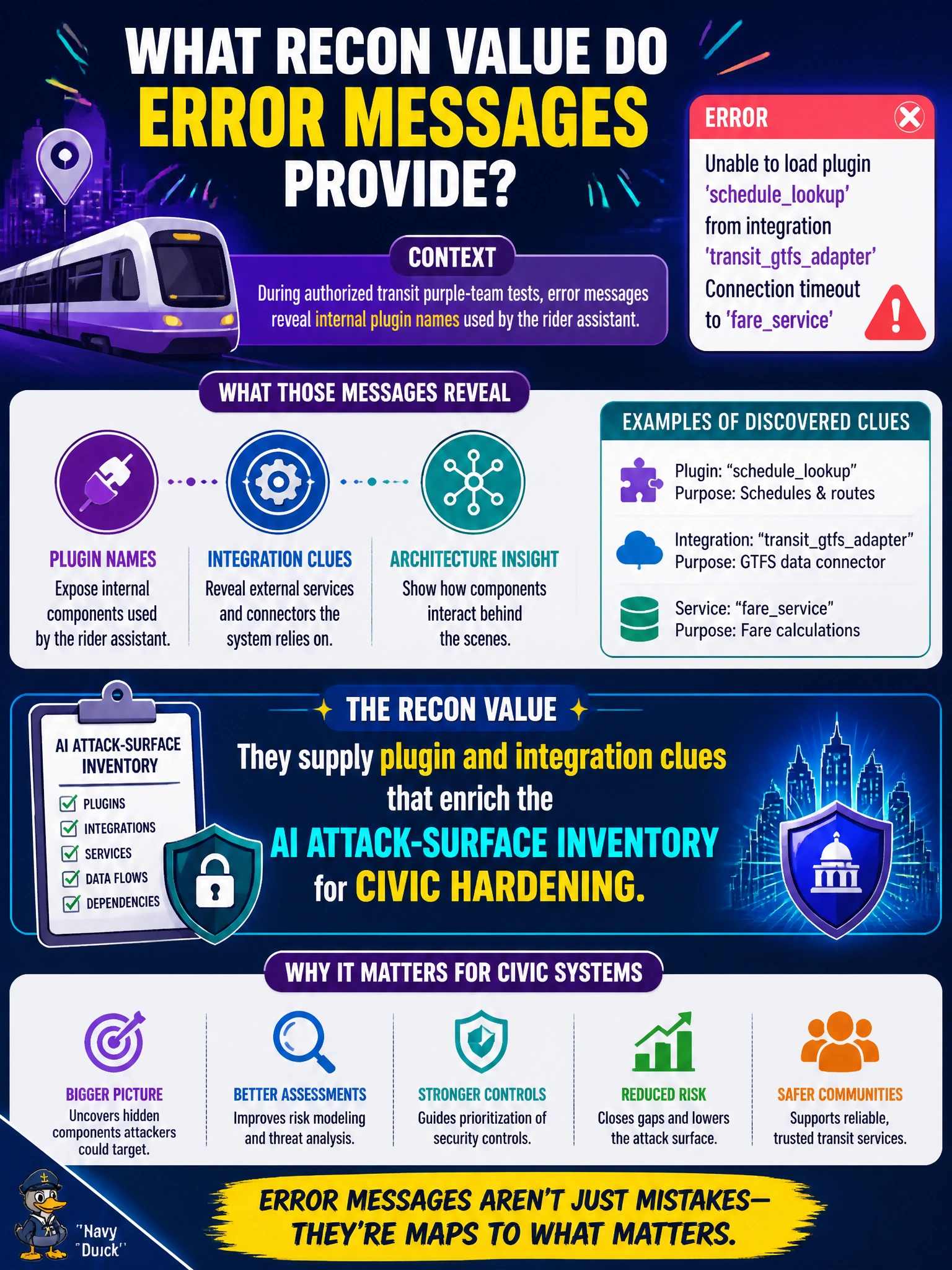
During authorized transit purple-team tests, error messages reveal internal plugin names used by the rider assistant. What recon value do those messages provide?
Select an answer to reveal the explanation.
Short Explanation
Chatty errors that name plugins are like a badge printer that accidentally prints department names—useful inventory for the purple team, as long as you treat it as a finding to fix, not gossip.
Full Explanation
During authorized transit purple-team tests, error messages that reveal internal plugin names used by the rider assistant provide recon value by supplying plugin and integration clues that enrich the AI attack-surface inventory for civic hardening. Verbose errors often disclose tool identifiers, schema hints, or backend path names that defenders should inventory and then suppress in production responses. Capturing those clues under RoE accelerates accurate mapping of what the assistant can invoke without requiring destructive exploitation.
Claiming plugin names confirm successful authentication events and validate enforcement of rider access controls fails conceptually: error messages exposing internal plugins do not authenticate users or validate access-control enforcement; they merely disclose application-layer identifiers. Claiming errors disclose detailed decoding parameters and sampling settings that guide tuning of timetable prediction quality fails as an unrelated leap: plugin names say nothing about model decoding parameters or timetable prediction tuning. Claiming errors provide latency and throughput metrics that inform autoscaling of transit inference endpoints fails because plugin names are application-layer disclosure, not performance telemetry for autoscaling.
Exam caveat: Verbose AI/app errors are treated as inventory enrichment plus a hardening backlog item (reduce leakage), not as confirmation of authentication events or access-control enforcement, as a source of decoding parameters or sampling settings for timetable tuning, or as latency/throughput metrics for autoscaling.
Operational check: log disclosed plugin names into the transit AI inventory; map each to privileges and data domains; open tickets to sanitize production error messages; and confirm monitoring still retains detailed errors in secured logs for operators without exposing them to riders.