
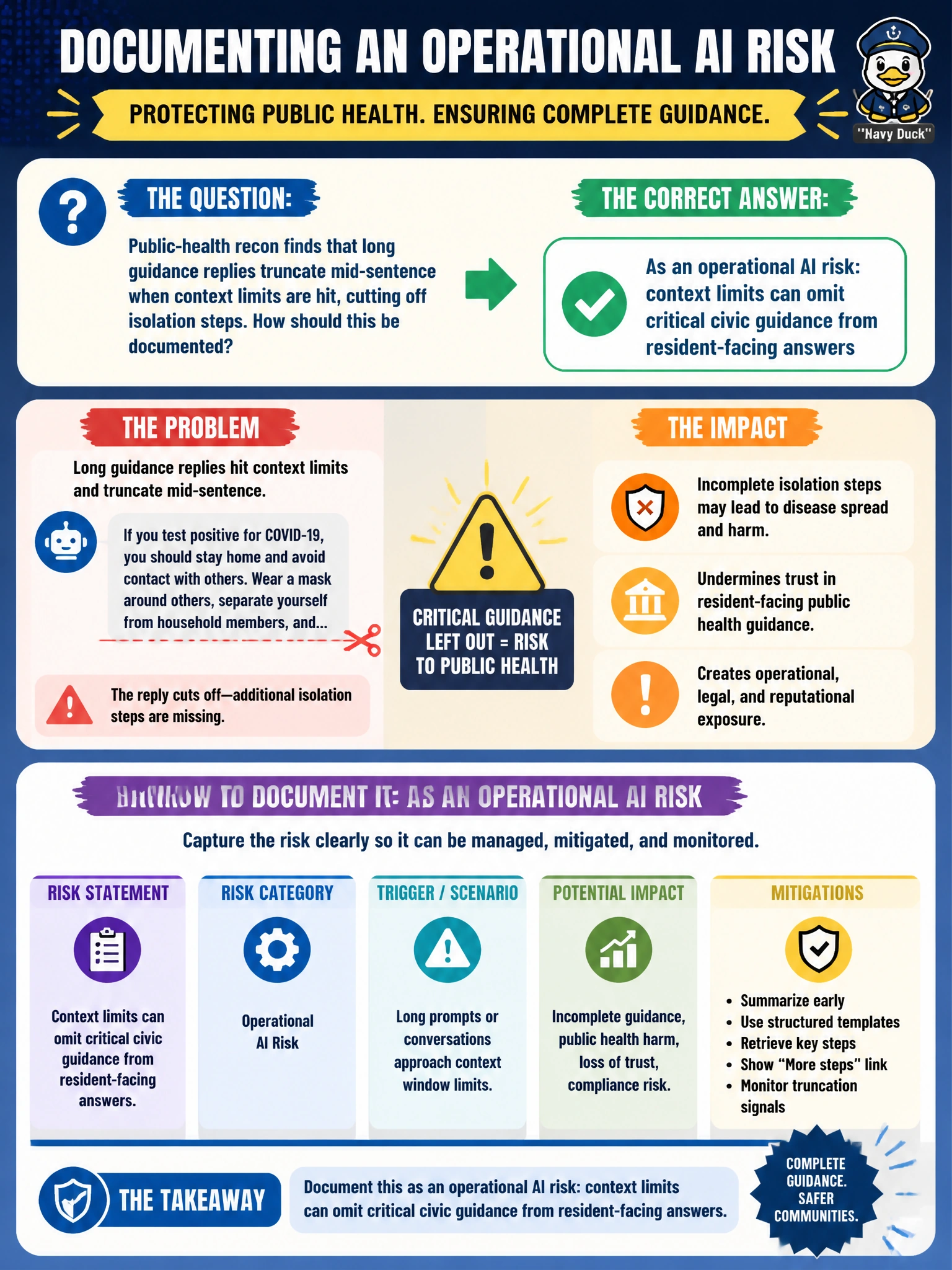
Public-health recon finds that long guidance replies truncate mid-sentence when context limits are hit, cutting off isolation steps. How should this be documented?
Select an answer to reveal the explanation.
Short Explanation
When isolation steps get chopped off mid-reply, that's not a readability improvement—cutting mid-sentence hides critical steps instead of making guidance easier to scan. Document context limits as operational risk for civic guidance.
Full Explanation
Public-health reconnaissance that finds long guidance replies truncating mid-sentence—cutting off isolation steps when context limits are hit—should be documented as an operational AI risk: context limits can omit critical civic guidance from resident-facing answers. In health and emergency assistants, incomplete isolation or escalation language is a safety and service-integrity issue, not a readability improvement. Authorized testers should record reproduction conditions (history length, retrieved chunk size, max tokens) and recommend mitigations such as prioritized mandatory boilerplate, retrieval summarization, UI warnings when output is truncated, or human handoff when critical steps cannot be completed.
Documenting truncation as a readability improvement fails conceptually: chopping replies mid-sentence removes isolation steps rather than making guidance easier to scan. Treating it as a retrieval coverage gap fails because the issue is output truncation under context limits, not a vector index returning stale isolation guidance. Treating it as a throughput limit fails because request throttling only delays delivery, while the observed defect is replies cut off before critical steps are finished.
Exam caveat: Context-window findings on civic safety content are scored as operational risk documentation problems. Prefer “omit critical guidance” framing over readability rationales, stale-index coverage claims, or throttling explanations.
Operational check: capture truncated versus complete replies under RoE; file a finding tied to isolation-step integrity; implement mandatory safety blocks that survive long contexts; and re-test that isolation steps remain present when prior-turn and RAG volume are high.