
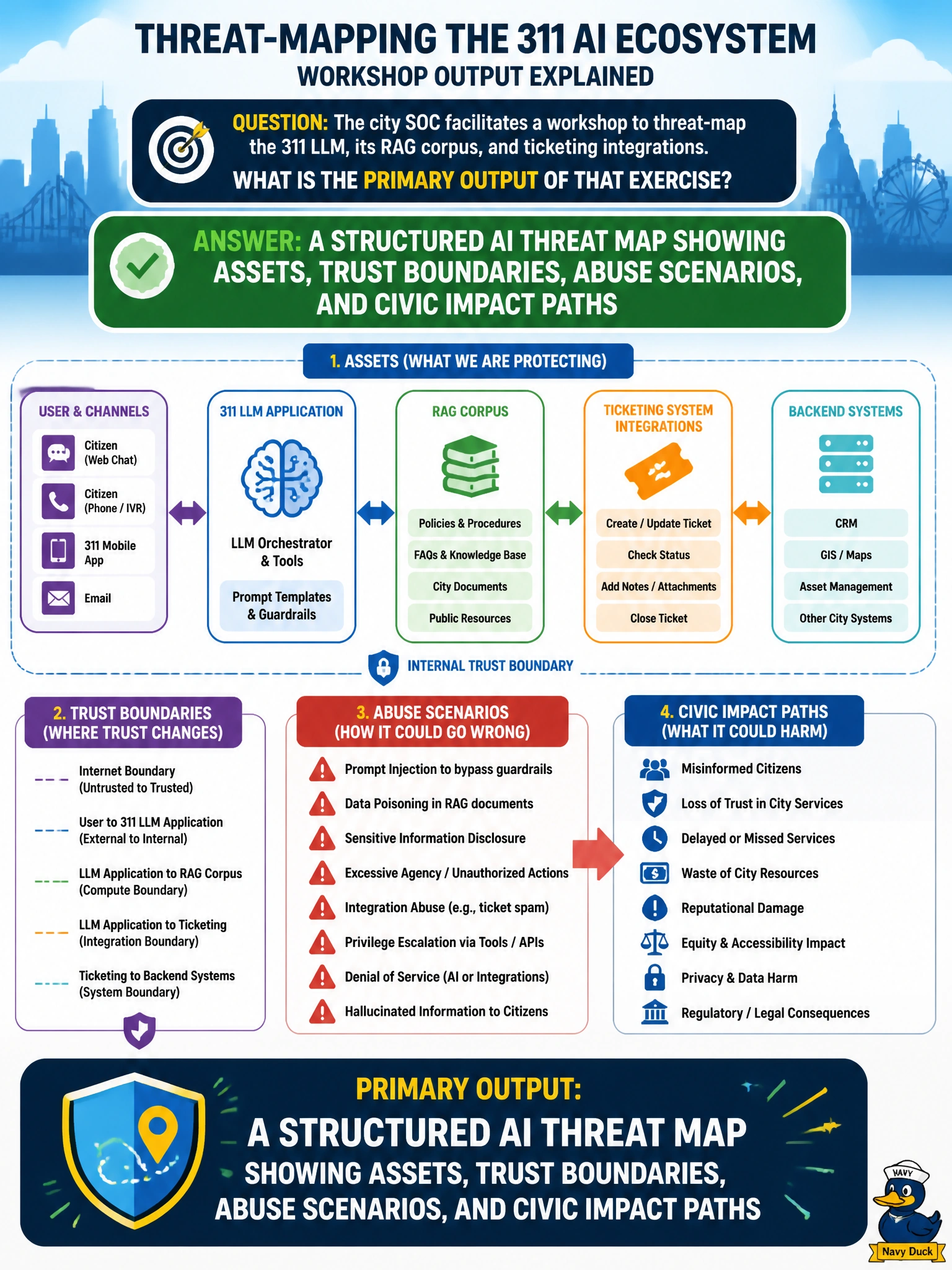
The city SOC facilitates a workshop to threat-map the 311 LLM, its RAG corpus, and ticketing integrations. What is the primary output of that exercise?
Select an answer to reveal the explanation.
Short Explanation
A threat-map workshop is like pinning sticky notes on a city subway map—LLM, RAG, and tickets connected with 'what goes wrong' arrows. You leave with a structured map, not an incident playbook for leaks and escalations.
Full Explanation
When the city SOC facilitates a workshop to threat-map the 311 LLM, its RAG corpus, and ticketing integrations, the primary output should be a structured AI threat map showing assets, trust boundaries, abuse scenarios, and civic impact paths. That artifact becomes the spine for recon depth, purple-team scenarios, monitoring use cases, and remediation roadmaps. Covering model, retrieval, and tool/ticket planes in one map prevents siloed thinking about “just a chatbot” when the system can create or alter municipal work orders.
A finalized incident playbook covering RAG leakage response and ticketing escalation steps is a response artifact, not a threat-mapping deliverable; the workshop produces the map that informs later playbooks. A tuned prompt filter deployed on 311 intents with blocked phrases and ticket validation rules is a control implementation, not the workshop’s primary output; the workshop maps where such controls are needed. An exported set of detailed chatbot conversation logs and ticketing records prepared for compliance audit review is an operational evidence artifact, not the threat map itself; workshops identify what to log, they don’t produce the export.
Exam caveat: Threat-mapping workshops are judged by structured security artifacts (assets, boundaries, scenarios, impact), not incident playbooks, deployed prompt filters, or compliance log exports.
Operational check: publish the threat map to the SOC knowledge base with owners for each asset node; link abuse scenarios to planned tests under RoE; and verify logging/monitoring coverage exists for the mapped ticket-integration paths before higher-impact testing begins.