
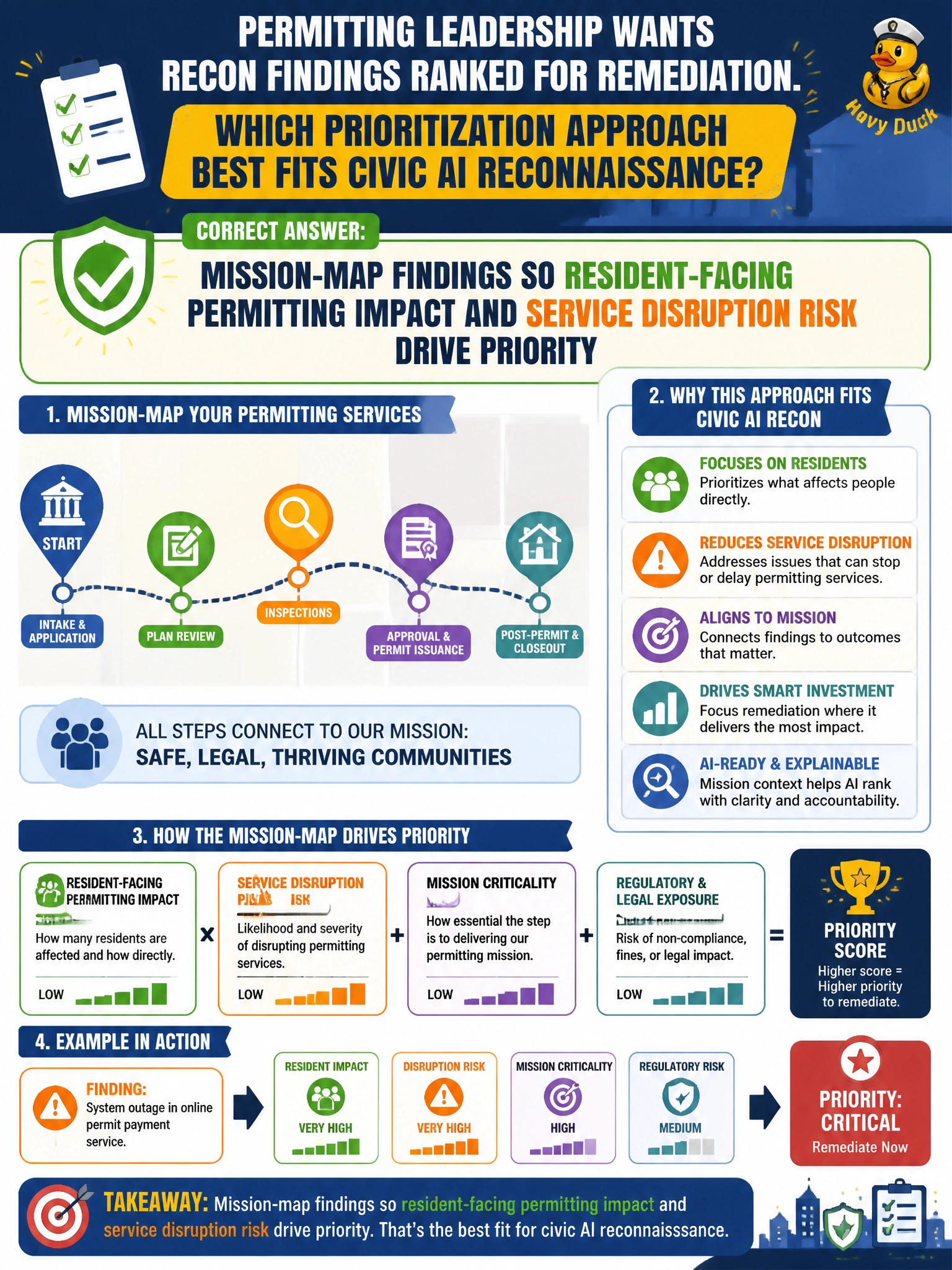
Permitting leadership wants recon findings ranked for remediation. Which prioritization approach best fits civic AI reconnaissance?
Select an answer to reveal the explanation.
Short Explanation
Rank findings the way a city ranks potholes on a parade route—what blocks residents and permits first. Mission-map impact beats CVSS technical severity, scan-sequence order, or patching-effort triage. You don't rank by how easy a patch is or when a scan popped.
Full Explanation
When permitting leadership wants recon findings ranked for remediation, mission-mapping so resident-facing permitting impact and service disruption risk drive priority is the approach that fits civic AI reconnaissance. Findings that enable wrongful guidance, unauthorized workflow changes, data exposure of applicant materials, or outages of intake assistants should outrank cosmetic or low-blast-radius issues. Prioritizing findings by CVSS base severity scores with technical severity weighting fails conceptually: technical severity alone misses resident-facing permitting impact and service disruption risk. Ranking findings in discovery scan sequence order fails because scan timing ignores resident impact and permitting workflow disruption. Prioritizing remediation tasks by estimated patching effort to reduce overall near-term operational overhead fails because it optimizes for convenience, not civic service risk, and leaves high-impact resident-facing issues unaddressed.
Exam caveat: Remediation-priority questions almost always reward mission/impact ranking over CVSS technical severity, scan-sequence ordering, or patching-effort triage.
Operational check: tag each finding with resident impact, likelihood, and affected permitting workflow; present a ranked backlog to leadership; and track closure against service-level risk reduction rather than CVSS technical severity, scan-sequence order, or patching-effort triage.