
A transit authority purple team is building a threat map for a rider-facing LLM that drafts service alerts. What linkage should the map emphasize for leadership?
Select an answer to reveal the explanation.
Short Explanation
A threat map for a rider-alert bot isn't a cloud-budgeting exercise—it's connecting 'what if the alert text gets steered' to real operational pain for riders and dispatch. Tie AI exposure to service impact, not planner arrival models or legal redaction workflows.
Full Explanation
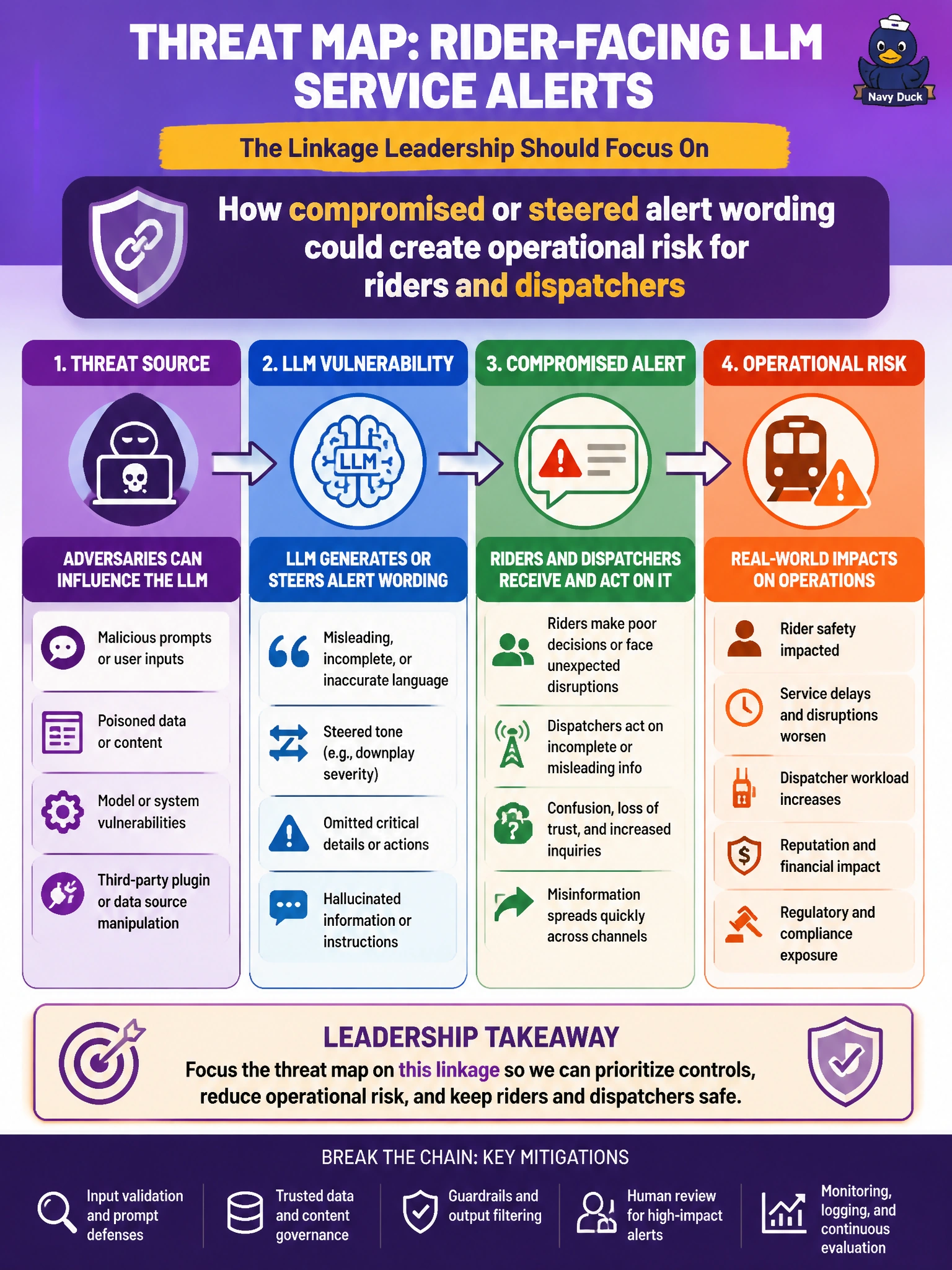
Threat maps for municipal AI are valuable to leadership only when they connect technical exposures to operational consequences. For a transit authority rider-facing LLM that drafts service alerts, the critical linkage is how compromised, injected, or steered alert wording can create operational risk for riders and dispatchers—missed detours, incorrect outage messaging, crowd misdirection, or conflicting instructions that stress operations staff. Emphasizing that path lets executives prioritize prompt/context controls, human review gates for high-impact alerts, and monitoring for anomalous alert drafts.
Token consumption and inference latency affecting cloud budgeting for IT operations fails conceptually: infrastructure cost and performance tracking are not threat-map linkages between compromised alert text and rider or dispatcher harm. Historic timetable fine-tuning improving arrival prediction accuracy for planners fails because planner-facing prediction accuracy is peripheral to the integrity of rider-facing service-alert drafting. Chat log retention and redaction workflows supporting routine records compliance for legal teams fails as a legal-records concern with no bearing on adversarial or reliability risk in alert generation.
Exam caveat: COASP threat-profiling items often test whether candidates map AI flaws to civic mission impact rather than cloud-budget, planner-accuracy, or legal-records features. For rider-alert systems, prefer operational-safety and dispatcher-impact narratives over IT operations, planning, or compliance distractors.
Operational check: the threat map should explicitly list alert-drafting as a trust boundary, name abuse scenarios (prompt injection, poisoned RAG, compromised tool output), and state rider/dispatcher impacts with proposed controls (approval workflows, allowlisted alert templates, anomaly detection). Leadership briefing slides should show that chain without including live exploit payloads.