
County IT is reconnoitering the clerk's document-summarizer agent under an MoU. Beyond model fingerprinting, which reconnaissance objective best maps the agent's integration attack surface?
Select an answer to reveal the explanation.
Short Explanation
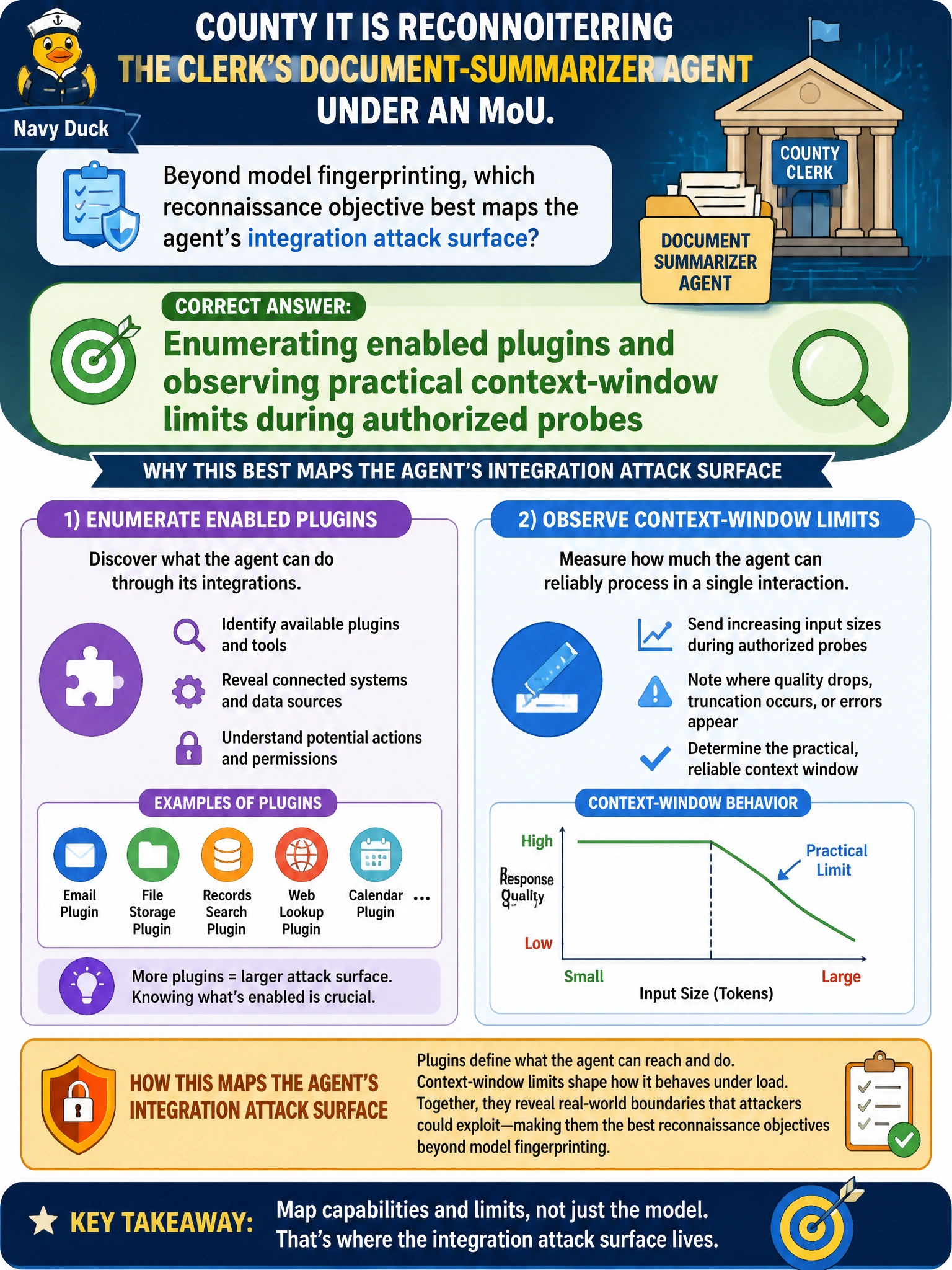
Think of plugins like extra keys on a municipal badge and the context window like how much of the policy binder fits on the desk. Recon that lists those keys and how much binder you can open maps the real AI attack surface better than checking summarization accuracy across document samples.
Full Explanation
Authorized reconnaissance of a county clerk’s document-summarizer agent must map more than model identity. Integration attack surface is defined by what the agent can invoke and how much untrusted content it can hold at once. Enumerating enabled plugins/tools and observing practical context-window limits during MoU-approved probes directly answers that need: plugins expand reachable systems (document stores, ticketing, email), and effective context limits govern how much adversarial or sensitive text can be injected, retained, or truncated mid-task. Those observations feed threat maps, RoE refinements, and control recommendations for municipal records workflows.
Profiling base model lineage through output formatting quirks and response latency patterns fails conceptually: it remains model fingerprinting and does not inventory AI tool bindings or retrieval/integration paths. Measuring summarization accuracy and fidelity across varied clerk document samples during trials fails because output-quality evaluation is unrelated to the agent’s digital plugin and context surface. Inferring hidden system instructions from refusal phrasing and stylistic consistency over multiple sessions fails as a prompt-extraction exercise that does not characterize the summarizer’s AI-specific integration attack surface.
Exam caveat: Offensive AI recon questions frequently contrast classic IT metrics with AI-native inventory (tools, plugins, RAG, context behavior). When the stem asks what best maps integration attack surface “beyond model fingerprinting,” choose plugin/tool and context-limit enumeration.
Operational check: produce an inventory listing each enabled plugin, its privileges, and data domains touched; record measured context truncation or overflow behavior under authorized probes; and update the clerk-office AI asset register so monitoring and least-privilege reviews cover the discovered integrations—not only the model name.