
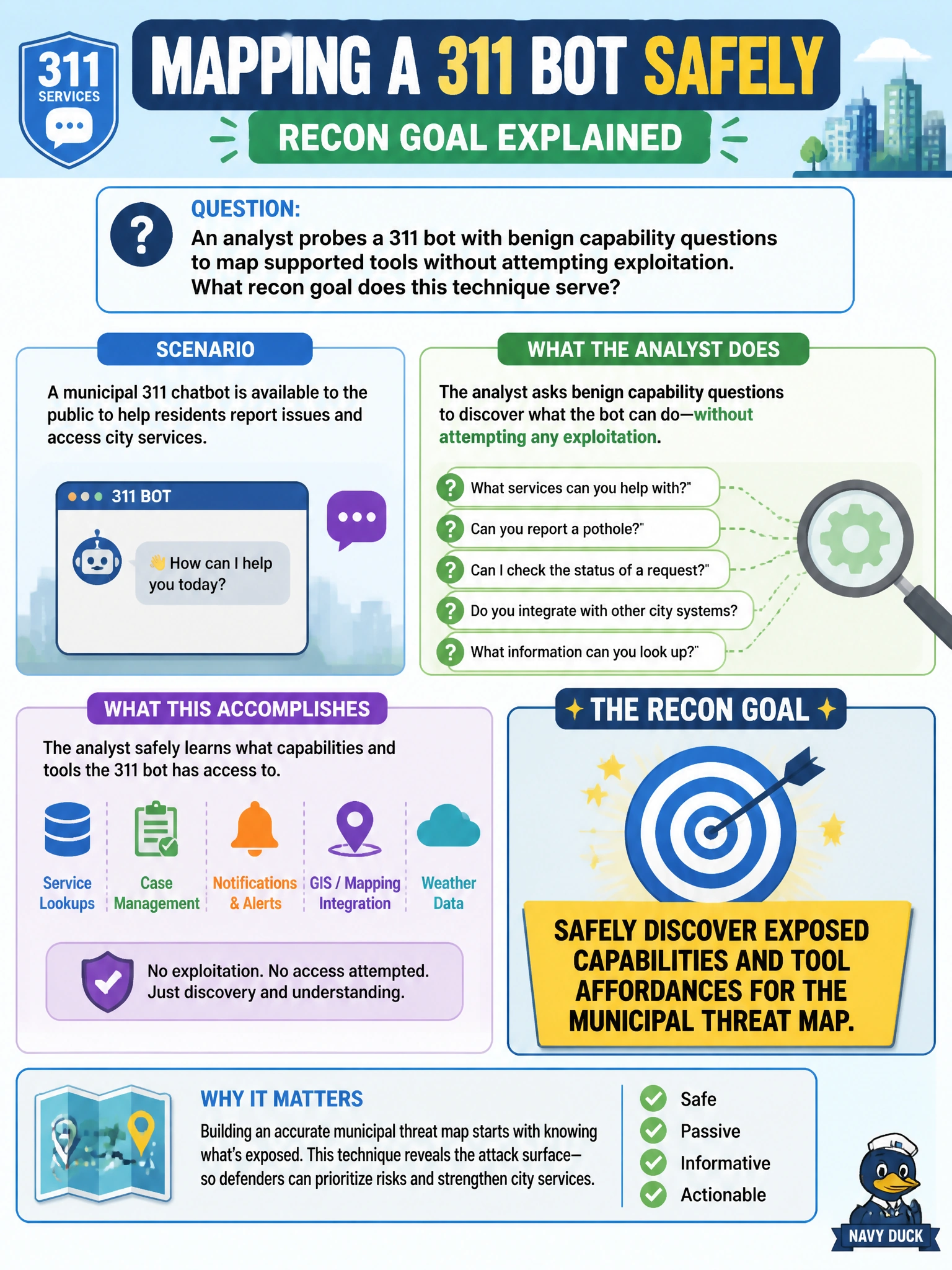
An analyst probes a 311 bot with benign capability questions to map supported tools without attempting exploitation. What recon goal does this technique serve?
Select an answer to reveal the explanation.
Short Explanation
Benign capability questions are like politely asking the front desk, “What can you help with?”—you learn which tools exist without jimmying the lock. That map feeds the threat profile before any heavier testing.
Full Explanation
Benign capability probing of a 311 bot uses non-destructive prompts to learn which tools, domains, and actions the assistant claims to support. For municipal 311 systems, that clarifies integration blast radius for threat profiling while staying inside rules of engagement. The recon goal is capability mapping for later controlled validation—not exploitation, exfiltration, or service disruption. Analysts convert claimed tool affordances into an authorized test backlog for the civic threat map.
Surveying historical 311 transcripts to profile neighborhood service demand patterns is a demand-analysis task, not benign recon of the bot's current exposed capabilities. Inspecting bot responses for inadvertent exposure of resident personal information is a privacy-review task, not capability mapping—the question asks what tools the bot exposes, not whether it leaks data. Characterizing ticketing workflow behavior under malformed resident service request inputs is robustness or fault-injection testing, not benign capability mapping—it probes how the workflow breaks rather than what tools the bot claims to support.
Exam caveat: benign capability questions safely map tools for the municipal threat map—reviewing old transcripts, checking for leaked personal information, and testing malformed inputs are not recon goals.
Operational check: script non-destructive capability questions under MoU; document claimed tools; confirm with owners; schedule heavier tests only after scope approval; leave malformed-input workflow characterization for a separate test phase.