
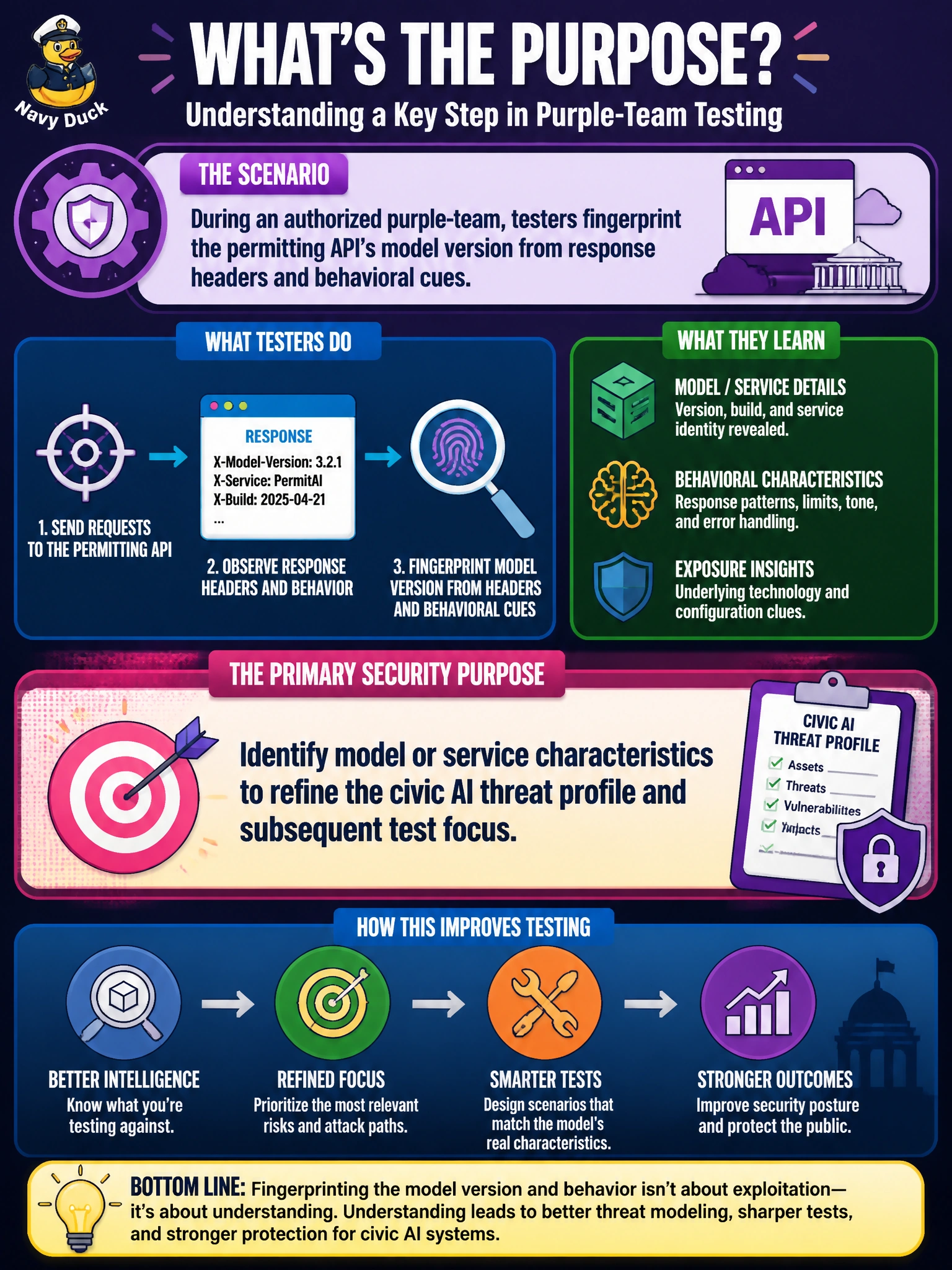
During an authorized purple-team, testers fingerprint the permitting API’s model version from response headers and behavioral cues. What is the primary security purpose of that step?
Select an answer to reveal the explanation.
Short Explanation
Fingerprinting is reading the nameplate on the city’s AI appliance—what family it is, how it behaves—so the threat map and test plan aim at the right target, not a generic guess.
Full Explanation
Model and endpoint fingerprinting during an authorized purple-team of a permitting API gathers indicators such as headers, error patterns, and behavioral signatures that suggest model family or gateway configuration. That intelligence refines the civic AI threat profile and prioritizes subsequent tests relevant to the deployed stack. Fingerprinting is a recon activity that sharpens focus; it is not remediation, disclosure, or a substitute for controls.
Sharing findings with peer organizations or forums to 'accelerate collective threat awareness' before internal remediation and vendor coordination still risks premature disclosure—responsible practice routes findings through disclosure processes first, not direct peer-to-peer sharing. Measuring inference timing variations across permit queries to tune response caching and inform capacity planning mistakes fingerprinting for performance tuning—it identifies model traits for threat profiling, not cache or capacity decisions. Verifying TLS configuration details from response headers to confirm encryption compliance mistakes fingerprinting for transport-security validation—reading headers reveals model or gateway traits, it does not confirm TLS compliance for resident records.
Exam caveat: fingerprinting refines threat profiles and test focus—it is not public dump, not caching or capacity planning, not TLS compliance verification. Operational check: record permitting API fingerprints in the threat profile; map them to relevant test cases; keep findings in the disclosure process; implement prompt/RAG/tool controls separately from recon.