
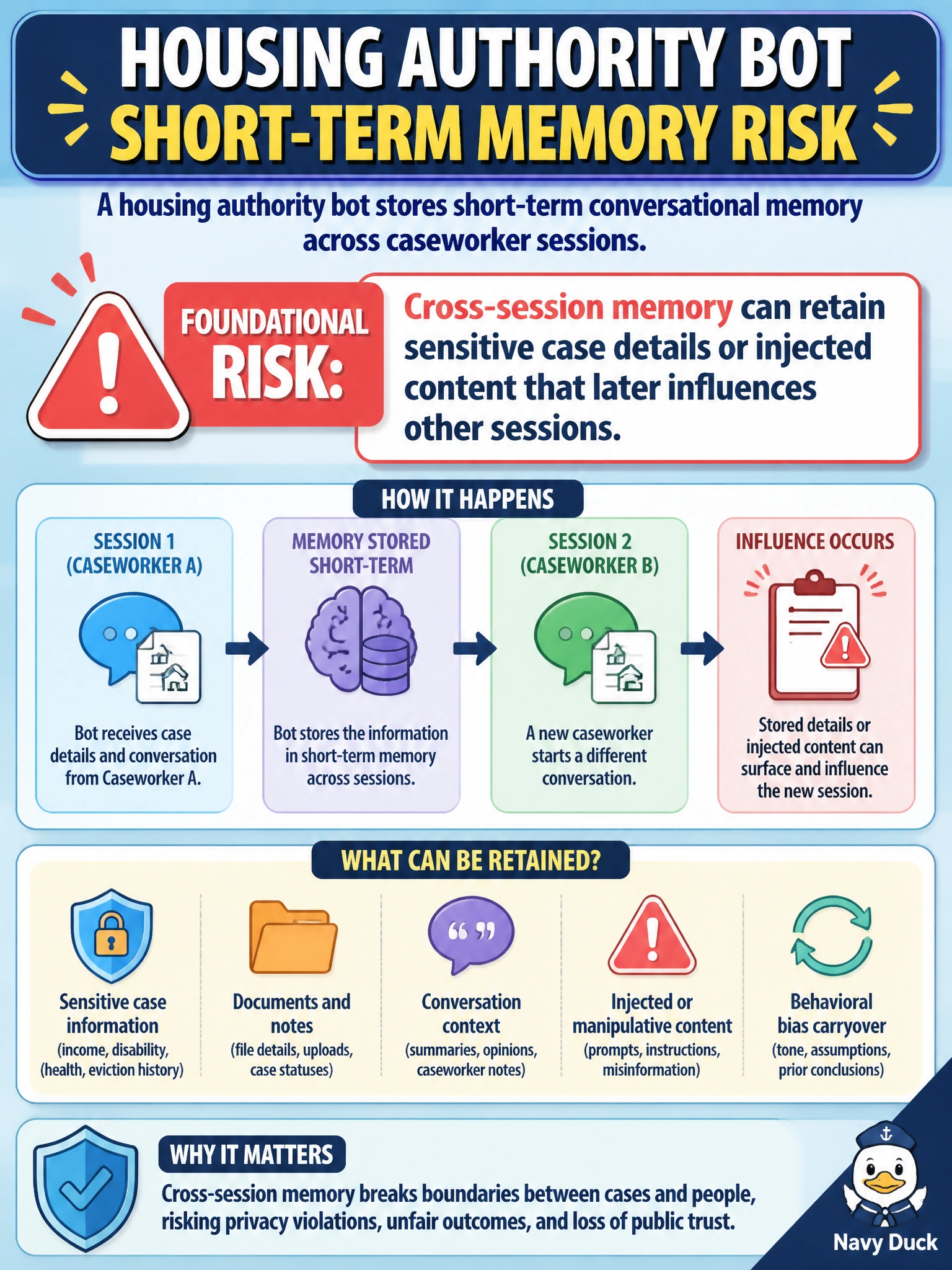
A housing authority bot stores short-term conversational memory across caseworker sessions. What foundational risk does this create?
Select an answer to reveal the explanation.
Short Explanation
Shared short-term memory is like leaving case sticky notes on a desk another caseworker inherits. Handy—until yesterday’s private details or a planted note steer today’s conversation.
Full Explanation
Short-term conversational memory across housing-authority caseworker sessions extends state beyond a single turn and can carry PII, policy text, or attacker-influenced content into later sessions. That expands confidentiality and integrity risk and becomes an offensive AI examination target. Controls include isolation by case or user, retention limits, sanitization of memory writes, and monitoring. Shared memory without those controls can leak case details or let injected content steer subsequent guidance.
Describing conversation summarization as reducing token usage by compressing prior turns into compact state for ongoing caseworker support tasks does not address the foundational risk of cross-session memory retaining sensitive case details or injected content that can influence later sessions. Describing scoped session stores that isolate caseworker context using per-user keys with explicit consent controls governing retention periods describes a control rather than the foundational risk of cross-session memory carrying sensitive or injected content into later sessions. Equating session memory with retrieval augmentation that grounds housing policy answers by fetching approved documents confuses a knowledge-grounding technique with mutable conversational state that can carry PII or injected content across sessions.
Exam caveat: cross-session memory retains sensitive or injected content—assume risk unless isolation/retention proven; it is not a conversation-summarization feature, not a scoped per-user consent-controlled store, and not retrieval augmentation that fetches approved documents. Operational check: verify memory keys by caseworker/case; test cross-session bleed under MoU; set short retention; monitor anomalous memory writes; disable shared memory if isolation cannot be demonstrated.