
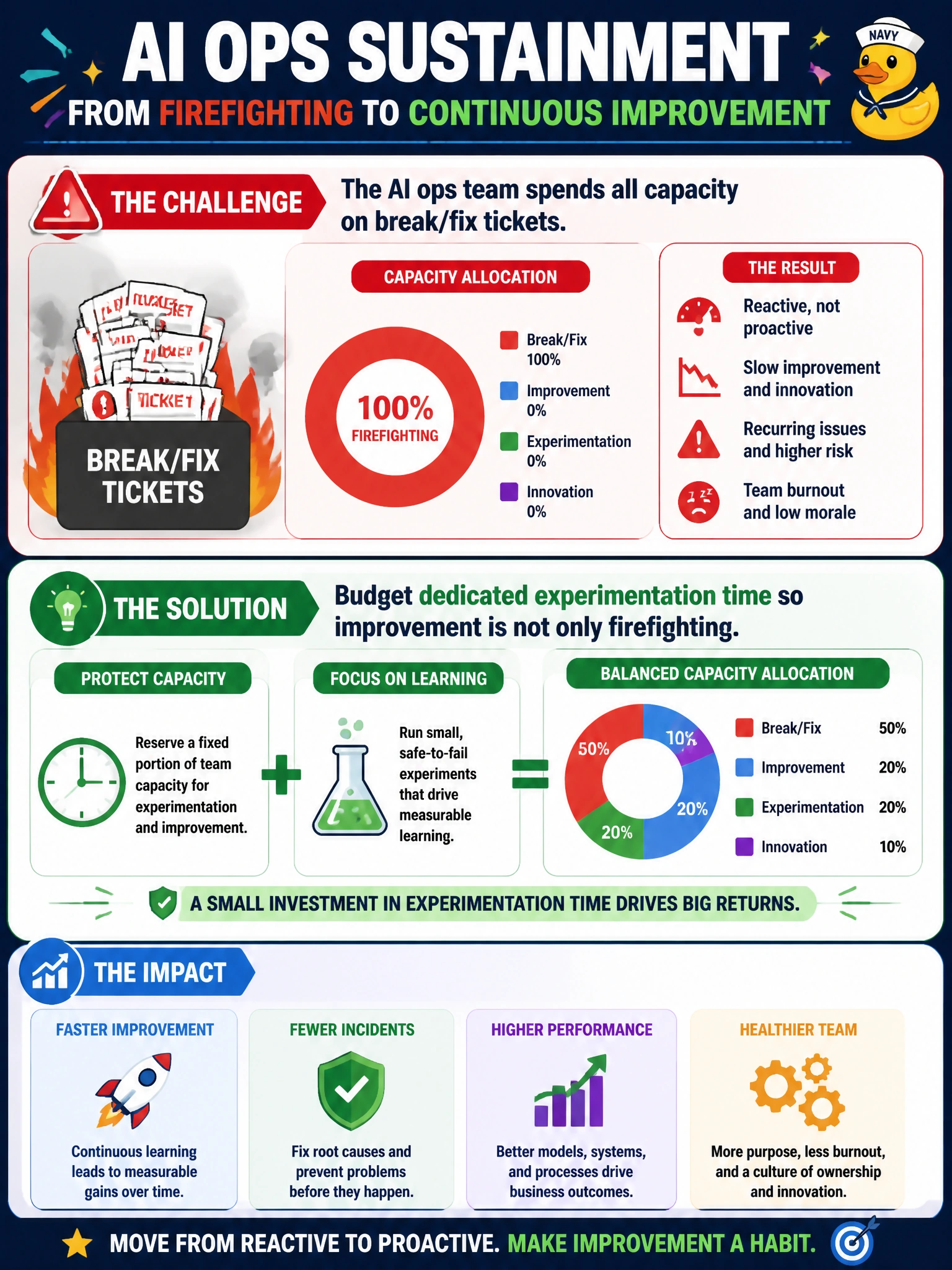
The AI ops team spends all capacity on break/fix tickets. What sustainment practice improves continuous improvement?
Select an answer to reveal the explanation.
Short Explanation
If every hour is a firehose, nothing gets better. Budget real experimentation time so continuous improvement isn’t forever stuck behind break/fix tickets.
Full Explanation
When the AI ops team spends all capacity on break/fix tickets, continuous improvement improves by budgeting dedicated experimentation time so improvement is not only firefighting. Sustainment for municipal AI needs reserved capacity for evaluation harnesses, prompt and knowledge experiments, accessibility fixes, and automation of toil—otherwise quality and value stagnate while the team only keeps the lights on for residents. Protected experimentation time is a management control, not a perk. Accepting that improvement work can only happen after major outages fails because waiting for crises is the opposite of continuous improvement and maximizes resident harm between incidents. Eliminating all ticket work so experiments never face real issues fails because operations feedback from clerks and residents is essential fuel for worthwhile experiments. Outsourcing experimentation exclusively to marketing without ops involvement fails by separating novelty from operational constraints, policy limits, and civic risk controls. Exam caveat: "100% utilization on tickets" looks productive on a staffing chart but is a classic sustainment anti-pattern on AI exams. Operational check: set a capacity policy such as 70/20/10 for ops, improvement, and innovation; track experiment outcomes in the backlog; and report improvement throughput alongside ticket SLAs to the CIO.