
A vendor pitches a 'better' retrieval stack for the city’s knowledge assistant. What should guide any migration decision?
Select an answer to reveal the explanation.
Short Explanation
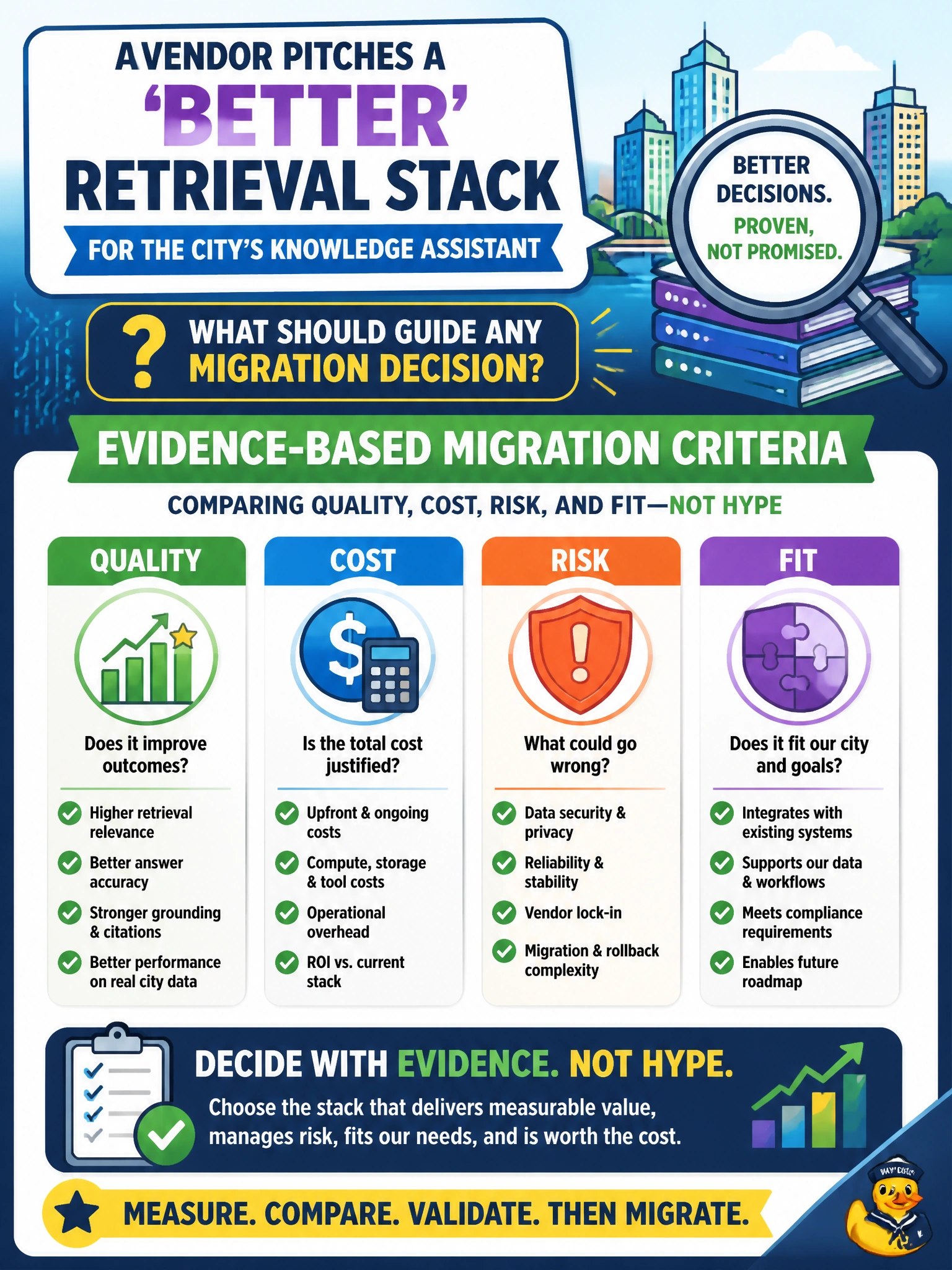
Pretty pitch decks aren’t proof. Set evidence-based migration criteria—quality, cost, risk, fit—and make the stack earn the move.
Full Explanation
When a vendor pitches a "better" retrieval stack for the city's knowledge assistant, migration decisions should follow evidence-based criteria comparing quality, cost, risk, and fit—not hype. Retrieval quality affects resident answers; cost affects sustainment; risk covers privacy, lock-in, and operability; fit covers integration with municipal identity, records, and support models. Side-by-side evaluation on city content is the antidote to pitch-deck gravity. Migrating immediately because the pitch deck looks modern fails by substituting aesthetics for measured improvement and inviting regression. Rejecting all improvements permanently to avoid disruption fails because refusal to evaluate can leave known quality problems unaddressed. Choosing the option with the longest marketing video fails as a decision rule unrelated to civic performance. Exam caveat: both reckless adoption and permanent rejection appear; the correct concept is comparative evidence before change. Operational check: define scored criteria, run a time-boxed bake-off on held-out civic questions, estimate switching and operating cost, review residual risk with security/privacy, and decide with a written recommendation to the AI program office.