
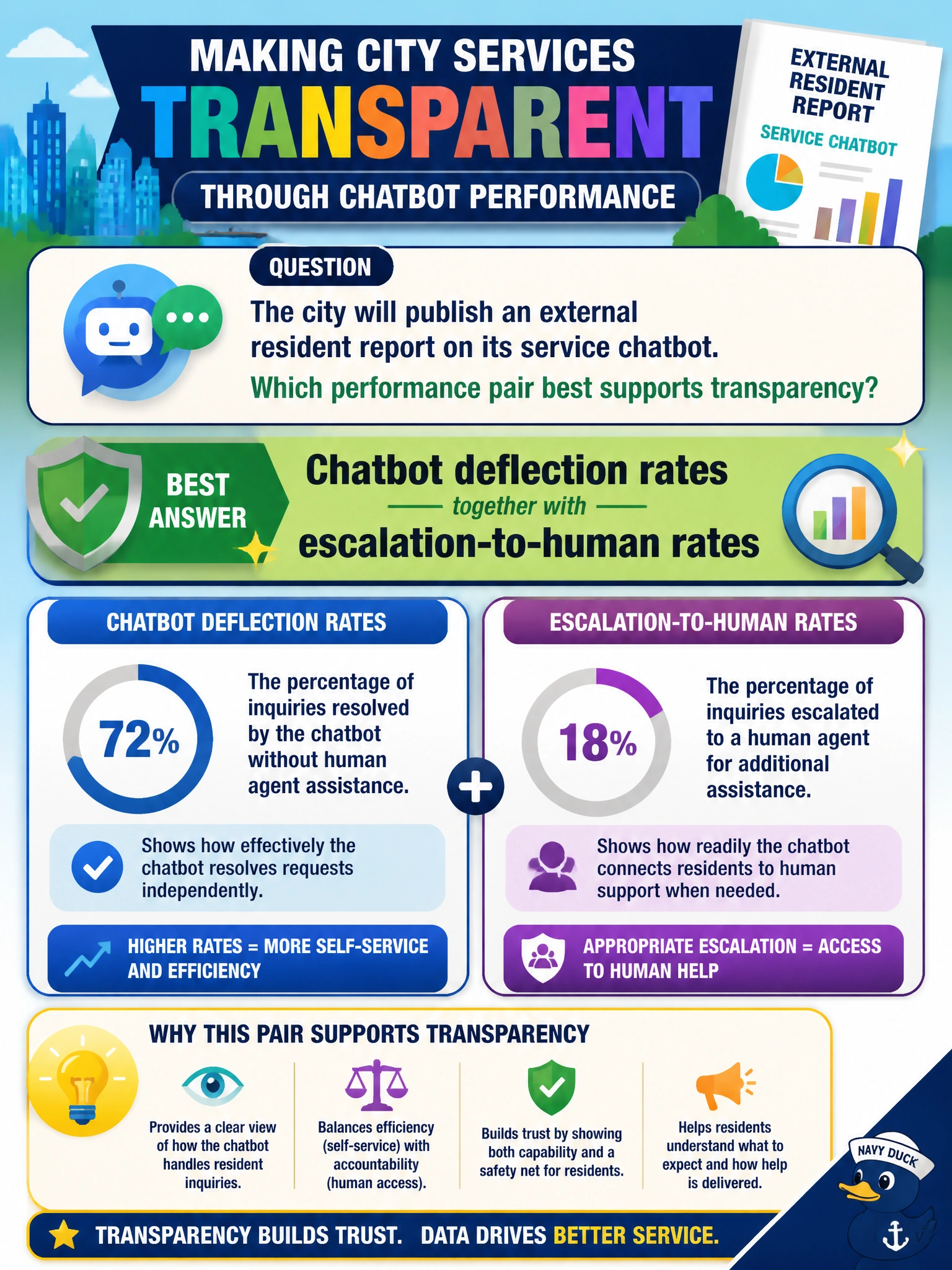
The city will publish an external resident report on its service chatbot. Which performance pair best supports transparency?
Select an answer to reveal the explanation.
Short Explanation
Residents care whether bots resolve issues and when humans step in. Publish deflection alongside escalation-to-human—both sides of the service coin, not just a page-view vanity trip.
Full Explanation
For an external resident report on a city service chatbot, the performance pair that best supports transparency is chatbot deflection rates together with escalation-to-human rates. Deflection shows how often the assistant resolves routine requests without staff handoff; escalation shows how often residents still need a person—and whether that safety valve is healthy. Publishing both sides prevents the city from advertising automation success while hiding unresolved or forced-bot experiences. Reporting only total page views on the chatbot landing page fails because views measure curiosity or navigation, not service outcomes. Internal employee satisfaction scores with no resident-facing outcomes fail the audience test: an external resident report must speak to resident experience, not only staff sentiment. Vendor uptime SLAs without any service-outcome measures fail because availability is necessary but not sufficient; a live bot can still give wrong routing advice. Exam caveat: uptime and page-view distractors sound quantitative yet miss citizen-service performance. Operational check: define deflection and escalation consistently, report them side by side with period baselines, note known limitations (channel mix, after-hours coverage), and link to how residents reach humans when the assistant cannot help.