
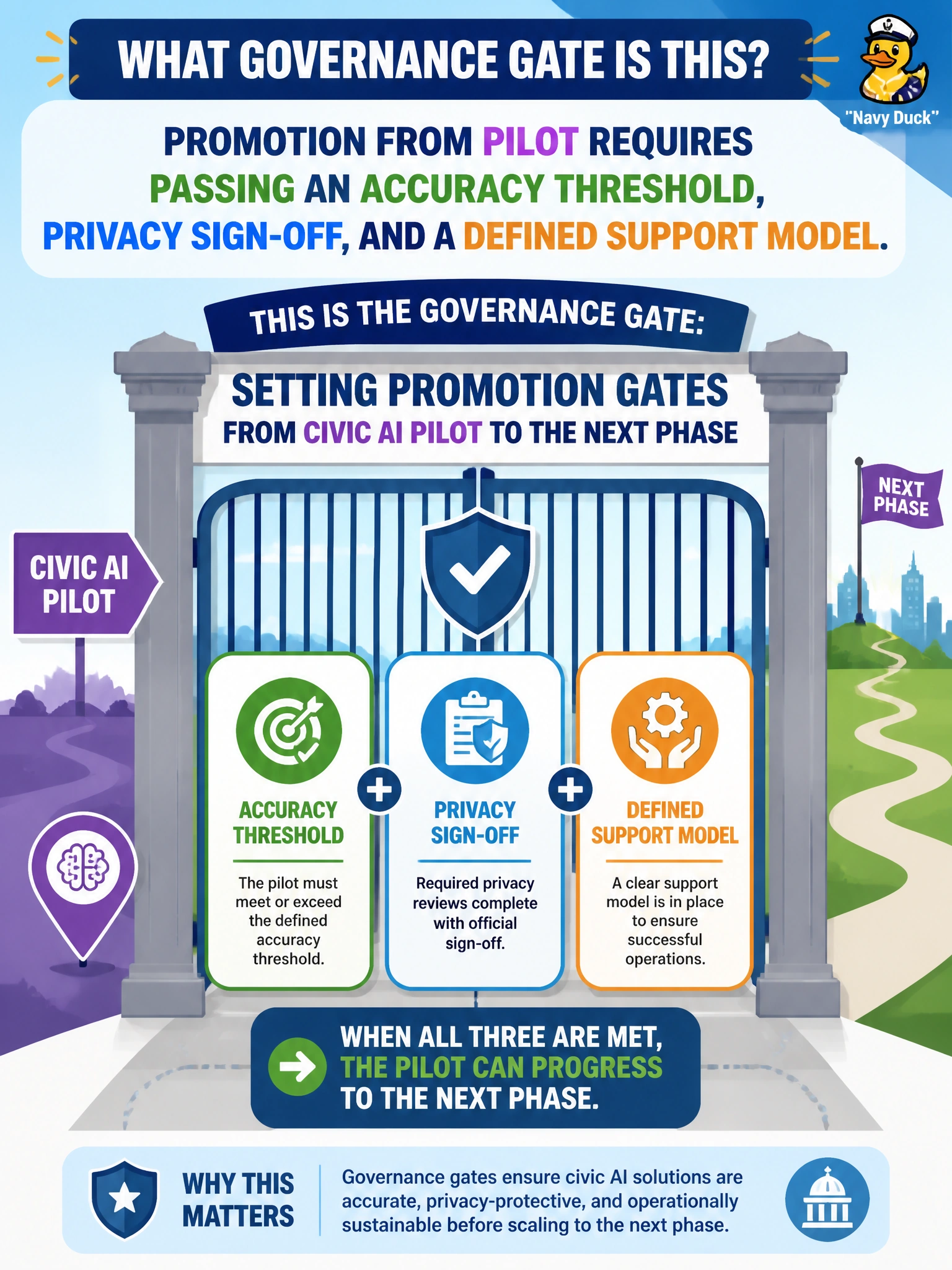
Promotion from pilot requires passing an accuracy threshold, privacy sign-off, and a defined support model. What governance gate is this?
Select an answer to reveal the explanation.
Short Explanation
Calendar expiry is not a green light. Hit the accuracy bar, get privacy sign-off, and name who supports it—then promote. Otherwise you just moved a science project onto the main street.
Full Explanation
Setting promotion gates from civic AI pilot to the next phase is the correct governance gate when promotion from pilot requires passing an accuracy threshold, privacy sign-off, and a defined support model. That works because calendar expiry is not evidence of readiness; accuracy, privacy, and support ownership are independent fail points. Explicit gates prevent science projects from becoming default production channels and force cross-functional sign-off before residents depend on the system at scale.
Promoting automatically when the pilot calendar expires fails by concept: time passing is not a quality, privacy, or support decision. Skipping privacy review if accuracy looks good enough fails by concept—accuracy does not imply lawful or acceptable data handling. Leaving support ownership undefined until after citywide launch fails by concept: production without owners creates orphaned incidents and slow remediation.
Exam caveat: gates must be enforced with authority to stop promotion; optional checklists that are routinely waived are not gates. Keep pilot-to-next-phase / municipal framing. Operational check: publish promotion criteria (accuracy threshold, privacy sign-off, named support model); require recorded approvals; block expansion tooling until gates pass; and re-run relevant gates after material model or data changes.