
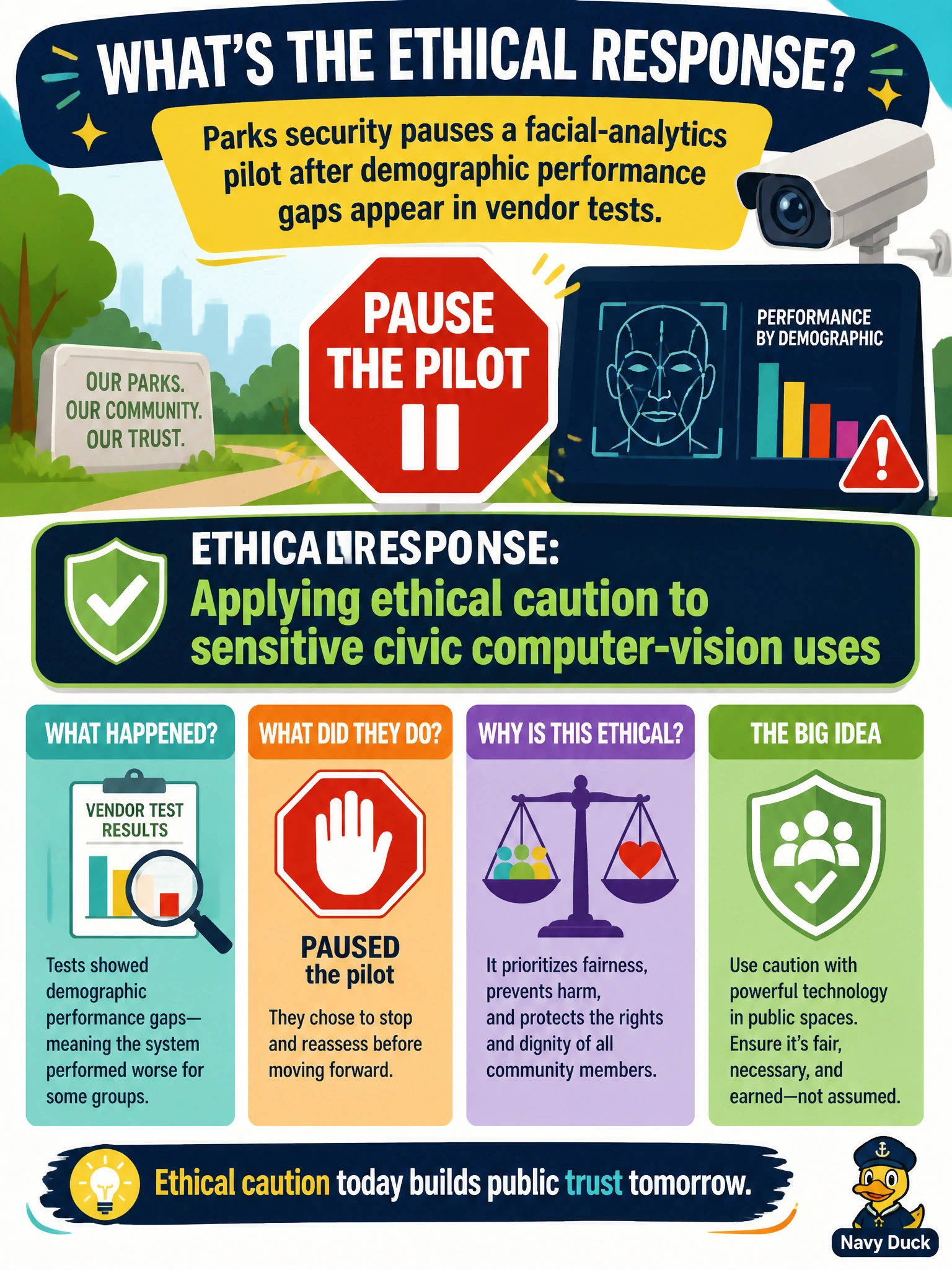
Parks security pauses a facial-analytics pilot after demographic performance gaps appear in vendor tests. What ethical response is this?
Select an answer to reveal the explanation.
Short Explanation
When the face-matching scores look uneven across groups, hit pause—not full-city rollout. Sensitive vision in parks is high-stakes; caution is the professional move, not a rebrand.
Full Explanation
Applying ethical caution to sensitive civic computer-vision uses is the correct response when parks security pauses a facial-analytics pilot after demographic performance gaps appear in vendor tests. That works because facial analytics in public parks affect liberty, privacy, and equal treatment; uneven demographic performance is a material fairness and safety signal, not a cosmetic bug. Pausing preserves the option to remediate, re-scope, or cancel before a flawed system scales across residents who did not opt into being test subjects.
Deploying citywide immediately to gather more demographic data in production fails by concept: production should not be the first place the city learns who is misidentified; that approach externalizes harm onto residents. Renaming the system 'smart cameras' and skipping ethics review fails by concept—rebranding does not change capability, risk, or the duty to review sensitive vision uses. Publishing resident photos publicly to crowd-source accuracy fixes fails by concept and privacy: exposing parkgoer imagery creates new privacy injuries and is not a legitimate remediation path.
Exam caveat: pause is a control decision with owners and exit criteria—not indefinite avoidance without a documented path (fix, restrict, redesign, or cancel). Keep parks security / facial-analytics framing. Operational check: stop expansion when demographic gaps appear; document the pause and owners; require independent or city-led retesting; involve ethics/privacy/legal; and only resume with evidence that gaps are mitigated and residual risk is accepted under policy.