
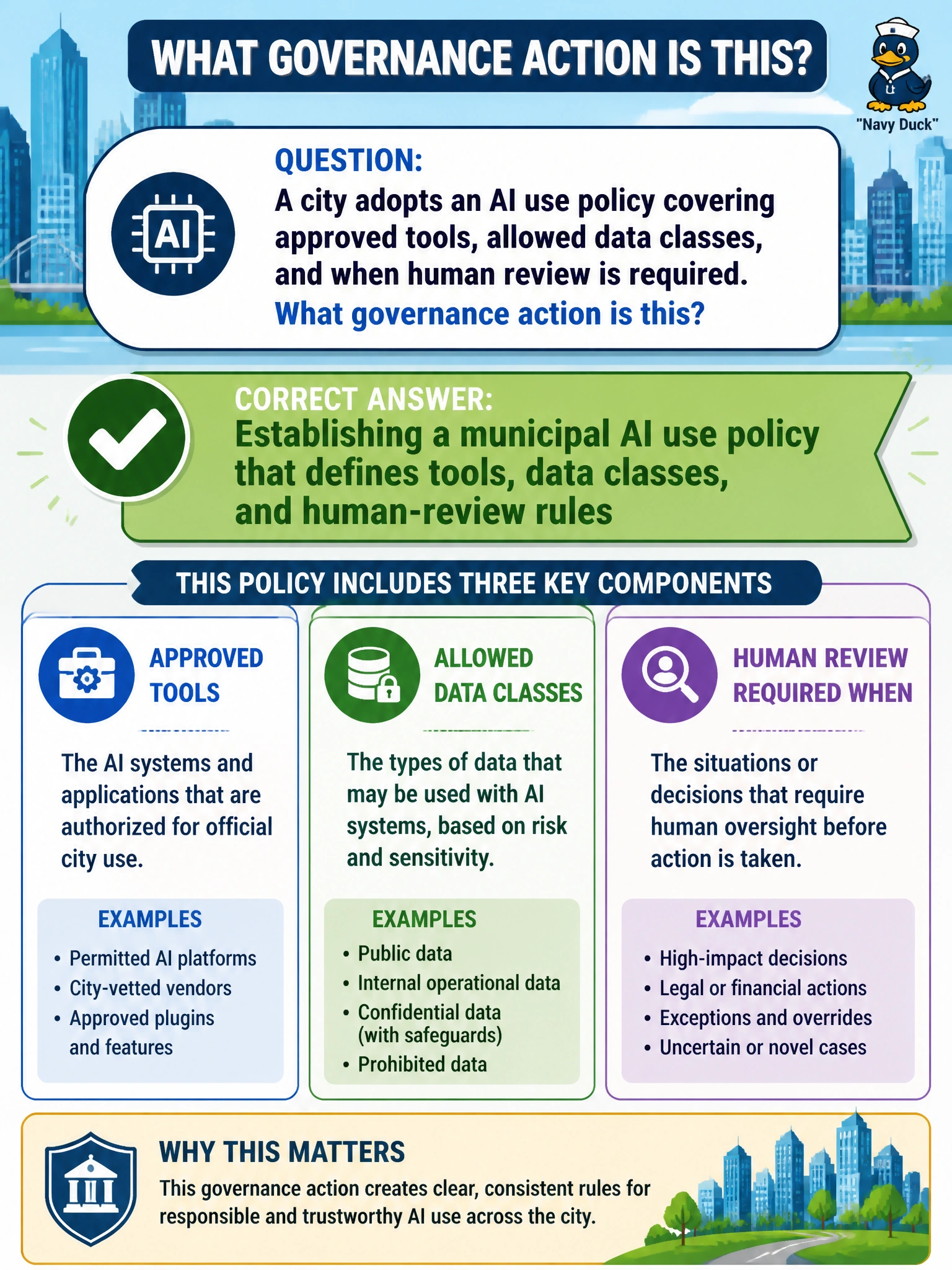
A city adopts an AI use policy covering approved tools, allowed data classes, and when human review is required. What governance action is this?
Select an answer to reveal the explanation.
Short Explanation
Without a use policy, every desk becomes its own AI legislature. Spell out approved tools, data classes, and human-review rules so staff know the rails—not just a pep talk about innovation.
Full Explanation
Establishing a municipal AI use policy that defines tools, data classes, and human-review rules is the correct governance action. Staff need operational guidance on which tools are approved, what data may be entered, and when a human must review outputs before action. Without that policy, each employee invents informal rules that conflict with records, privacy, and risk expectations. A clear use policy creates a shared baseline for training, enforcement, and audits across departments. The action works because municipal AI governance starts with explicit, usable rules—not slogans or silence.
Letting every employee invent personal AI rules without a citywide policy fails by concept: fragmented personal rules produce inconsistent risk and make accountability impossible. Posting a vague slogan about innovation with no operational guidance fails by concept—slogans do not tell staff whether a case file may be pasted into a chatbot. Banning documentation of AI use so audits find nothing fails by concept and integrity: hiding use prevents governance and creates larger audit and trust failures.
Exam caveat: a use policy should be specific enough to operate (tools, data classes, human review) while remaining updateable as platforms change. Keep citywide municipal governance framing. Operational check: publish an AI use policy covering approved tools, prohibited data classes, and human-review triggers; train staff; provide an intake for exceptions; and verify through spot checks that high-risk uses follow the documented rules.