
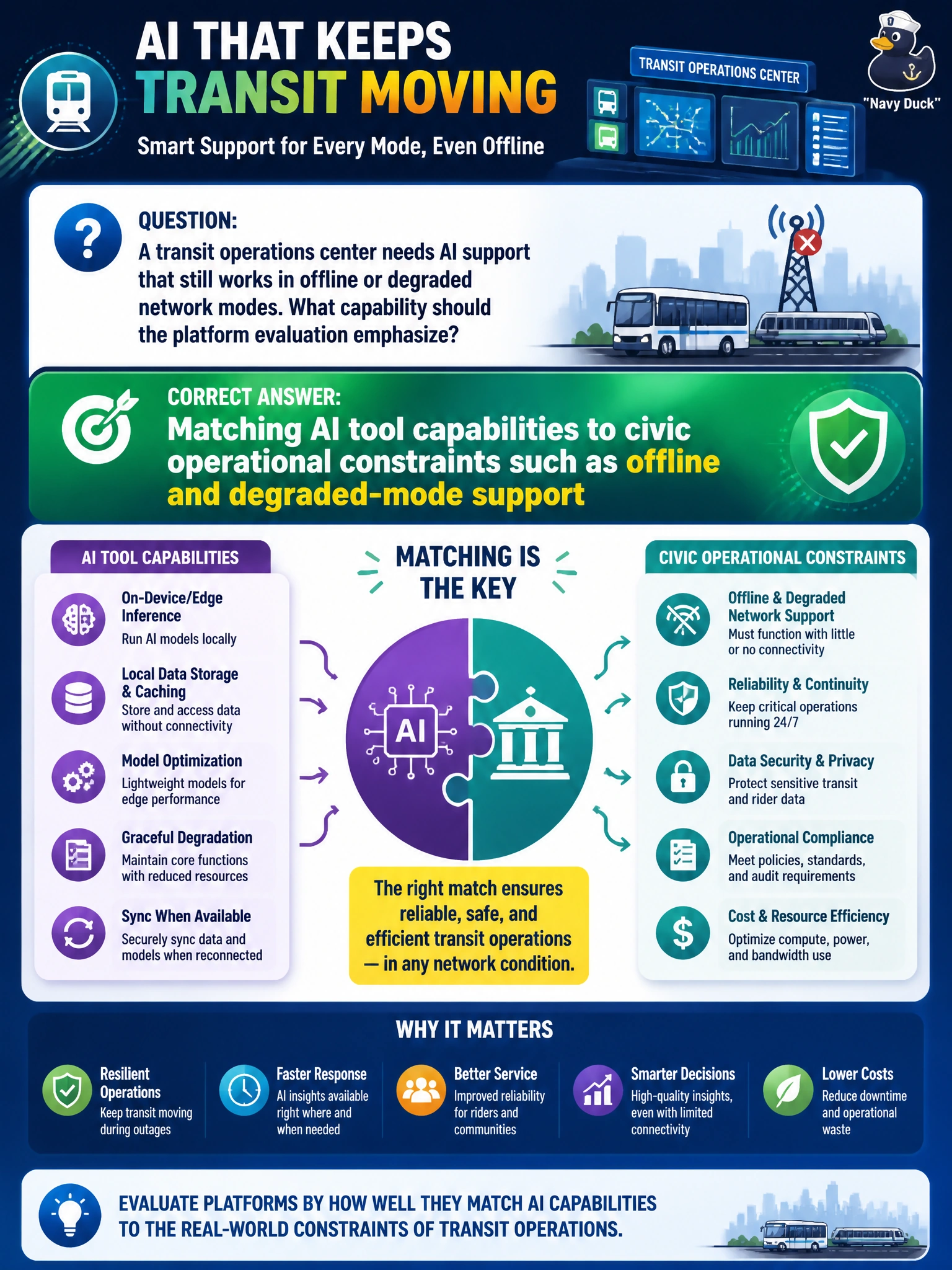
A transit operations center needs AI support that still works in offline or degraded network modes. What capability should the platform evaluation emphasize?
Select an answer to reveal the explanation.
Short Explanation
You can’t pause transit operations when the WAN hiccups. If your AI tool fails offline, it’s a fancy paperweight, so emphasize degraded-mode support, not just sunny-day demos.
Full Explanation
Matching AI tool capabilities to civic operational constraints such as offline and degraded-mode support is the right platform-evaluation emphasis for a transit operations center. You cannot assume pristine WAN connectivity: decision support that vanishes when links degrade becomes a liability. Evaluate whether AI assistance remains available—or fails safely with clear degraded behavior—under offline or limited-connectivity conditions, and whether it fits ops-center workflows. Cloud-only chat that fails hard whenever the wide-area link drops breaks operational continuity. A consumer mobile app with no ops-center integration path does not fit transit dashboards, roles, or incident workflows. A standalone chatbot for operator questions, without checking offline or degraded-network support, leaves a critical operational constraint unverified. Exam caveat: offline/degraded support does not mean every municipal AI must run fully air-gapped; your evaluation should match the stated operational constraint rather than ignore it. Practical check: include offline and degraded-mode scenarios in the proof of concept, document what happens when the WAN drops, and prefer designs that cache critical context, queue requests safely, or degrade gracefully within the ops interface. Reject tools that work only when the cloud path is perfect.