
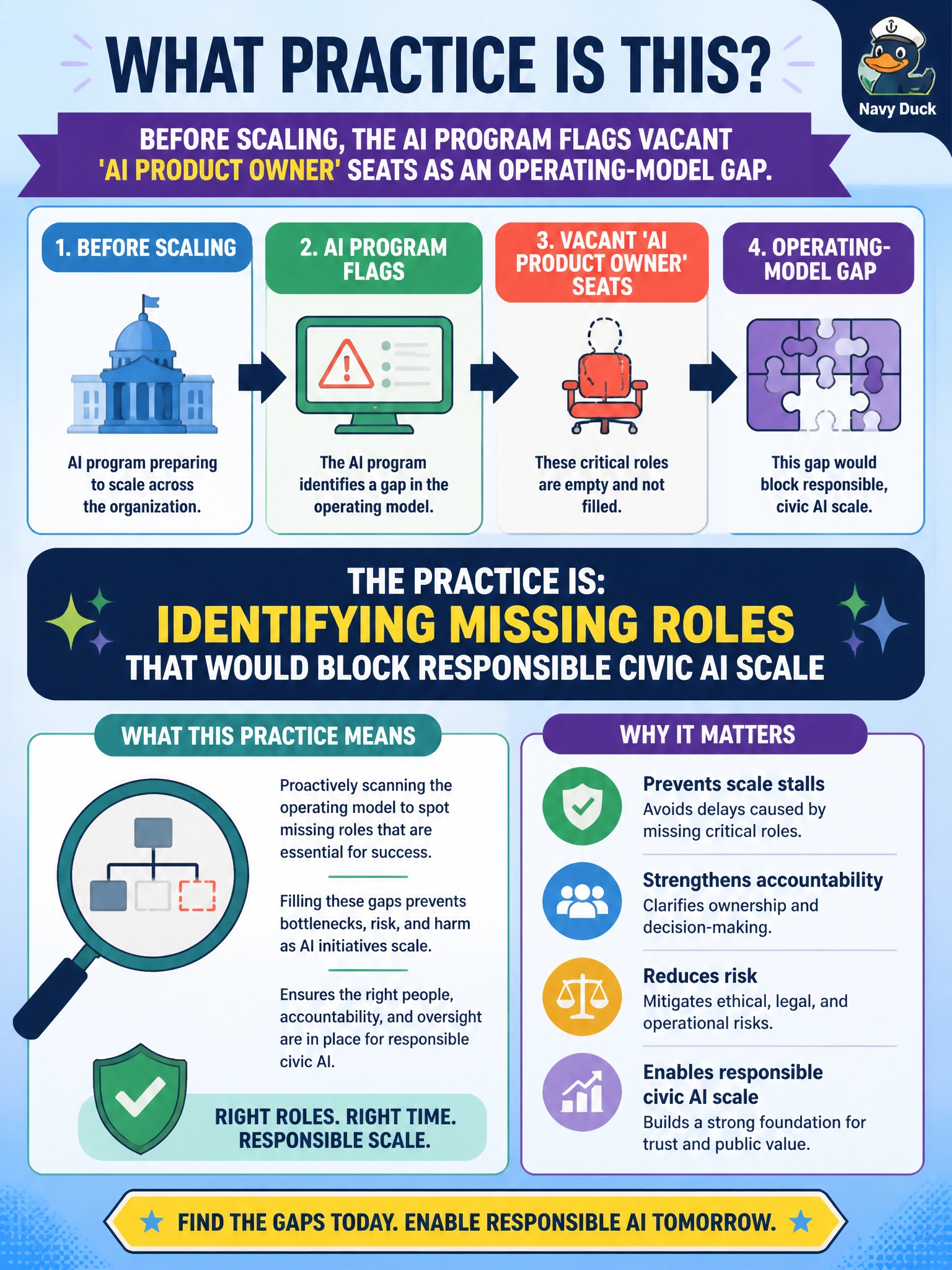
Before scaling, the AI program flags vacant 'AI product owner' seats as an operating-model gap. What practice is this?
Select an answer to reveal the explanation.
Short Explanation
You don’t open a second firehouse with empty captain chairs. Spot vacant AI product-owner seats before you scale—gaps in the org chart become gaps in the street.
Full Explanation
Operating-model readiness is as much about filled seats as about slideware. Flagging vacant 'AI product owner' roles before scaling is the practice of identifying missing roles that would block responsible civic AI scale. Product owners translate policy into backlog, prioritize safety and value tradeoffs, own acceptance criteria, and remain the named contact when models drift or residents complain. Scaling without them leaves pilots orphaned, vendors unsupervised, and departments unable to sustain human-in-the-loop duties. Spotting the gap early is therefore a governance strength, not bureaucracy.
Scaling citywide while leaving product-owner roles unfilled on purpose fails by concept: intentional vacancy guarantees unowned decisions at the moment volume and risk rise. Treating vacant product-owner roles as irrelevant to readiness fails because role coverage is a primary readiness criterion in AI operating models—tools without owners are liabilities. Deleting product-owner roles from the chart to accelerate go-live optics fails because removing the seat does not remove the work; it only hides accountability until failure surfaces in production.
Exam caveat: do not confuse 'lean org chart' with 'no product ownership.' CAIPM-aligned answers treat named civic AI product ownership as a scale prerequisite. Operational check: before citywide rollout, inventory required AI product-owner seats per major use case, verify hiring or designation status, and block scale gates where seats remain vacant or covered only by temporary vendor staff without municipal authority.