
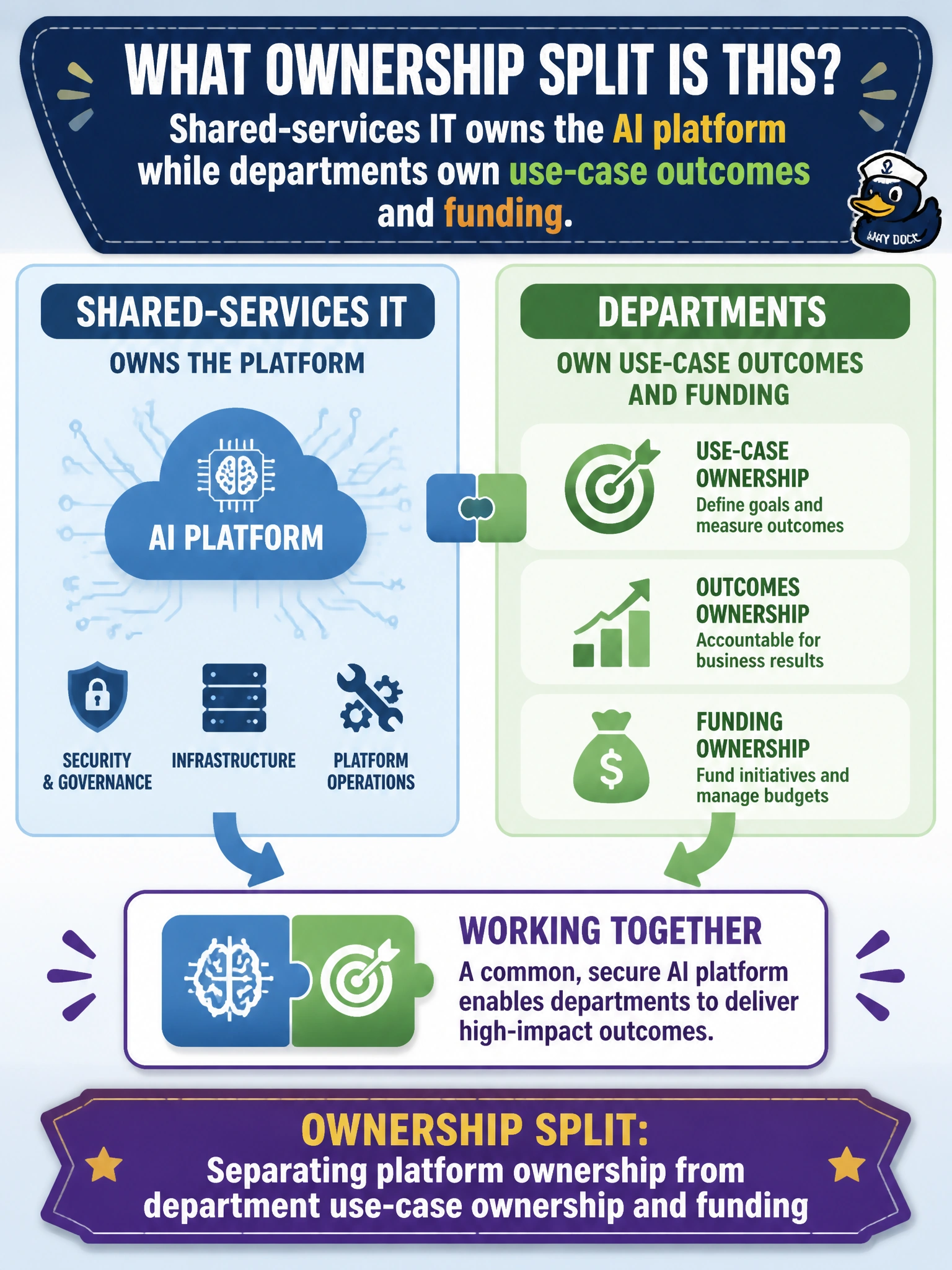
Shared-services IT owns the AI platform while departments own use-case outcomes and funding. What ownership split is this?
Select an answer to reveal the explanation.
Short Explanation
IT runs the kitchen; departments own the menu and the grocery bill. Split platform ownership from use-case outcomes so nobody plays hot potato.
Full Explanation
Healthy municipal AI ownership separates the shared platform from mission use cases. When shared-services IT owns the AI platform while departments own use-case outcomes and funding, the city avoids both 'IT is responsible for every mission result' and 'every department builds its own stack.' The correct option—separating platform ownership from department use-case ownership and funding—works because platforms need engineering standards, security baselines, model hosting, observability, and cost controls, whereas permitting, 311, housing, or transit outcomes need domain product owners who fund priorities, define success metrics, and accept residual risk for their resident workflows.
Making IT solely accountable for every department’s mission outcomes fails by concept: IT cannot own housing placement quality or transit reliability; that misassignment creates accountability theater and chronic finger-pointing. Letting departments own the platform while IT owns none of the stack fails the dual risk of duplicated insecure platforms and lost enterprise controls. Leaving both platform and outcomes without any named owner fails because unowned systems drift—no patch owner, no budget owner, no metric owner—until an incident forces emergency ownership.
Exam caveat: 'shared services owns everything' sounds efficient but collapses mission accountability; 'departments own everything' sounds agile but fragments the platform. Municipal stems usually reward the split. Operational check: read the RACI or service catalog—platform SLAs and security under IT; use-case OKRs, funding lines, and product owners under departments—and confirm chargeback or funding matches that split in practice.