
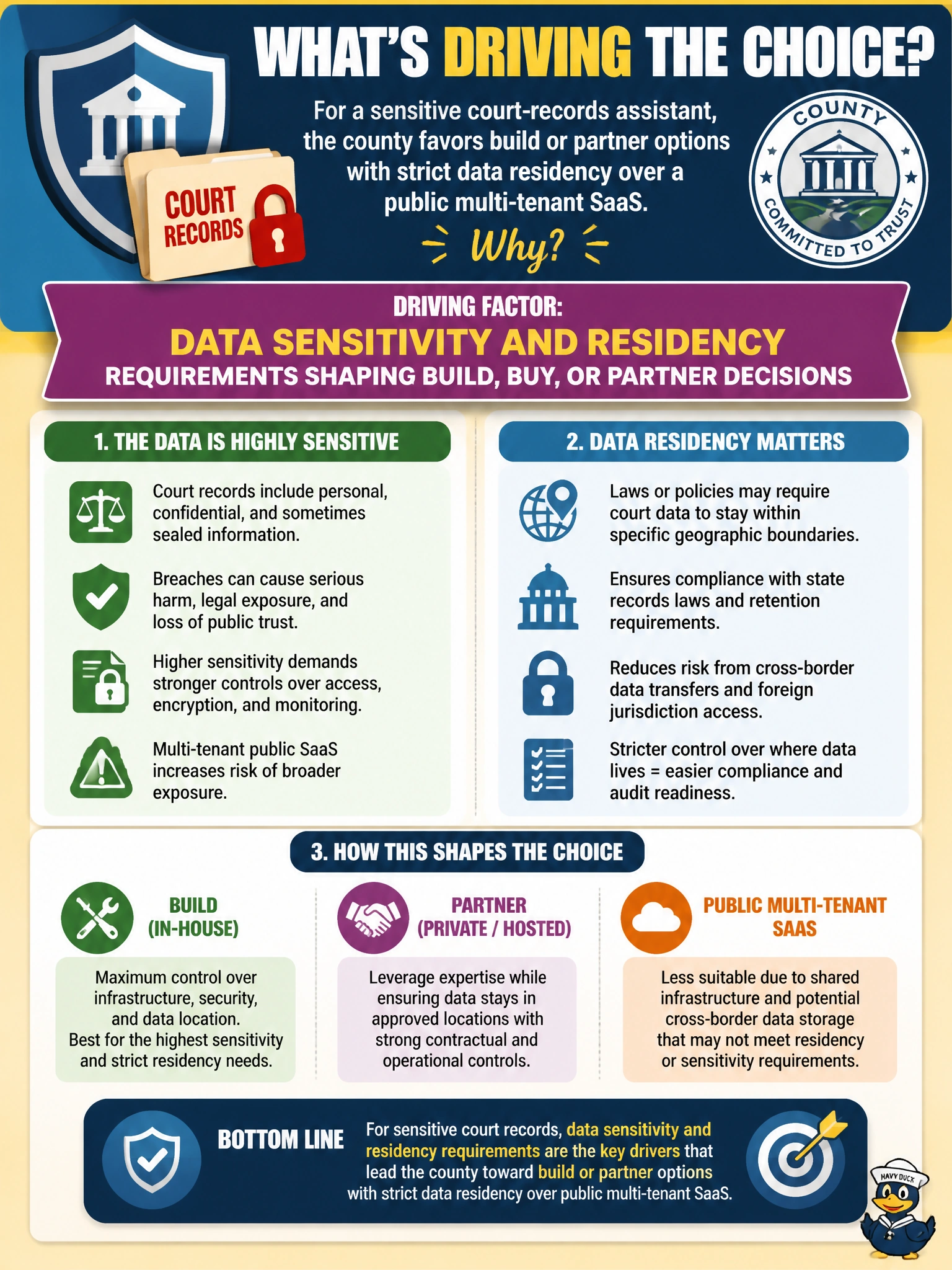
For a sensitive court-records assistant, the county favors build or partner options with strict data residency over a public multi-tenant SaaS. What is driving that choice?
Select an answer to reveal the explanation.
Short Explanation
Court records aren’t lunch-menu trivia. When data is that sensitive, residency and control beat the shiniest public SaaS pitch.
Full Explanation
Data sensitivity and residency requirements are legitimate drivers of municipal build, buy, or partner decisions. Court records often include personally identifying information, sealed matters, and access rules that public multi-tenant SaaS may not satisfy without exceptional controls. Favoring build or tightly governed partnerships with strict data residency reflects that constraint: the county retains stronger control over where data lives, who can access it, and how models are trained or logged. The sourcing choice is therefore shaped by records rules and risk, not by consumer chatbot fashion.
A preference for the flashiest consumer chatbot regardless of records rules fails because marketing polish does not satisfy court data obligations. Avoiding any residency controls because courts never hold sensitive data fails factually and conceptually—court systems routinely hold sensitive data. Choosing SaaS only because it requires zero contract review fails because high-sensitivity civic AI almost always needs contract, security, and privacy review; skipping review is a governance failure, not a sourcing virtue.
Exam caveat: “build or partner” is not automatically safer than SaaS; poorly governed builds can still leak data. The point is that sensitivity and residency must shape the decision criteria. Operational check: classify the court-records data, map residency and access requirements, and reject any delivery option—SaaS included—that cannot meet those requirements in writing before procurement or build kickoff.