
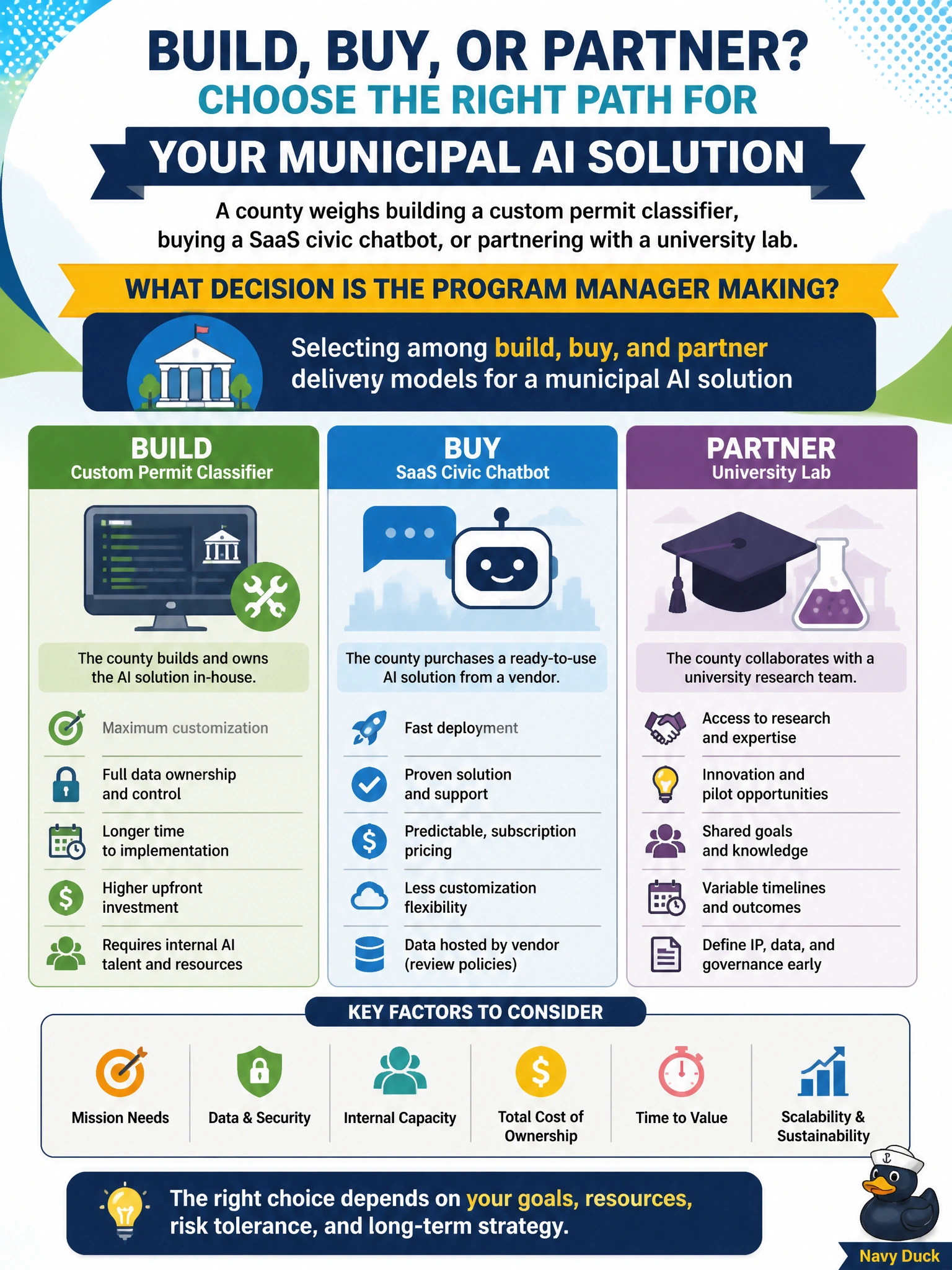
A county weighs building a custom permit classifier, buying a SaaS civic chatbot, or partnering with a university lab. What decision is the program manager making?
Select an answer to reveal the explanation.
Short Explanation
Build it, buy it, or buddy up with a lab—that’s the classic fork in the road. The manager is picking a delivery model, not inventing a new tax.
Full Explanation
Build, buy, and partner are the standard delivery-model choices for municipal AI solutions. Building a custom permit classifier implies in-house or contracted development of differentiated logic on city data. Buying a SaaS civic chatbot implies purchasing a commercial product for a more commodity interaction pattern. Partnering with a university lab implies collaborating for research capacity, specialized methods, or shared innovation under agreements that define IP, data use, and sustainment. The program manager is selecting among those sourcing paths for how the municipality will obtain and operate the capability.
Choosing a new municipal tax rate for AI users fails because tax policy is unrelated to delivery-model selection for a permit or chatbot capability. Deciding which election to postpone because of AI fails as a category error: election timing is not an AI sourcing decision. Deleting all existing permitting systems before any analysis fails because premature rip-and-replace skips requirements, integration assessment, and risk analysis that should precede any build/buy/partner choice.
Exam caveat: the three paths are not mutually exclusive for an entire portfolio; a single program may buy a component and partner for integration. Operational check: before recommending build, buy, or partner for a civic AI item, document required data residency, explainability, staffing to sustain the choice, integration points with systems of record, and multi-year TCO so council sees the trade-offs clearly.