
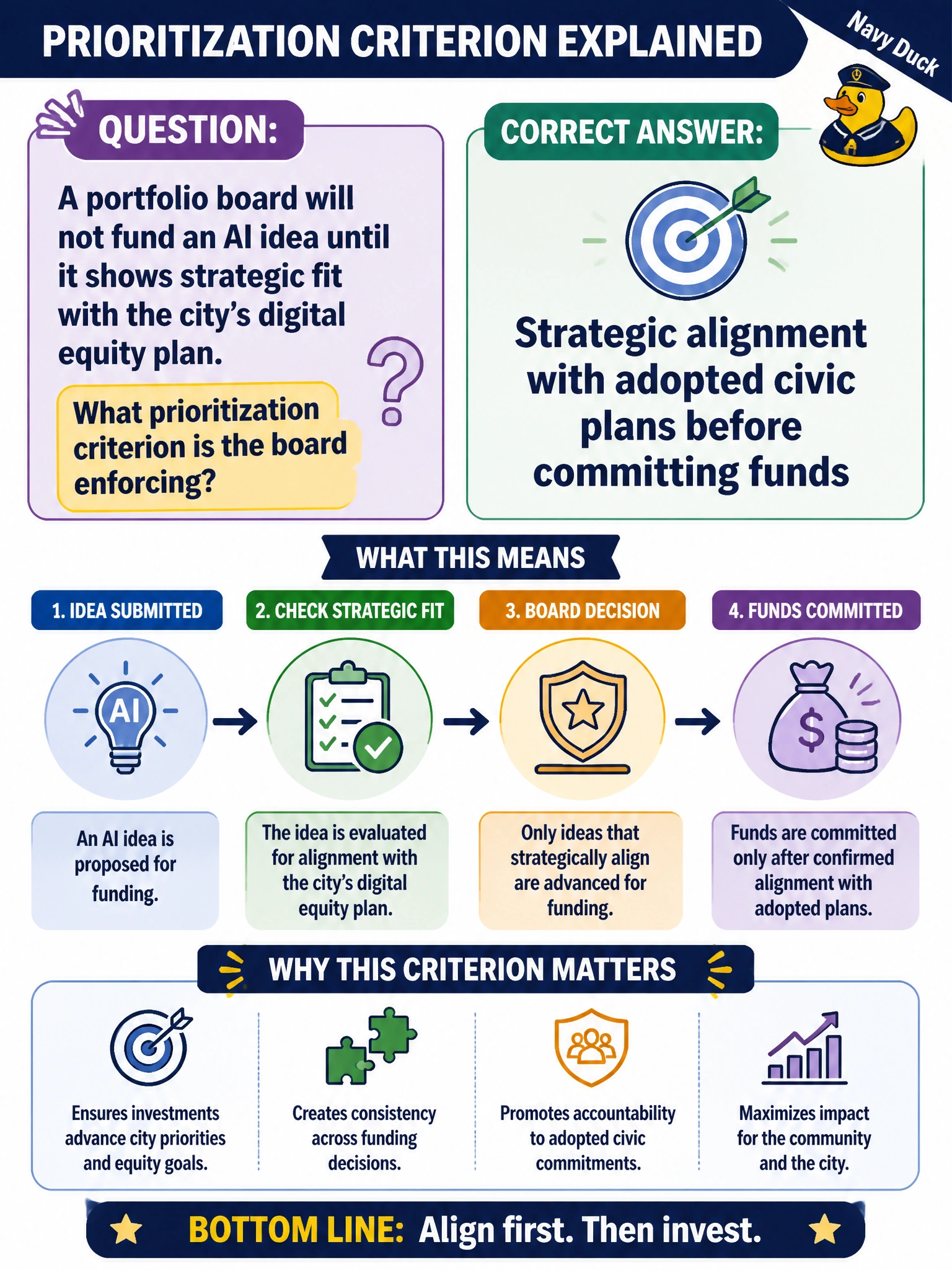
A portfolio board will not fund an AI idea until it shows strategic fit with the city’s digital equity plan. What prioritization criterion is the board enforcing?
Select an answer to reveal the explanation.
Short Explanation
If it doesn’t help the digital equity plan, it doesn’t get the check. The board is scoring strategic fit, not picking shiny logos out of a hat.
Full Explanation
Strategic alignment is a core municipal AI prioritization criterion: funding should follow adopted civic plans, not vendor excitement or ad-hoc enthusiasm. When a portfolio board withholds funds until an AI idea shows fit with the city’s digital equity plan, it is enforcing that criterion. Digital equity commitments typically address access, language, device gaps, and service fairness. An AI proposal that cannot map to those outcomes is an orphan pilot—potentially interesting technologically, but weakly justified against public strategy and budget discipline.
Vendor logo preference unrelated to city goals fails because logo prestige is not a strategic-fit test and often drives shadow IT. Random lottery selection among all submitted pilots fails because lotteries ignore mission alignment, risk, and capacity; they are not governance. Funding only projects that contradict equity commitments fails by definition: contradiction of adopted equity goals is disqualifying, not a funding rationale.
Exam caveat: strategic fit is necessary but not sufficient. A proposal may align with digital equity and still fail on data readiness, privacy, or TCO. Operational check: require each municipal AI funding request to cite the specific adopted plan objectives it advances, the equity or service metrics it will move, and how success will be reported to the board—reject submissions that only name a vendor product.