
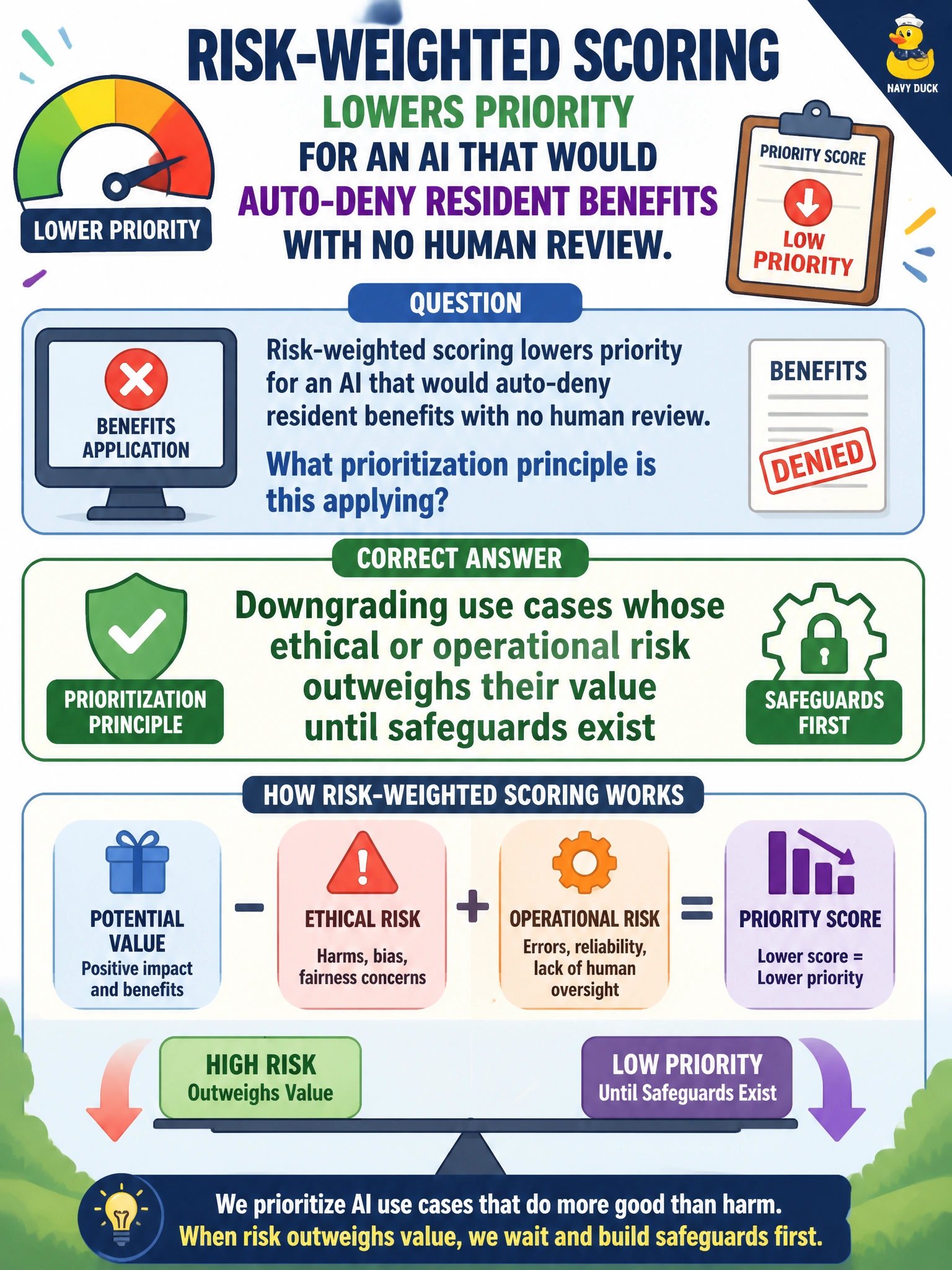
Risk-weighted scoring lowers priority for an AI that would auto-deny resident benefits with no human review. What prioritization principle is this applying?
Select an answer to reveal the explanation.
Short Explanation
Auto-denying someone’s benefits with zero human eyes is a five-alarm risk, not a clever shortcut. Risk-weighted scoring pushes that idea down the list until review and safeguards catch up.
Full Explanation
Risk-weighted prioritization for municipal AI portfolios treats ethical and operational harm as first-class scoring inputs, not as afterthoughts once ROI looks attractive. When a proposed system would auto-deny resident benefits with no human review, the adverse impact on livelihoods, due-process expectations, and public trust typically outweighs near-term efficiency gains. Downgrading that use case until safeguards—human-in-the-loop review, appeal paths, audit logging, and policy clearance—exist is therefore the correct application of risk-weighted scoring: value is discounted by residual risk until controls bring the residual within acceptable bounds.
Raising any fully automated denial tool to the top of the portfolio regardless of harm fails the principle because prioritization is not “automation intensity equals priority.” Fully automated adverse decisions are among the highest-risk civic AI patterns; elevating them by default inverts risk weighting. Ignoring ethical and operational risk when ranking municipal AI ideas fails because risk-weighted scoring exists precisely to keep those dimensions inside the ranking model alongside feasibility and benefit. Prioritizing only tools that remove every staff checkpoint by default fails because removing checkpoints is often a risk amplifier in benefits administration; the portfolio should not reward checkpoint elimination as an intrinsic goal.
Exam caveat: risk weighting lowers priority or sequences work behind controls—it does not always mean permanent rejection. A benefits-denial assistant may re-enter the portfolio once human review, explanation, and appeals are designed. Operational check: for any auto-adverse municipal use case, require documented residual-risk acceptance, named reviewers, and an appeals workflow before funding or production release.