
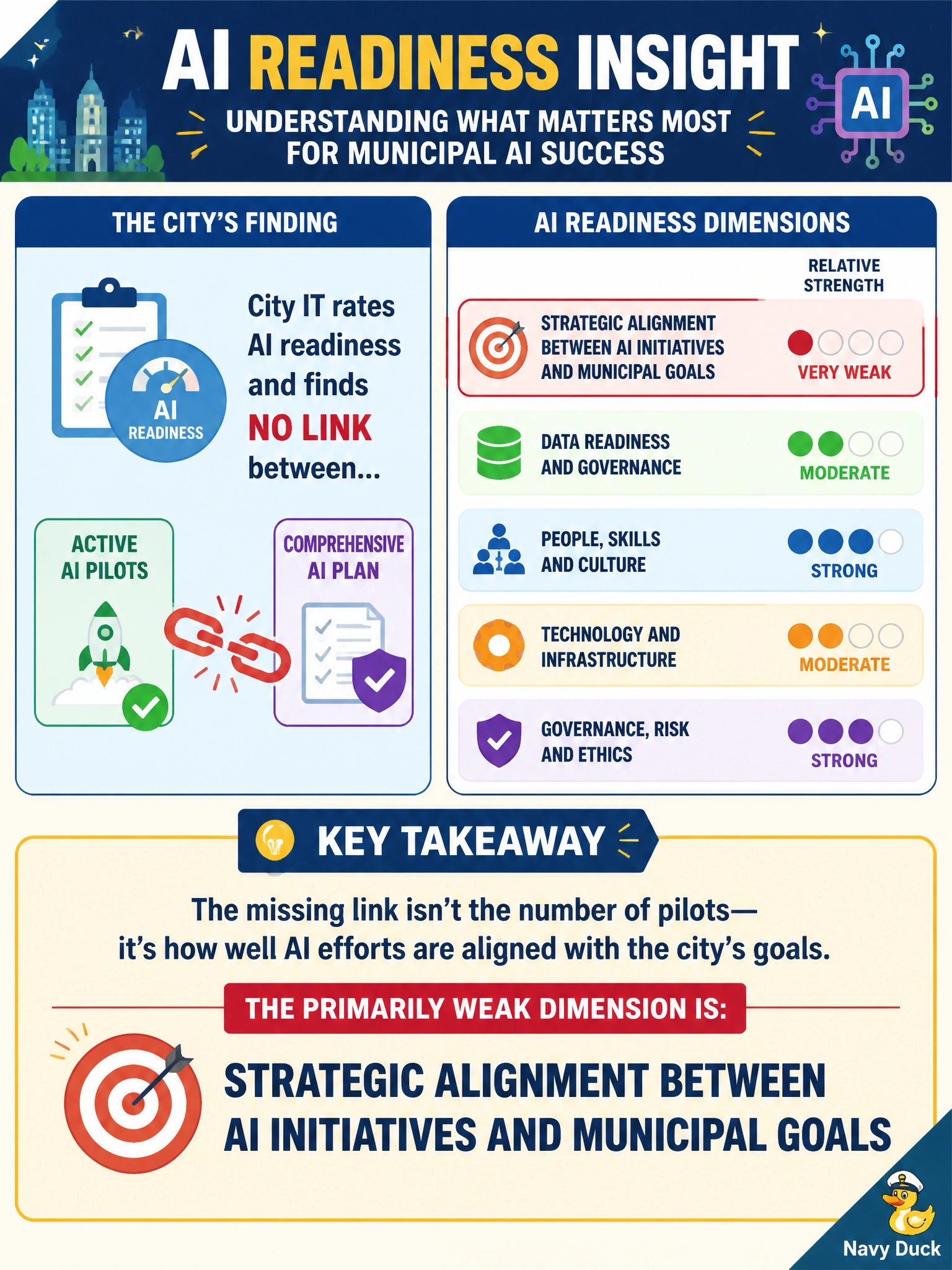
City IT rates AI readiness and finds no link between active AI pilots and the comprehensive plan. Which readiness dimension is primarily weak?
Select an answer to reveal the explanation.
Short Explanation
If the pilots do not show up in the comprehensive plan, they are side quests, not strategy. Readiness starts with a clear line from city goals to AI work—not with prettier wikis or more laptop stickers.
Full Explanation
When city IT rates AI readiness and finds no linkage between active AI pilots and the comprehensive plan, the primarily weak dimension is strategic alignment. Initiatives should map to adopted municipal goals, plan elements, and measurable outcomes. Orphan pilots may demonstrate technical curiosity yet signal weak strategic readiness because they do not advance governed civic priorities. Program managers remediate by tying each use case to plan goals and portfolio criteria—or by stopping misaligned work. GPU rack density in a single closet is an infrastructure detail that does not repair missing strategy linkage. Font choice on the pilot status wiki is cosmetic noise unrelated to goal alignment. The number of stickers on engineering laptops is cultural trivia that cannot substitute for comprehensive-plan mapping. Exam caveat: readiness is multi-dimensional; a strategy gap is not fixed by more hardware, prettier wikis, or team aesthetics. Operational check: require each pilot charter to cite comprehensive-plan or equivalent strategic objectives, report outcomes to the AI steering body against those goals, maintain a portfolio heatmap of alignment, and sunset or reshape pilots that cannot show durable civic-value linkage.