
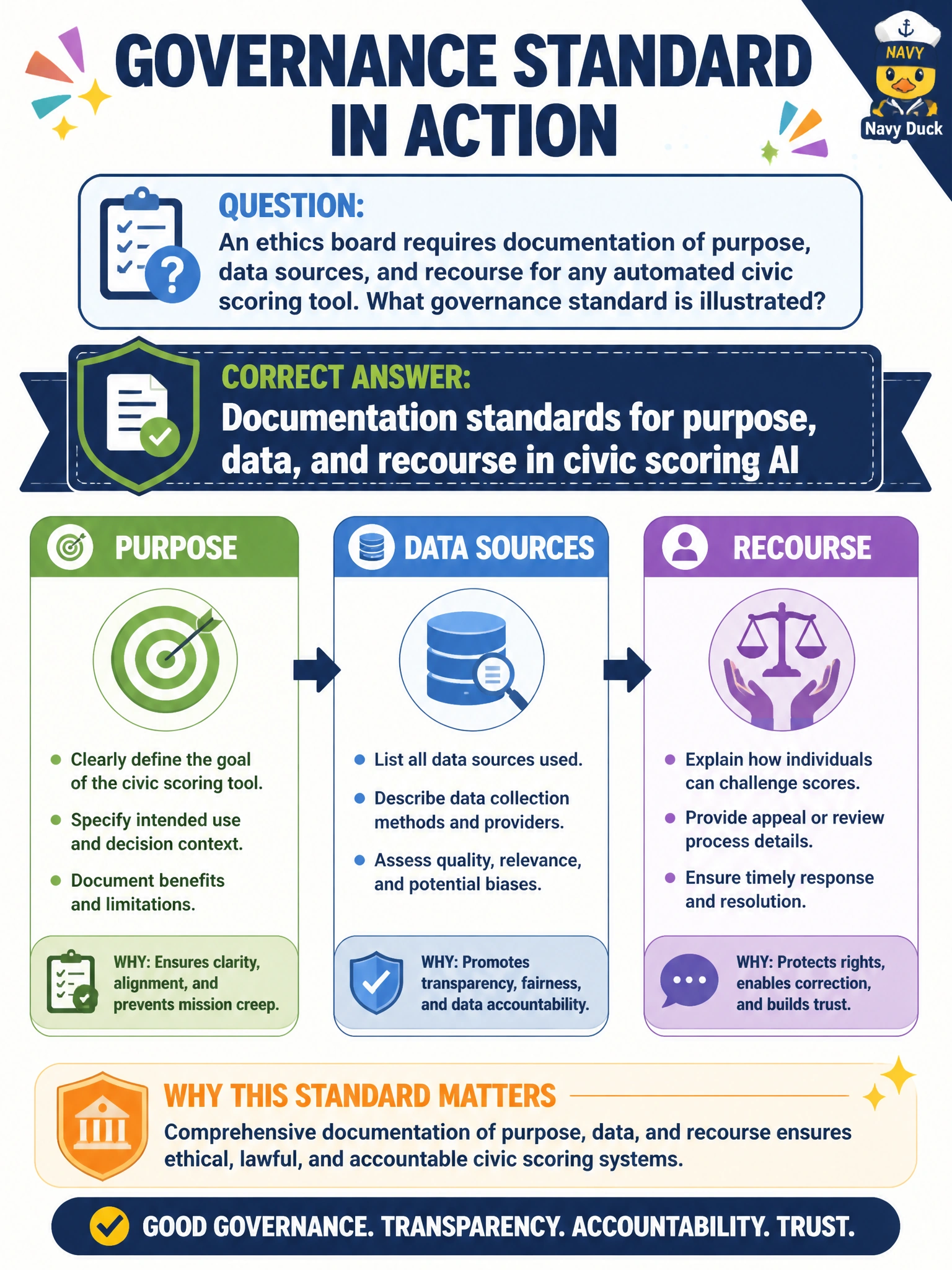
An ethics board requires documentation of purpose, data sources, and recourse for any automated civic scoring tool. What governance standard is illustrated?
Select an answer to reveal the explanation.
Short Explanation
If a scoring tool can affect residents, write down why it exists, where data came from, and how people fight back. That documentation is governance. An impact assessment evaluates risks you'll create, monitoring tracks drift you'll see over time, and explainability clarifies predictions you'll get, but it's the standard that says you've got to document those three things.
Full Explanation
An ethics board requiring documentation of purpose, data sources, and recourse for any automated civic scoring tool illustrates documentation standards for purpose, data, and recourse in civic scoring AI. The correct answer is documentation standards for purpose, data, and recourse in civic scoring AI. Scoring systems that rank or classify residents for services, inspections, or eligibility can materially affect outcomes. Written purpose limits function creep; data-source disclosure enables bias and quality scrutiny; clear recourse tells people how to challenge errors—core procedural fairness in municipal automation.
Algorithmic impact assessments for evaluating societal risks in civic scoring AI fails: assessments evaluate broader societal risks, affected groups, and mitigations for a proposed scoring use but do not illustrate the specific documentation standard requiring purpose, data sources, and recourse; the question illustrates the board-mandated documentation artifacts, not the wider pre-deployment risk evaluation.
Continuous monitoring protocols for tracking data drift within civic scoring AI fails: monitoring tracks post-deployment data drift, performance shifts, and emerging bias over time but does not establish the upfront governance requirement to document purpose, data sources, and recourse; the question illustrates the standard requiring those artifacts, not ongoing surveillance of model inputs.
Explainability frameworks for clarifying model predictions in civic scoring AI fails: explainability clarifies how individual model predictions or scores were reached to aid understanding but does not set the governance rule to document purpose, data sources, and recourse; the question illustrates the normative documentation standard, not methods for interpreting outputs.
Exam caveat: documentation standards are necessary but not sufficient for fair scoring. The tested practice is requiring purpose, data, and recourse artifacts; cities must still validate performance and legality of the score itself.
Operational check: refuse production scoring without a filed purpose statement, data inventory, and published or accessible recourse path; review those artifacts at ethics board; monitor challenge outcomes for systemic errors; and block new data sources or purposes until documentation is updated and re-approved.
Prefer to study offline? Printable PDF study book + test engine ($7.50, unofficial). These questions stay free here.