
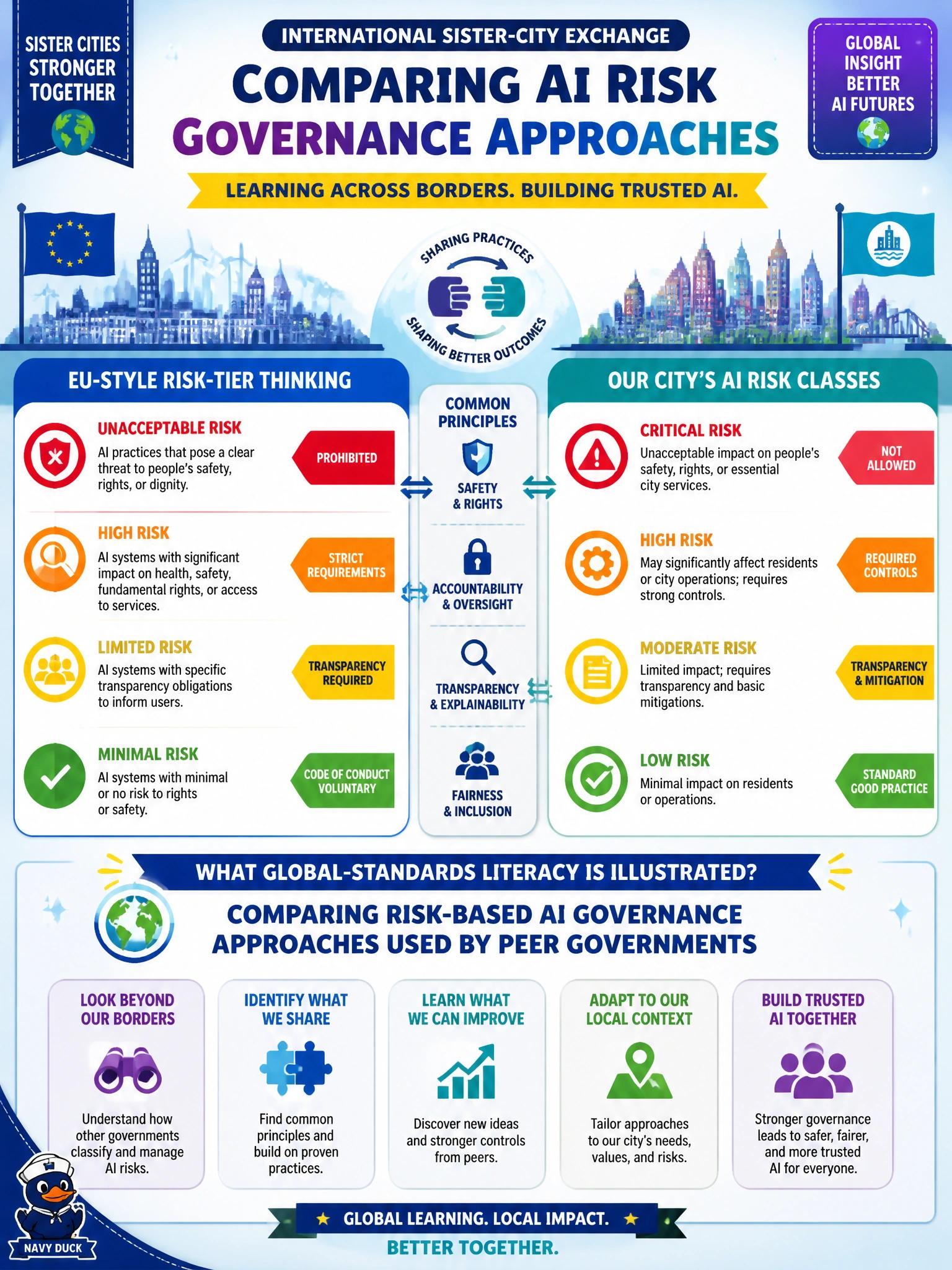
An international sister-city exchange compares EU-style risk-tier thinking with the city’s own AI risk classes. What global-standards literacy is illustrated?
Select an answer to reveal the explanation.
Short Explanation
Comparing EU-style risk tiers with the city’s own classes is learning from global playbooks. You’re comparing governance approaches, and you’ll miss it if you make it about data sovereignty since that’s about where data lives, not how you tier risk. Risk-based thinking travels.
Full Explanation
An international sister-city exchange comparing EU-style risk-tier thinking with the city’s own AI risk classes illustrates comparing risk-based AI governance approaches used by peer governments. The correct answer is comparing risk-based AI governance approaches used by peer governments. Risk-tier models classify uses by potential harm and attach heavier duties to higher tiers. Studying how peer governments structure those classes helps a municipality refine its own taxonomy, procurement questions, and prohibited lists without pretending foreign statutes automatically bind local operations.
Comparing municipal AI safety frameworks with global trade agreements misplaces the focus on trade; global trade agreements govern commerce, not AI risk-tier classification, while the question is about comparing EU-style risk-tier thinking with the city’s own classes to learn from peer approaches. Comparing international data sovereignty models to local AI strategies shifts to data-control questions about where and how data is stored and governed, not classifying AI uses by risk tier, and the question is about comparing risk-tier governance thinking, not data-localization strategy. Comparing local AI compliance audits against international AI treaties mistakes a treaty-compliance audit for the broader governance comparison at issue; the literacy is about comparing overall risk-based approaches used by peer governments, not measuring local audits against treaty obligations.
Exam caveat: comparative literacy is not wholesale legal transplantation. The tested idea is learning from peer risk-tier thinking to improve local classes; binding rules remain those the city is actually subject to or adopts through its own process.
Operational check: document a crosswalk between sister-city/EU-style tiers and local risk classes, note gaps (e.g., biometric or social scoring), update the municipal tier table where useful, train procurement staff on the comparison, and avoid citing foreign law as binding without counsel confirmation.
Prefer to study offline? Printable PDF study book + test engine ($7.50, unofficial). These questions stay free here.