
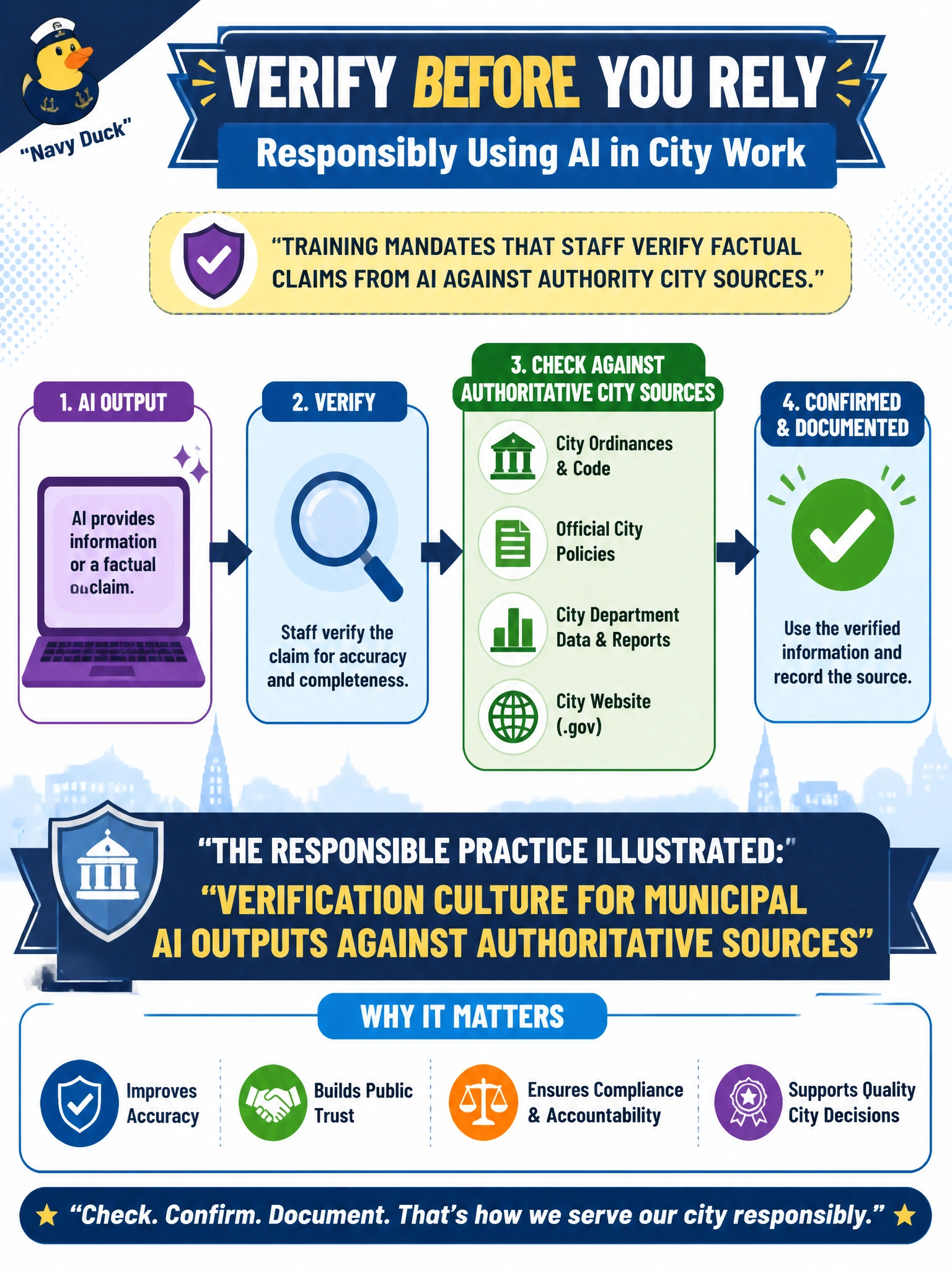
Training mandates that staff verify factual claims from AI against authoritative city sources. What responsible practice is illustrated?
Select an answer to reveal the explanation.
Short Explanation
AI can sound sure and still be wrong, so you still have to check it against city sources. You're the verification step, and passing quality assurance testing doesn't mean it's actually right. An algorithmic audit or tracking data provenance won't cut it when you've got to verify what you'll share against city sources.
Full Explanation
Training that mandates staff verify factual claims from AI against authoritative city sources illustrates a verification culture for municipal AI outputs. The correct answer is verification culture for municipal AI outputs against authoritative sources. Generative systems produce fluent, confident text that can misstate fee amounts, eligibility rules, or ordinance citations. Requiring staff to check AI claims against codes, official websites, and system-of-record databases prevents hallucinated guidance from becoming de facto city policy in emails, case notes, or public replies. Algorithmic auditing for municipal AI outputs against authoritative sources fails because it is a periodic systemic review of model behavior and bias, not the routine frontline verification of factual claims against authoritative city sources before staff act on AI output. Quality assurance testing for municipal AI outputs against authoritative sources fails because it is pre-deployment testing of system performance, not staff confirming factual content against codes, ordinances, or official records as the training mandate requires. Data provenance tracking for municipal AI outputs against authoritative sources fails because it traces the origin and lineage of training data, not verifying AI-generated factual claims against authoritative sources upfront as the training mandate describes. Exam caveat: verification culture does not mean staff must retype every sentence from scratch. The tested practice is checking material factual claims against authoritative sources; stylistic drafting help can remain, but numbers, eligibility, and legal citations require confirmation. Operational check: teach staff to treat AI as a draft assistant, require citation to ordinance sections or official URLs for factual claims, sample work products for unverified assertions, and block publish workflows that lack a human verification attestation for resident-facing policy content.
Prefer to study offline? Printable PDF study book + test engine ($7.50, unofficial). These questions stay free here.