
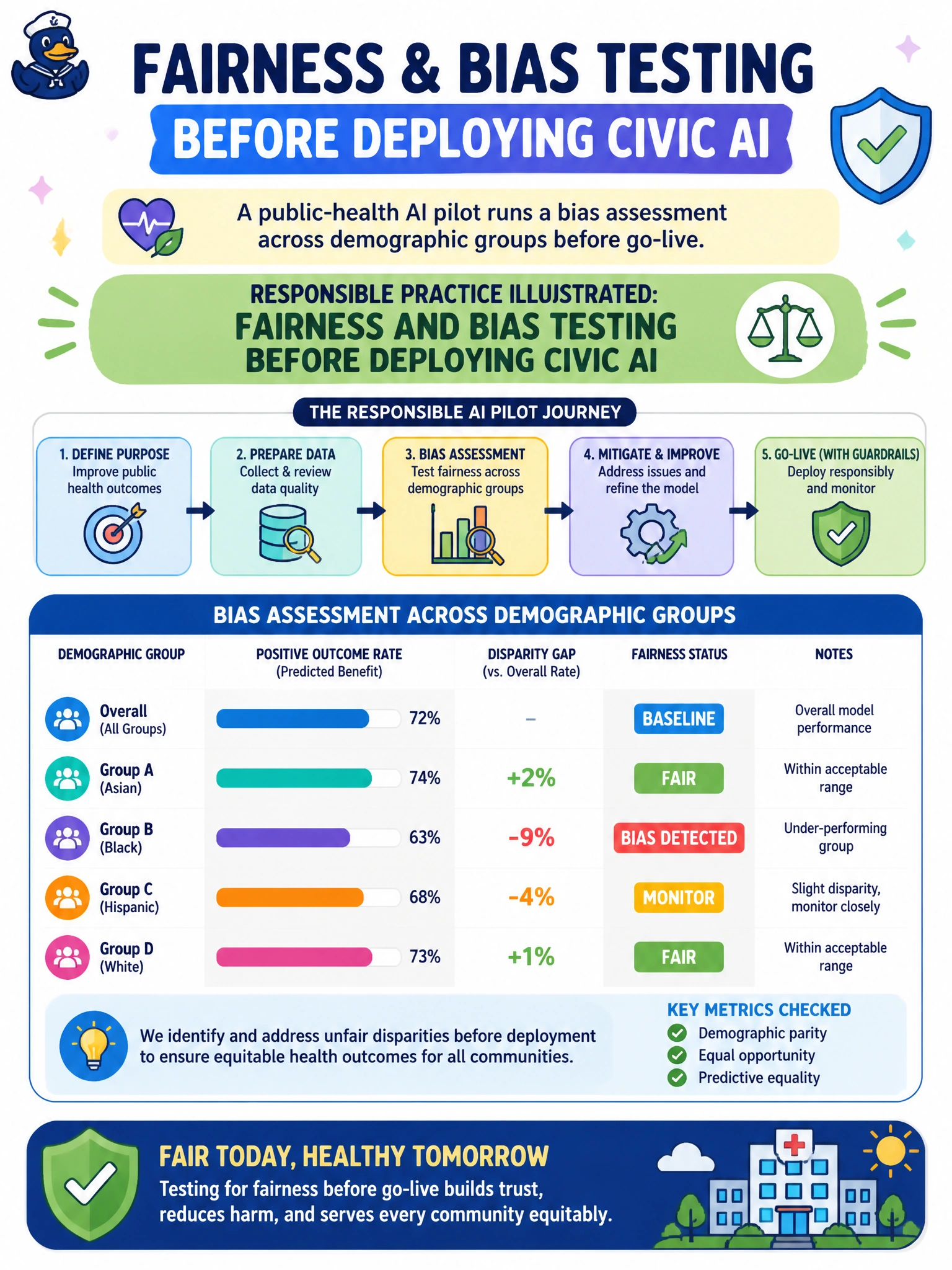
A public-health AI pilot runs a bias assessment across demographic groups before go-live. What responsible practice is illustrated?
Select an answer to reveal the explanation.
Short Explanation
Checking how the model treats different groups before go-live is fairness testing. If you only aim for demographic parity alignment, you'll miss full bias testing in smaller groups before launch. Civic AI needs bias assessment up front.
Full Explanation
A public-health AI pilot that runs a bias assessment across demographic groups before go-live illustrates fairness and bias testing before deploying civic AI. The correct answer is fairness and bias testing before deploying civic AI. Adversarial bias red teaming before deploying civic AI fails because probing with adversarial prompts to elicit biased failures cannot replace systematic measurement of subgroup harm—missed outreach to language minorities, under-detection in older adults, or unequal false-positive rates. Measuring performance by relevant demographic and service slices before launch lets the city remediate, constrain scope, or cancel rather than discovering disparate impact through resident complaints after the tool is embedded in workflows.
Fairness and bias mitigation before deploying civic AI fails: applying bias mitigations addresses fixing or reducing disparities, not the prospective fairness and bias testing across demographic groups required before civic AI go-live. Adversarial bias red teaming before deploying civic AI fails conceptually because eliciting biased outputs with adversarial probes does not include the systematic disaggregated subgroup fairness assessment that fairness testing is meant to surface before launch. Demographic parity alignment before deploying civic AI fails as a different effort; responsible practice is prospective bias testing across all demographic groups before go-live, not pursuing a single parity target that sidesteps the required fairness assessment for smaller groups.
Exam caveat: fairness and bias mitigation before deploying civic AI addresses applying fixes to reduce bias, not bias assessment across demographic groups before go-live. The tested idea is evaluating subgroup performance before deployment; appropriate thresholds depend on domain harm, sample size, and legal requirements, but relying on fairness and bias mitigation alone without first assessing disparities is not acceptable.
Operational check: adversarial bias red teaming before deploying civic AI only evaluates responses to adversarial bias probes and does not substitute for the prospective subgroup fairness assessment, go/no-go thresholds, and mitigations required before civic AI go-live.
Prefer to study offline? Printable PDF study book + test engine ($7.50, unofficial). These questions stay free here.