
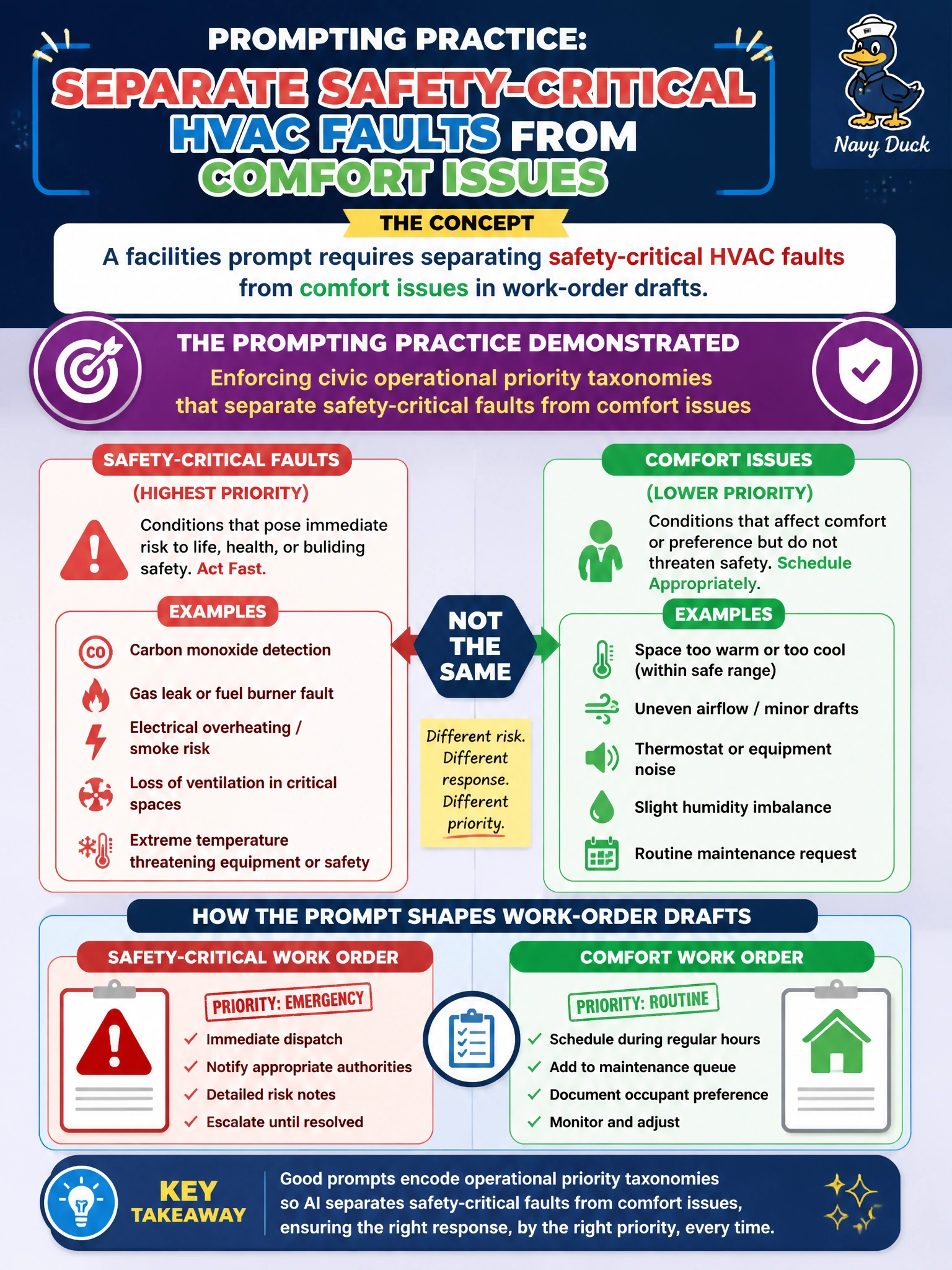
A facilities prompt requires separating safety-critical HVAC faults from comfort issues in work-order drafts. What prompting practice is demonstrated?
Select an answer to reveal the explanation.
Short Explanation
A failed boiler safety switch is not the same as a lukewarm office. Put that priority taxonomy in the prompt. Crews need safety first, comfort second.
Full Explanation
Facilities work-order quality depends on priority taxonomy in the prompt. Requiring separation of safety-critical HVAC faults from comfort issues demonstrates enforcing civic operational priority taxonomies so crews see life-safety and equipment-protection items ahead of lukewarm-office complaints. Safety-critical faults (for example, failed limit switches, carbon monoxide alarms, refrigerant leaks posing hazard) demand different response times and escalation paths than comfort tickets. Encoding that split in the draft prompt reduces mis-queueing and under-response.
Applying asset lifecycle priority scores that separate safety-critical faults from comfort issues fails because it frames the split as capital-planning and remaining-life scoring rather than enforcing a civic operational priority taxonomy with response times and escalation paths. Assigning energy retrofit priority tiers that separate safety-critical faults from comfort issues fails because retrofit tiers organize energy-efficiency upgrade sequencing, not work-order triage priority with escalation and SLAs. Generating occupant request priority groupings that separate safety-critical faults from comfort issues fails because it organizes faults as occupant-service queues instead of surfacing the operational priority taxonomy crews need for triage.
Exam caveat: priority labels in a draft are not a substitute for on-site triage. Sensors and technician judgment can upgrade or downgrade a ticket; the tested practice is prompting that surfaces the taxonomy, not claiming AI alone ranks field risk perfectly.
Operational check: define safety-critical versus comfort codes in the facilities prompt; require every work-order draft to carry a priority class and brief hazard rationale; audit weekly that safety-class tickets meet response SLAs before comfort backlog.
Prefer to study offline? Printable PDF study book + test engine ($7.50, unofficial). These questions stay free here.