
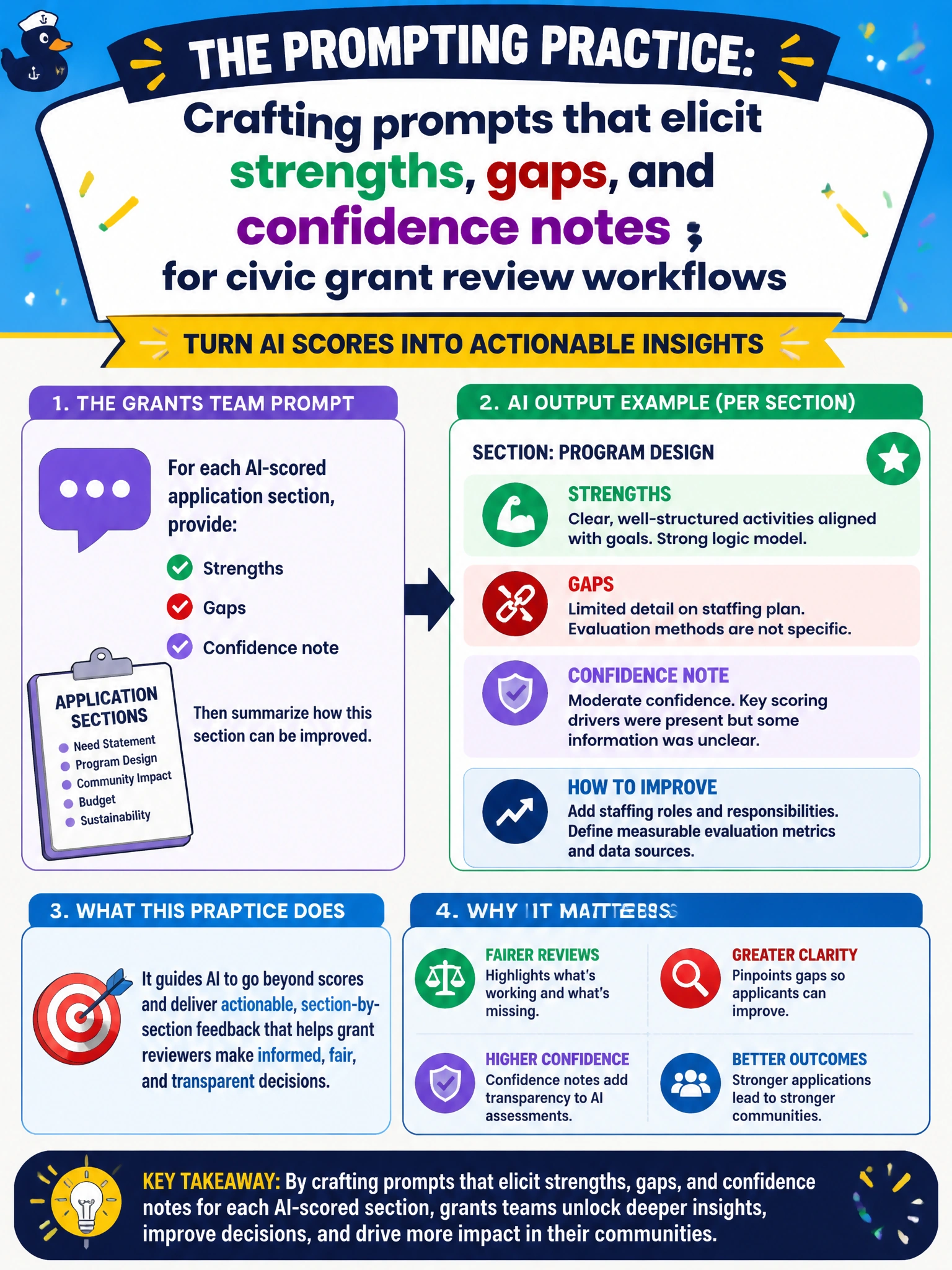
A grants team prompt asks for strengths, gaps, and a confidence note for each AI-scored application section. What prompting practice is shown?
Select an answer to reveal the explanation.
Short Explanation
Grants review is not a magic score. Ask the model for strengths, gaps, and how sure it is on each section. Confidence notes keep humans in the loop when the AI is guessing.
Full Explanation
In civic grant review, AI scoring is decision support, not adjudication. The correct practice is crafting prompts that elicit strengths, gaps, and a confidence note for each scored application section so staff can see where the model is sure and where it is guessing. Strengths and gaps give reviewers a structured critique they can verify against the packet; confidence notes surface uncertainty instead of hiding it behind a single opaque number. That design keeps humans accountable for award recommendations while still using the model to triage volume.
Chaining prompts to refine strengths, gaps, and confidence notes for civic grant review workflows fails because the scenario describes a single prompt eliciting that reviewable content for each section, not a multi-step sequence where one prompt's output is refined by the next; chaining describes iterative refinement, not the act of asking for strengths, gaps, and confidence in each section.
Tuning model weights to improve strengths, gaps, and confidence notes for civic grant review workflows fails because tuning changes underlying model parameters through training, not through instruction; the scenario is a prompting practice that asks for strengths, gaps, and confidence for each scored section, not a fine-tuning run to improve generation.
Enforcing JSON schemas to constrain strengths, gaps, and confidence notes for civic grant review workflows fails because schemas constrain output structure and validity after generation and do not themselves elicit the substantive critique; a schema-validated output can still be missing the requested strengths, gaps, and confidence.
Exam caveat: requesting confidence notes does not make the model calibrated. Low confidence can be wrong and high confidence can be wrong; the tested concept is eliciting reviewable structure, not trusting self-reported certainty as truth.
Operational check: require section-level strengths, gaps, and confidence in every grants-scoring prompt; block publication of scores without those fields; have a named reviewer override or confirm any low-confidence section before the recommendation enters the award packet.
Prefer to study offline? Printable PDF study book + test engine ($7.50, unofficial). These questions stay free here.