
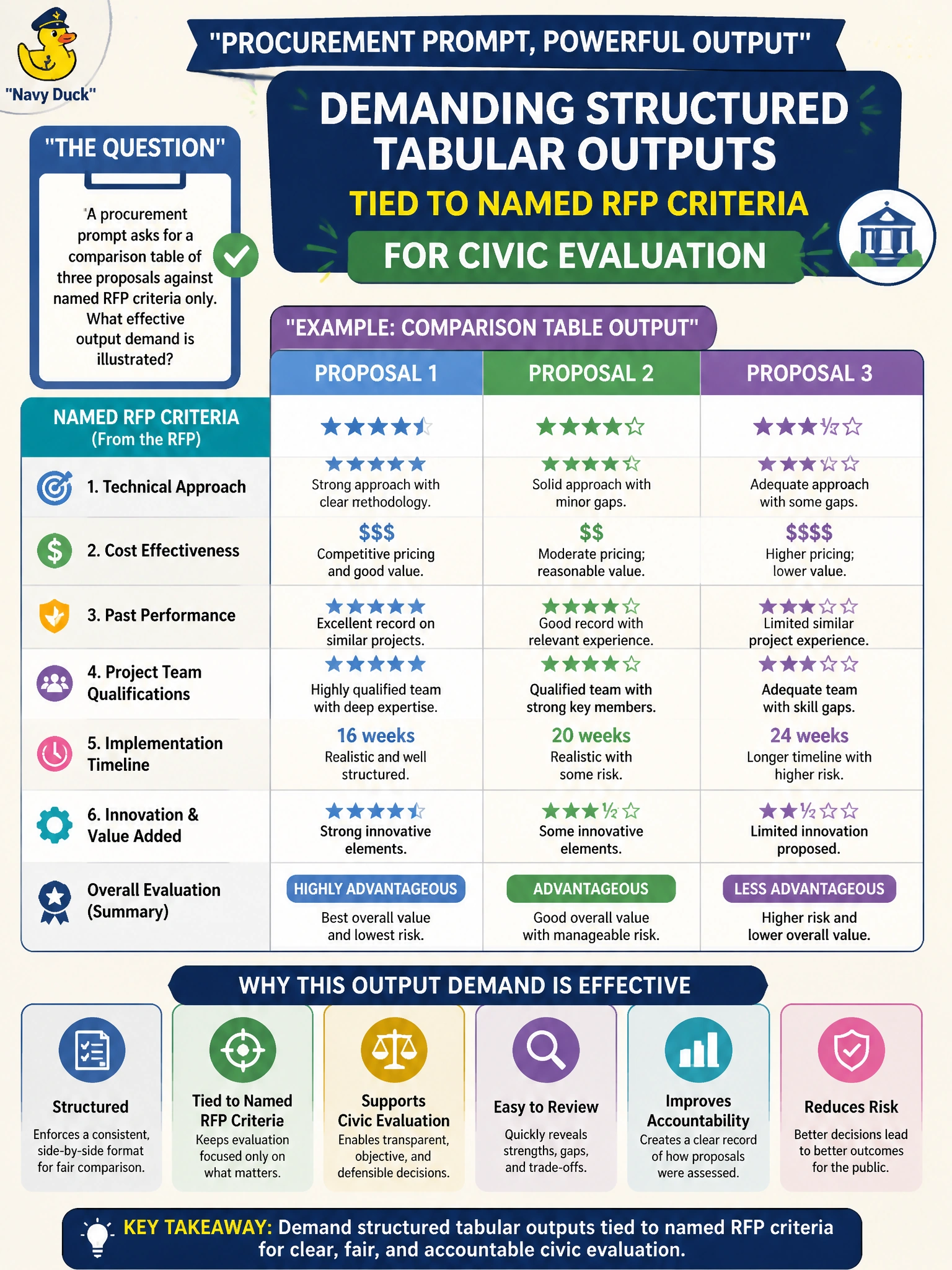
A procurement prompt asks for a comparison table of three proposals against named RFP criteria only. What effective output demand is illustrated?
Select an answer to reveal the explanation.
Short Explanation
Want an apples-to-apples vendor look? Ask for a table against the named RFP criteria—nothing else. You'll break your table rule if you switch to relational schemas or vector embeddings, and you'll lose the side-by-side check if you settle for entity extractions.
Full Explanation
A procurement prompt asking for a comparison table of three proposals against named RFP criteria only illustrates demanding structured tabular outputs tied to evaluation factors. Civic procurement evaluation needs apples-to-apples comparison on scored criteria (price, experience, technical approach, etc.), not structured relational schemas tied to named RFP criteria or structured vector embeddings tied to named RFP criteria that substitute database schema or numeric vector formats for the tabular comparison the prompt demands. Specifying table structure and criteria names in the prompt aligns generative assistance with fair, auditable evaluation practice under municipal purchasing rules. Demanding structured relational schemas tied to named RFP criteria for civic evaluation fails the same evaluation discipline; using relational schemas substitutes a database schema format for the structured tabular comparison the table format is meant to force. Demanding structured vector embeddings tied to named RFP criteria for civic evaluation fails the output discipline by substituting numeric vector embeddings for the comparison table structure the prompt requires. Demanding structured entity extractions tied to named RFP criteria for civic evaluation fails the output discipline by substituting extracted entity lists for the criteria-based comparison table the prompt requires. Exam caveat: generative comparison tables assist analyst preparation; they do not replace the official evaluation committee scoring, conflict-of-interest certifications, or sealed-process rules. Operational check: paste only the named criteria and relevant proposal excerpts under confidentiality controls, instruct "table rows = criteria; no extra factors; flag missing evidence," prohibit adding unstated criteria, and have procurement counsel review before any committee use.
Prefer to study offline? Printable PDF study book + test engine ($7.50, unofficial). These questions stay free here.