
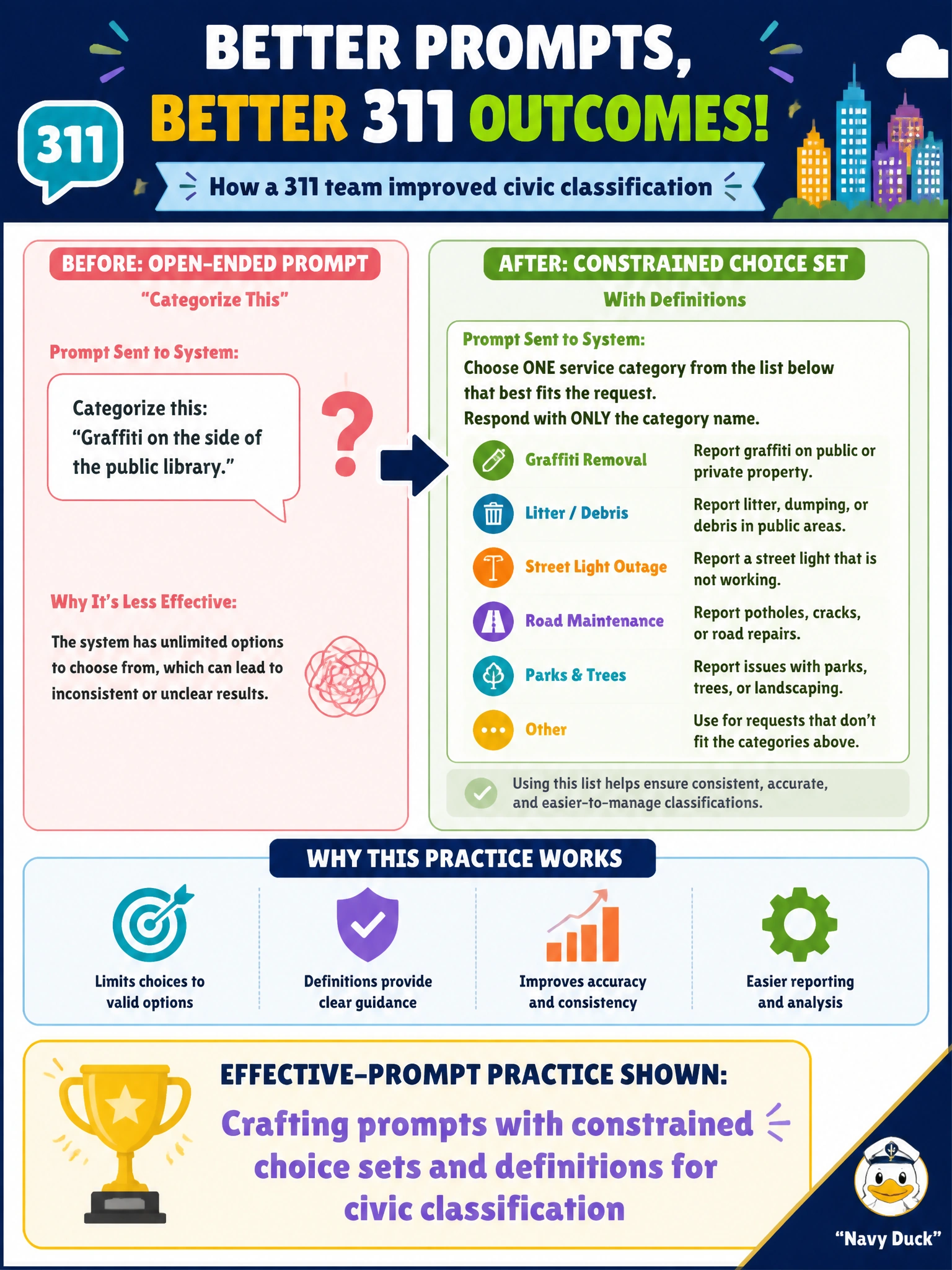
A 311 team revises a prompt from open-ended "categorize this" to a closed list of valid service categories with definitions. What effective-prompt practice is shown?
Select an answer to reveal the explanation.
Short Explanation
Give the model the official menu—named categories plus short definitions—and categorization gets cleaner. Chaining steps to break up the request won't help, pulling in guidelines with vector search won't lock the list, and showing old labeled examples won't enforce it either — you'll still get chaos without one crafted prompt with a closed list and clear definitions. 311 runs on constrained choice sets.
Full Explanation
A 311 team revising from open-ended "categorize this" to a closed list of valid service categories with definitions demonstrates constrained choice-set prompting for civic classification. Ticket labels must map to real departments, SLAs, and reporting dashboards. Providing named categories plus short definitions reduces novel label invention, improves routing consistency, and makes generative assistance fit the city's system of record rather than inventing a parallel taxonomy. Applying prompt chaining to decompose complex open-ended requests for civic classification misses the mark: it describes linking multiple prompts in sequence to break down a complex task rather than constraining a single prompt to a closed list with definitions, so it does not explain the shift from open-ended categorization to defined categories. Integrating vector search to retrieve relevant contextual guidelines for civic classification misdirects the effort: it focuses on fetching relevant guidelines from a store rather than crafting the prompt content with a closed category list and definitions, so similar requests can still invent novel labels and take the wrong department path. Using few-shot prompting with labeled historical examples for accurate civic classification adds the wrong technique: it describes showing example tickets and labels to guide the model rather than crafting the categorization prompt with a closed list and definitions itself, so it would not prevent novel label invention or improve routing consistency. Exam caveat: constrained sets need periodic governance updates when council creates new services; a frozen wrong taxonomy is also harmful, so version the category list with the 311 product owner. Operational check: embed the official category list and definitions in the prompt or classifier config, instruct "choose only from this list; if none fit, return Needs Human Review," sample-audit weekly accuracy against human labels, and sync categories with the live 311 CRM.
Prefer to study offline? Printable PDF study book + test engine ($7.50, unofficial). These questions stay free here.