
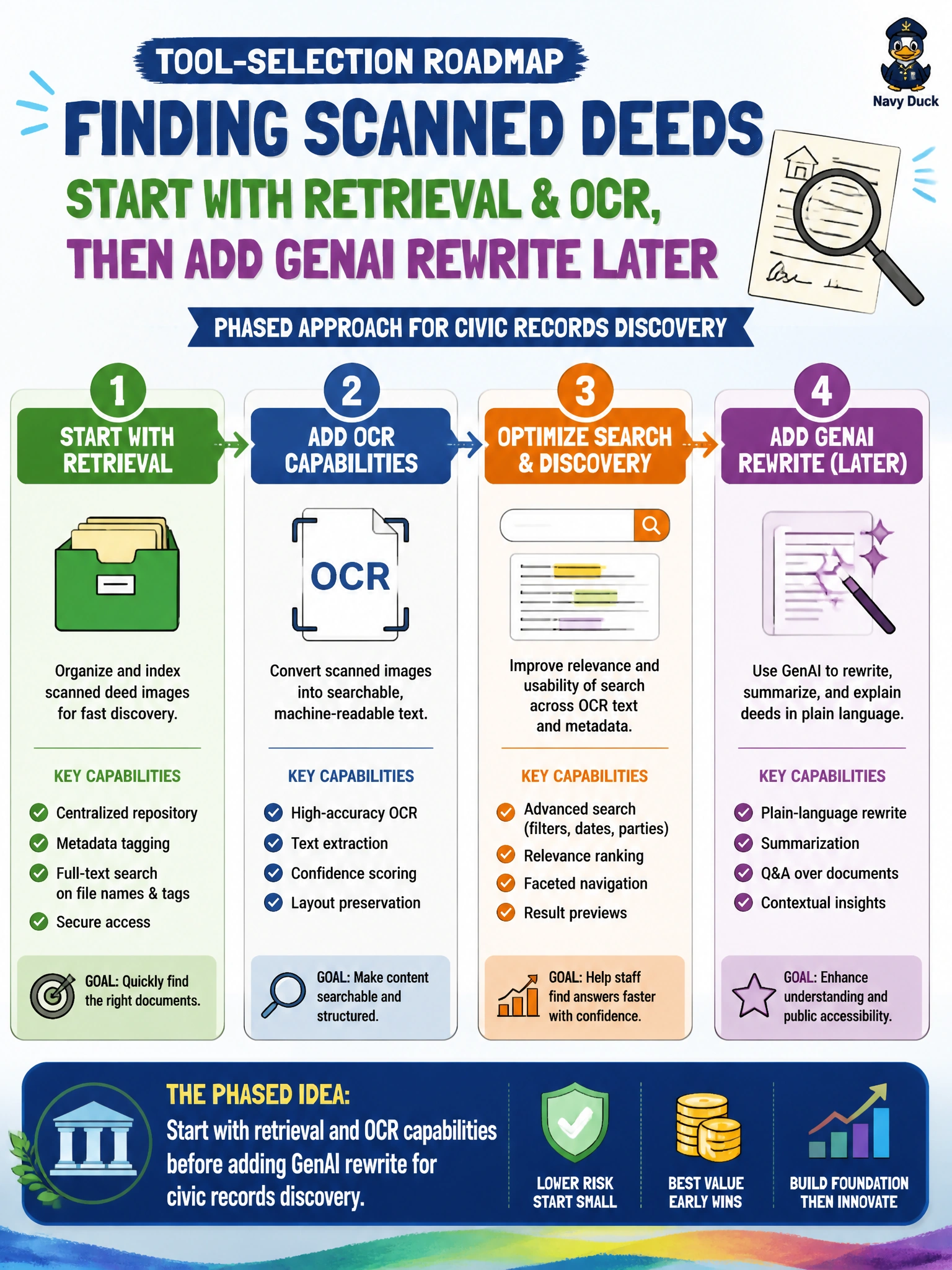
A records office picks OCR plus search first and treats generative rewrite as optional later for finding scanned deeds. What phased tool-selection idea fits?
Select an answer to reveal the explanation.
Short Explanation
Find the deed before you rewrite the deed. OCR and search get you a trustworthy base; generative fluff comes later if at all. You'll slip up if you let generated summaries become the index you're searching, waste effort fine-tuning on OCR text you haven't proven, or use rewrite to execute deeds when you've only set it up to find them.
Full Explanation
A records office that adopts OCR plus search first, treating generative rewrite as optional later, is practicing phased tool selection for civic records discovery. Scanned deeds must become trustworthy, searchable text before any generative layer can safely summarize or rephrase them. OCR and retrieval establish a verifiable base: staff can find book/page, parties, and instruments without inventing content. Generative rewrite may later improve readability, but it is secondary and optional because discovery and fidelity come first in archival workflows.
Starting with retrieval and OCR capabilities before generating GenAI summaries as search index for discovery gets the sequence right but misassigns the search layer, so staff would search unverified summaries instead of cleaned OCR text and lose reliable traceability to the underlying instrument. Starting with retrieval and OCR capabilities before fine-tuning GenAI rewrite on OCR text for discovery overbuilds an optional aid into a heavy customization, because fine-tuning trains the model on imperfect OCR output before retrieval integrity is proven and adds cost and maintenance that finding deeds does not require. Starting with retrieval and OCR capabilities before adding GenAI rewrite for automated deed execution confuses finding with acting, because discovery leaves the instrument unchanged while execution creates legal effects that require authorization, witnessing, and recording controls search plus optional rewrite cannot provide.
Exam caveat: phasing does not forbid GenAI forever—it sequences capability so retrieval integrity precedes optional generation. Some offices may never need rewrite if search alone meets the use case. Operational check: measure OCR accuracy on a deed sample, stand up indexed search with human verification paths, and only then pilot rewrite prompts that require quoting source snippets; never allow generative output to replace the retained scan or certified copy.
Prefer to study offline? Printable PDF study book + test engine ($7.50, unofficial). These questions stay free here.