
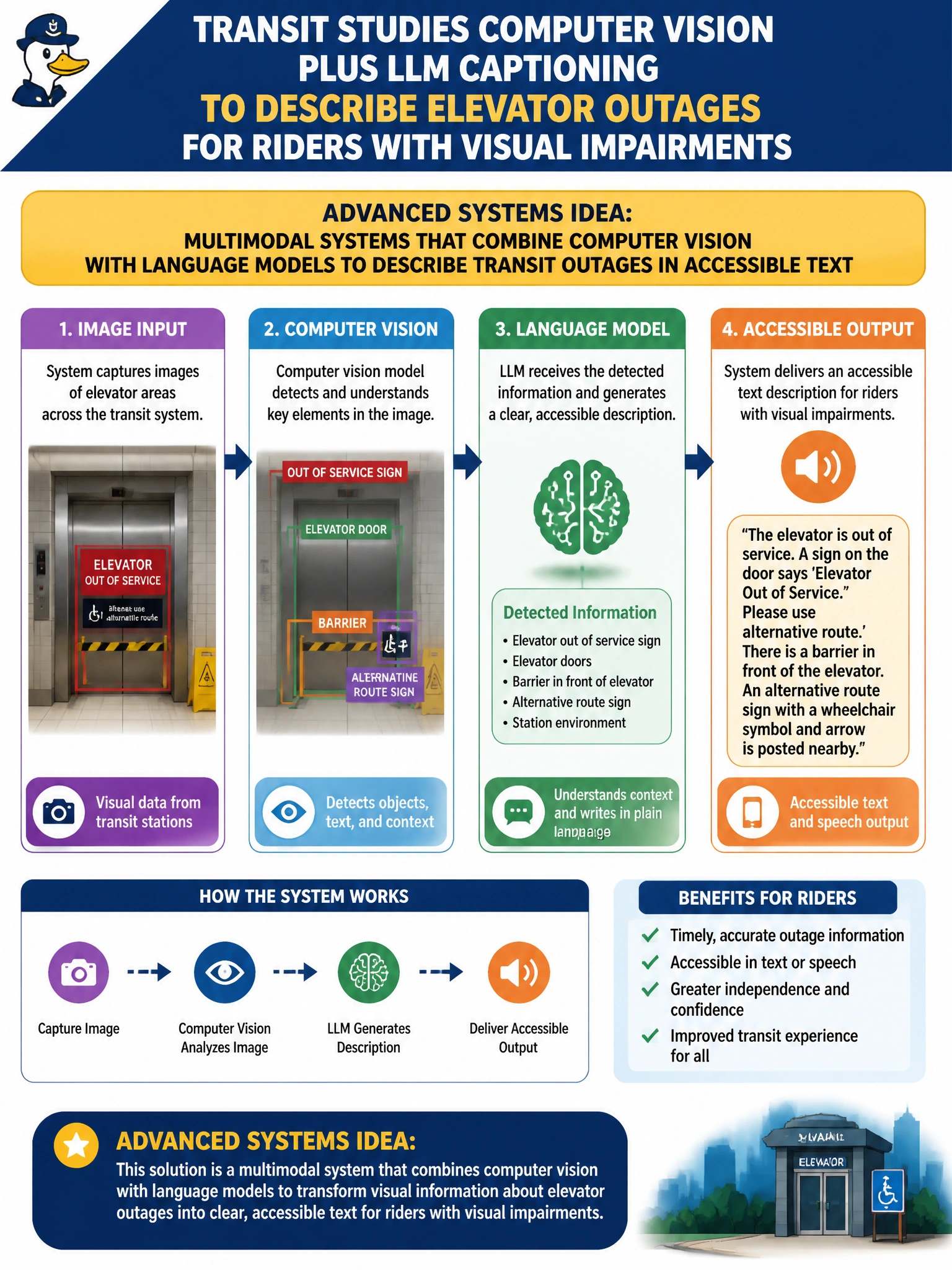
Transit studies computer vision plus LLM captioning to describe elevator outages for riders with visual impairments. What advanced systems idea is shown?
Select an answer to reveal the explanation.
Short Explanation
Cameras spot the outage; language models turn it into words riders can hear—that is multimodal help for accessibility. If you're just querying a visual database for summaries, just having an agent decide when to trigger vision tools, or just mapping images to fixed categories, that's not the fresh description from what cameras see that you'll need. Transit is pairing senses on purpose.
Full Explanation
Multimodal advanced AI systems combine different input or output modalities—here, computer vision that detects elevator outage conditions with language models that produce accessible captions or descriptions for riders with visual impairments. Transit agencies study that pairing so status information can move from cameras or sensors into language riders can hear via screen readers or audio channels. The literacy idea is modality fusion for accessibility, not querying visual databases to summarize outages, triggering vision tools through agentic workflows, or mapping image embeddings to fixed categories without generating descriptions from what cameras observe. Retrieval-augmented systems that query visual databases using language models to summarize transit outages in accessible text query stored visual records to ground summaries rather than fuse live computer vision observation with language generation to describe the current scene, so they do not show vision-to-language description for riders. Agentic workflows that trigger computer vision tools through language models to describe transit outages in accessible text emphasize autonomous orchestration where a language model decides when to call vision tools rather than the direct combination of vision and language modalities to generate accessible descriptions, so they do not show modality fusion for accessibility. Zero-shot visual classifiers that map image embeddings to text categories to describe transit outages in accessible text assign images to predefined text labels without generating new descriptive captions from visual observation, so they do not show generative vision-to-language description for riders. Exam caveat: multimodal pipelines can mis-describe scenes or lag behind real status; accessibility requires timely truth, not merely generated prose. Operational check: validate captions against ground-truth elevator telemetry, provide non-AI fallback status channels, involve disability advocates in testing, and timestamp descriptions so riders know freshness.
Prefer to study offline? Printable PDF study book + test engine ($7.50, unofficial). These questions stay free here.