
A city attorney distinguishes GenAI creating new text from classical classifiers labeling existing tickets. What conceptual contrast is correct?
Select an answer to reveal the explanation.
Short Explanation
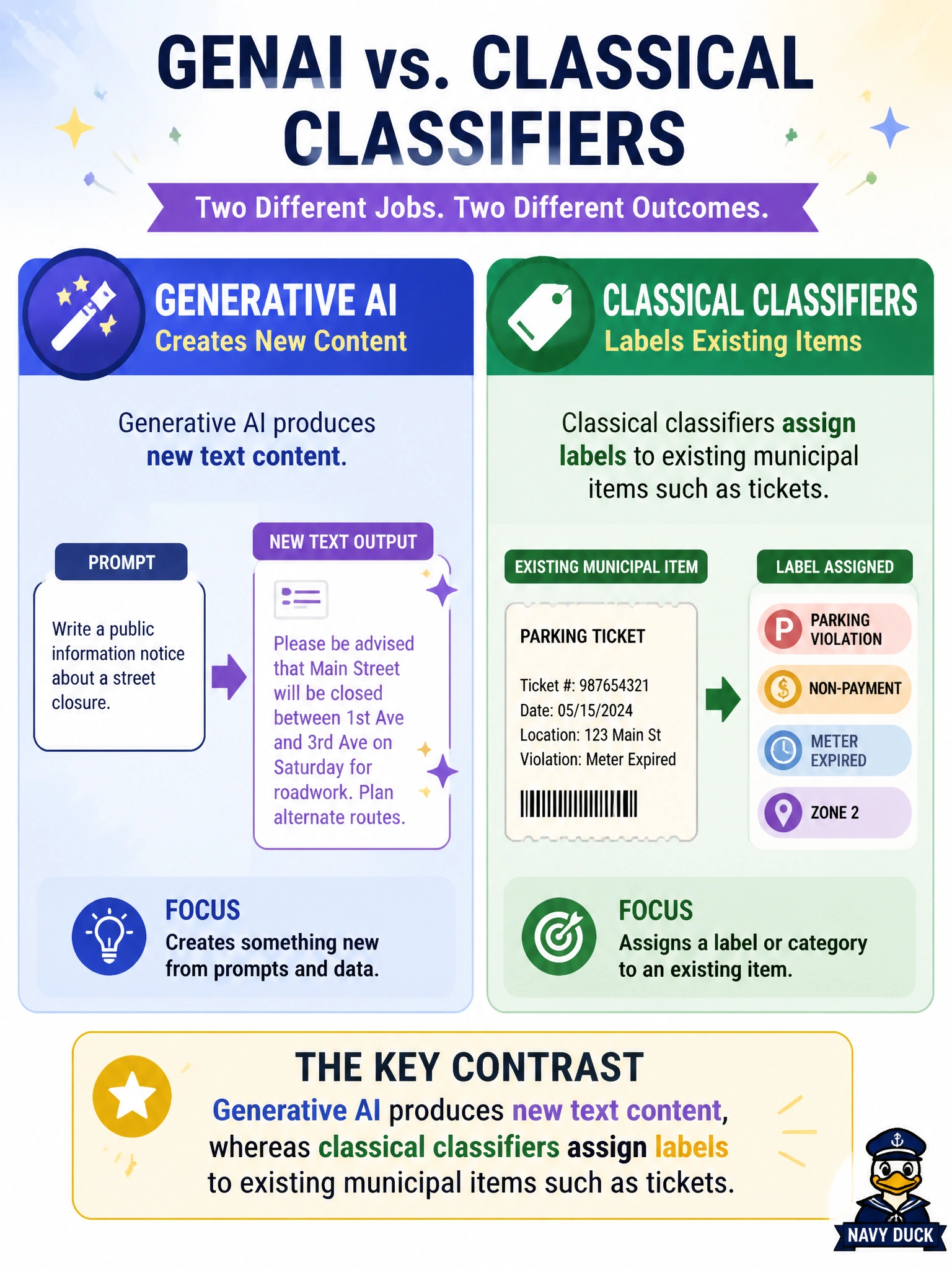
GenAI writes new words; classifiers stamp labels on tickets that already exist. The attorney is splitting create-versus-classify so nobody confuses a drafting bot with a triage model. They are not the same toolbox.
Full Explanation
The conceptual contrast a city attorney needs is that generative AI creates new text (or other content), while classical classifiers assign labels or scores to existing municipal items such as tickets, cases, or images. GenAI might draft a notice, paraphrase a policy, or propose ordinance language for human editing. A classical classifier might predict a ticket category, priority, or fraud flag without authoring prose. Mixing those roles leads to wrong controls, wrong testing methods, and wrong expectations about creativity versus discrimination performance.
Saying generative AI produces new text content, whereas classical classifiers assign labels to existing tickets from topics emerging in data misstates classification — discovering emergent topics is unsupervised clustering, not assigning predefined labels to existing tickets. Claiming generative AI produces new text content, whereas classical classifiers assign labels to existing tickets by ranking similarity to ordinances confuses classification with retrieval — ranking by similarity to find ordinances is search, not assigning a label or score to a ticket. Asserting that generative AI produces new text content, whereas classical classifiers assign labels to existing tickets by recalling ordinance passages misdescribes classifiers — they learn patterns to assign labels, not recall memorized passages verbatim.
Exam caveat: some products wrap both classifiers and generators; literacy means identifying which component is doing which job. Operational check: for each municipal AI use case, label it as classify/detect versus generate/draft, then attach the matching evaluation (precision/recall vs. factuality/style review) and human-approval rules.
Prefer to study offline? Printable PDF study book + test engine ($7.50, unofficial). These questions stay free here.