
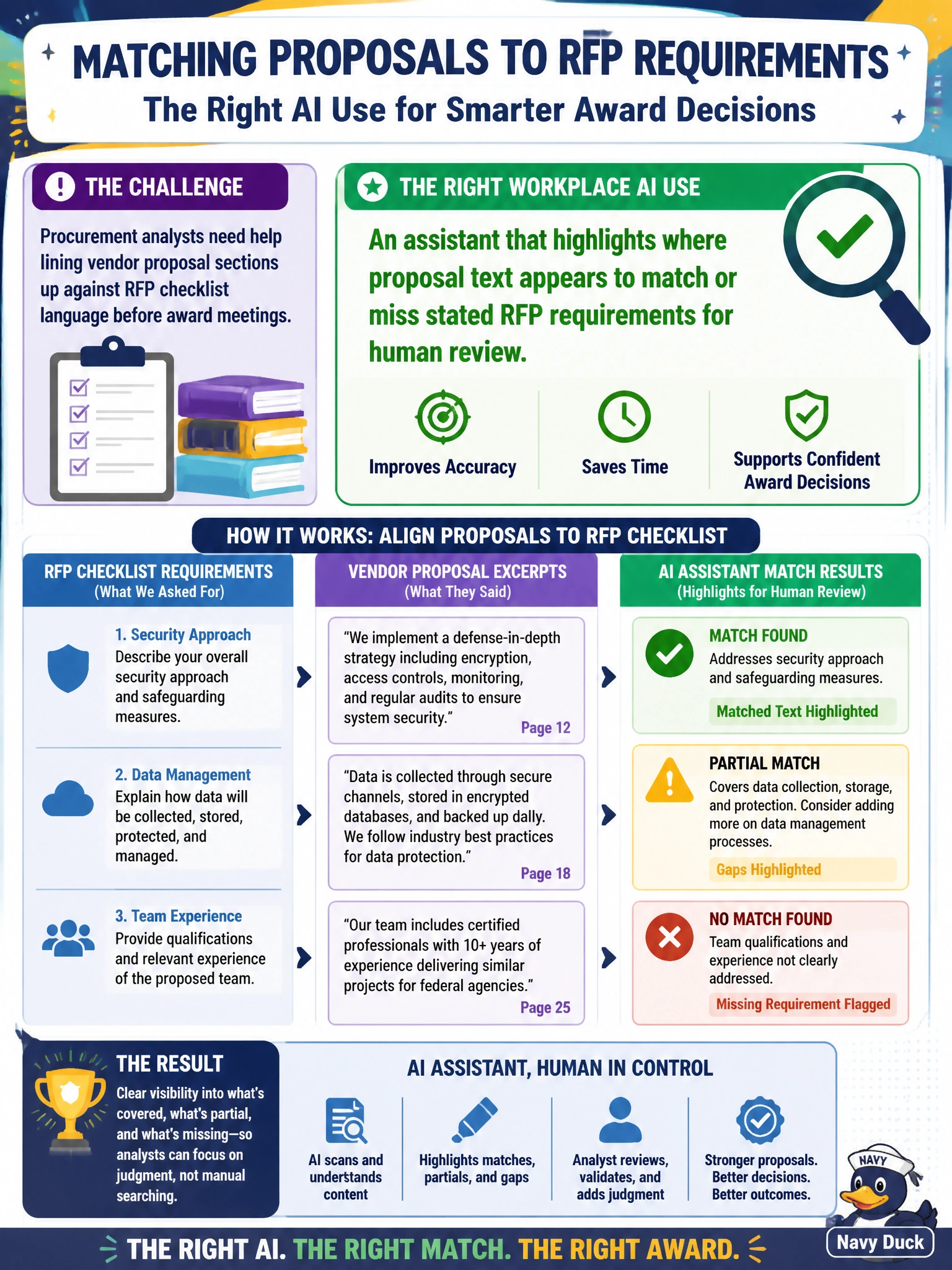
Procurement analysts need help lining vendor proposal sections up against RFP checklist language before award meetings. What workplace AI use matches that task?
Select an answer to reveal the explanation.
Short Explanation
Picture the RFP checklist as a grocery list and each proposal as a cart—AI can flag what looks present or missing so you still decide. It's the direct proposal-to-checklist match you'll need, not how you'll match a prior RFP, whether you've copied the checklist word-for-word, or whether only your pricing section matches. Humans keep the award pen.
Full Explanation
Procurement analysts comparing vendor proposals to RFP checklist language need an assistant that highlights where proposal text appears to match or miss stated requirements for human review. That workplace pattern uses structured extraction and semantic comparison so buyers can see coverage gaps before award meetings without reading every page in isolation. The AI accelerates evidence gathering; it does not decide responsiveness, scoring, or award under municipal procurement codes and protest risk rules. An assistant that highlights where proposal text appears to match prior RFP requirements for human review compares proposals to historical solicitations rather than to the current RFP checklist, so it measures similarity to old requirements instead of coverage of stated requirements analysts must verify. An assistant that highlights where proposal text appears to repeat stated RFP requirements verbatim for human review looks only for exact word-for-word copying and never assesses substantive match or miss, so it cannot surface the coverage gaps analysts need. An assistant that highlights where proposal pricing text appears to match stated RFP requirements for human review checks only the pricing portion against requirements rather than lining up all proposal sections against the checklist, so it misses the full language-matching task described. Exam caveat: Everyday AI for government buying is framed as decision support with retained officer judgment. Prior-RFP matching, verbatim-repeat checking, and pricing-only matching are distractors that confuse related comparisons with direct proposal-to-RFP requirement matching. Operational check: Keep source citations back to proposal page and RFP clause, require analysts to confirm each flagged gap, preserve evaluation notes for audit, and never let model confidence substitute for formal scoring sheets.
Prefer to study offline? Printable PDF study book + test engine ($7.50, unofficial). These questions stay free here.