
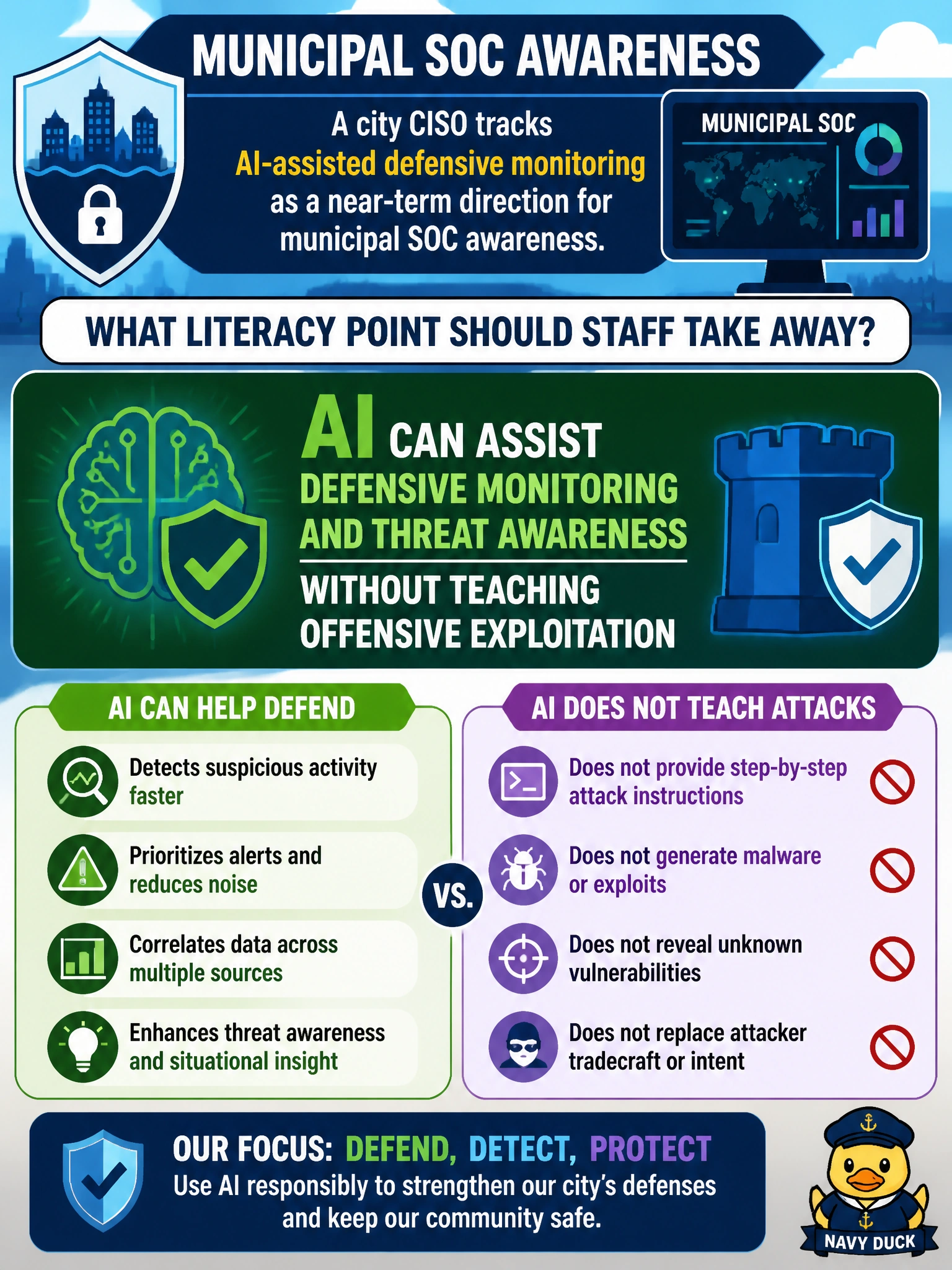
A city CISO tracks AI-assisted defensive monitoring as a near-term direction for municipal SOC awareness. What literacy point should staff take away?
Select an answer to reveal the explanation.
Short Explanation
You'll spot more as a defender when you've got AI learning your baseline traffic to flag anomalies, parsing messy unstructured intel, and scoring alerts so you'll know what to handle first. That's defensive awareness for you, and it's why you'll need baselines, unstructured processing, and probabilistic scores to make it work. Keep your focus on protection that senses and prioritizes.
Full Explanation
A city CISO tracking AI-assisted defensive monitoring as a near-term direction for municipal SOC awareness wants staff to take away that AI can help detect anomalous traffic, prioritize alerts, and improve threat awareness without turning the cybersecurity program into an offensive exploit workshop. Defensive pattern detection and triage assistance are the literacy focus: better sensing and correlation for defenders, not teaching staff how to invent attacks against external targets. Assisting defensive monitoring and anomaly detection without analyzing baseline network traffic is wrong because anomaly detection depends on analyzing baseline network traffic to identify deviations, which is central to the awareness-scope literacy point about detecting anomalous traffic, prioritizing alerts, and improving threat awareness. Assisting defensive monitoring and intelligence parsing without processing unstructured formats is wrong because intelligence parsing depends on processing unstructured formats such as threat reports and logs; the focus should remain on anomaly detection, alert prioritization, and threat awareness with intel support rather than claiming intel value without unstructured processing. Assisting defensive monitoring and alert prioritization without generating probabilistic scores is wrong because alert prioritization relies on generating probabilistic scores to rank alerts by risk, which is core to the defensive-monitoring takeaway of spotting anomalies, ranking alerts, and improving situational awareness. Exam caveat: municipal AI-security literacy items emphasize defensive monitoring assistance—not assisting defensive monitoring and anomaly detection without analyzing baseline network traffic, assisting defensive monitoring and intelligence parsing without processing unstructured formats, or assisting defensive monitoring and alert prioritization without generating probabilistic scores. Operational check: introduce AI assist on detection and triage with mandatory analyst override; tune models against civic network baselines and known maintenance windows; avoid tooling that encourages unauthorized offensive testing from city assets; and measure mean-time-to-detect alongside false-positive rates before expanding automation so defensive gains are evidenced rather than assumed.
Prefer to study offline? Printable PDF study book + test engine ($7.50, unofficial). These questions stay free here.