
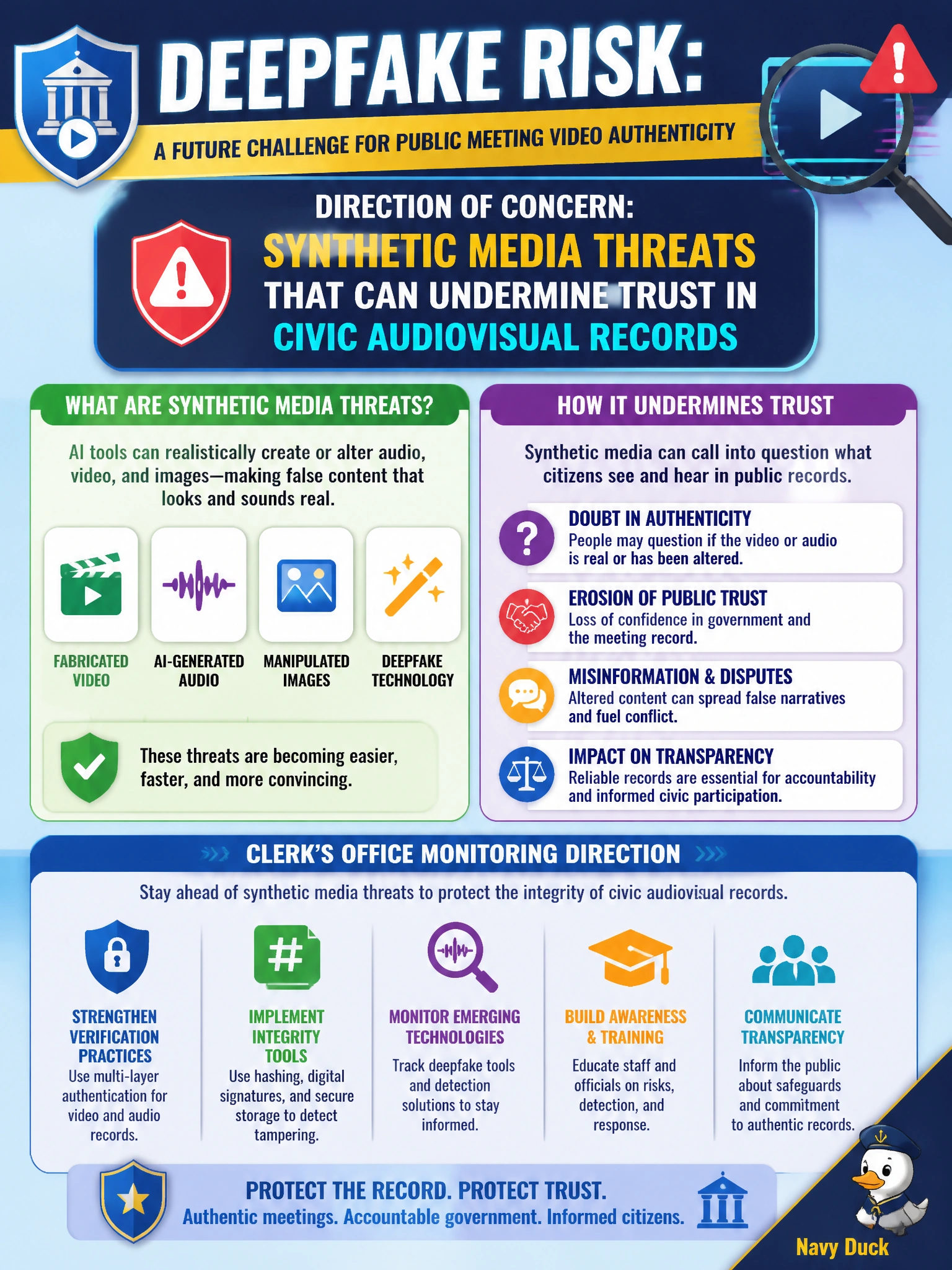
A clerk’s office monitors deepfake risk as a future challenge for verifying public meeting video authenticity. What direction of concern is this?
Select an answer to reveal the explanation.
Short Explanation
If anyone can fake a council clip that looks real, you’ve got a trust problem on your hands. Deepfakes are that future headache for clerks guarding meeting video. Watch the risk; don’t shrug it off.
Full Explanation
A clerk’s office monitoring deepfake risk as a future challenge for verifying public meeting video authenticity is correctly framing synthetic media as a threat direction that can undermine trust in civic audiovisual records. Council and board recordings are treated by residents, journalists, and sometimes courts as evidence of what officials said; generative video and audio that convincingly fabricate those moments erode the integrity of the official record unless authenticity controls keep pace. Literacy here means recognizing verification and chain-of-custody as emerging operational requirements—not treating every viral clip as automatically authoritative. Adversarial perturbations that can disrupt transcription in civic audiovisual records do not address the core issue—subtle noise crafted to fool speech-to-text says nothing about whether a recording is authentic or has been synthetically manipulated, which is exactly the risk the clerk’s office is monitoring. Steganographic embeddings that can conceal hidden payloads in civic audiovisual records are a separate concealment concern—they hide extra data inside a file but do nothing to verify that the underlying video or audio hasn’t been deepfaked, so they don’t answer the authenticity risk. Generative hallucinations that can fabricate metadata tags in civic audiovisual records only describe errors in descriptive labels around a file; they do not determine whether the audiovisual content itself is a deepfake, so they don’t address the threat to trust in civic records. Exam caveat: deepfake literacy questions for municipal clerks focus on threats to trust in official AV records and the need for authenticity practices—not celebrating fake media or abandoning verification. Operational check: retain signed or hashed archival masters of public meetings on controlled storage; publish clearly branded official channels; train communications staff to challenge manipulated clips circulating on social platforms; and establish a verification workflow before any viral ‘meeting excerpt’ drives legal, disciplinary, or operational responses.
Prefer to study offline? Printable PDF study book + test engine ($7.50, unofficial). These questions stay free here.