
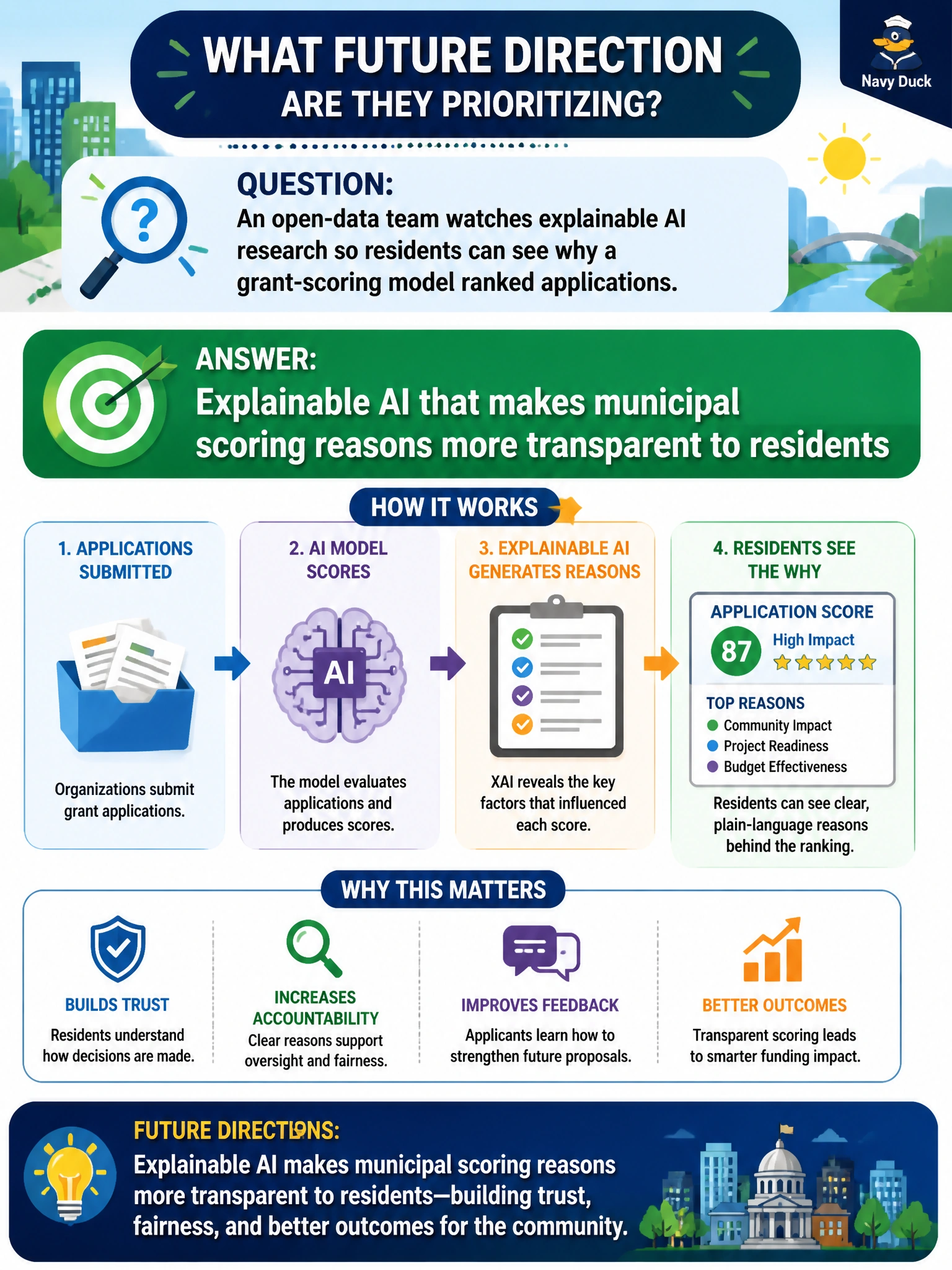
An open-data team watches explainable AI research so residents can see why a grant-scoring model ranked applications. What future direction are they prioritizing?
Select an answer to reveal the explanation.
Short Explanation
If a grant scoreboard shrugs “because the model said so,” residents tune out fast. That’s why you push explainable AI—showing the why in plain sight. Open data is betting transparency keeps civic scoring trustworthy.
Full Explanation
An open-data team that watches explainable AI research so residents can see why a grant-scoring model ranked applications is prioritizing transparency as a concrete future direction for municipal scoring systems. Explainability methods—reason codes, feature attributions, policy-mapped rationales, or plain-language decision summaries—help applicants, auditors, and oversight bodies understand why one proposal outranked another instead of confronting an opaque scoreboard. That priority aligns civic AI literacy with democratic accountability: scoring automation may accelerate review, but residents still deserve intelligible grounds for ranking outcomes that affect funding access. Explainable AI that makes municipal scoring source code more transparent to residents publishes the program code behind scoring, but exposing code alone does not explain why a particular application was ranked as it was, so it does not make scoring reasons transparent to residents. Explainable AI that makes municipal scoring training data more transparent to residents describes the historical examples used to train scoring, but describing training examples in the abstract does not reveal why one proposal outranked another, so it does not make scoring reasons transparent to residents. Explainable AI that makes municipal scoring error rates more transparent to residents reports aggregate accuracy or error statistics, but showing overall performance numbers alone does not produce plain-language ranking reasons or applicant-level rationales, so it does not make scoring reasons transparent to residents. Exam caveat: explainable-AI items in government contexts reward making municipal scoring reasons more transparent to residents—not explainable AI that makes municipal scoring source code more transparent to residents, explainable AI that makes municipal scoring training data more transparent to residents, or explainable AI that makes municipal scoring error rates more transparent to residents, none of which explains why one application outranked another. Operational check: publish plain-language scoring factors before rounds open; provide applicant-level reason summaries where law allows; audit that explanations match the live model rather than a simplified storyboard; and pair explanations with appeal or clarification paths so transparency is actionable for grant seekers rather than merely informational.
Prefer to study offline? Printable PDF study book + test engine ($7.50, unofficial). These questions stay free here.