
A transit authority evaluates smaller on-device models for offline station kiosks versus cloud LLMs. What future direction is under review?
Select an answer to reveal the explanation.
Short Explanation
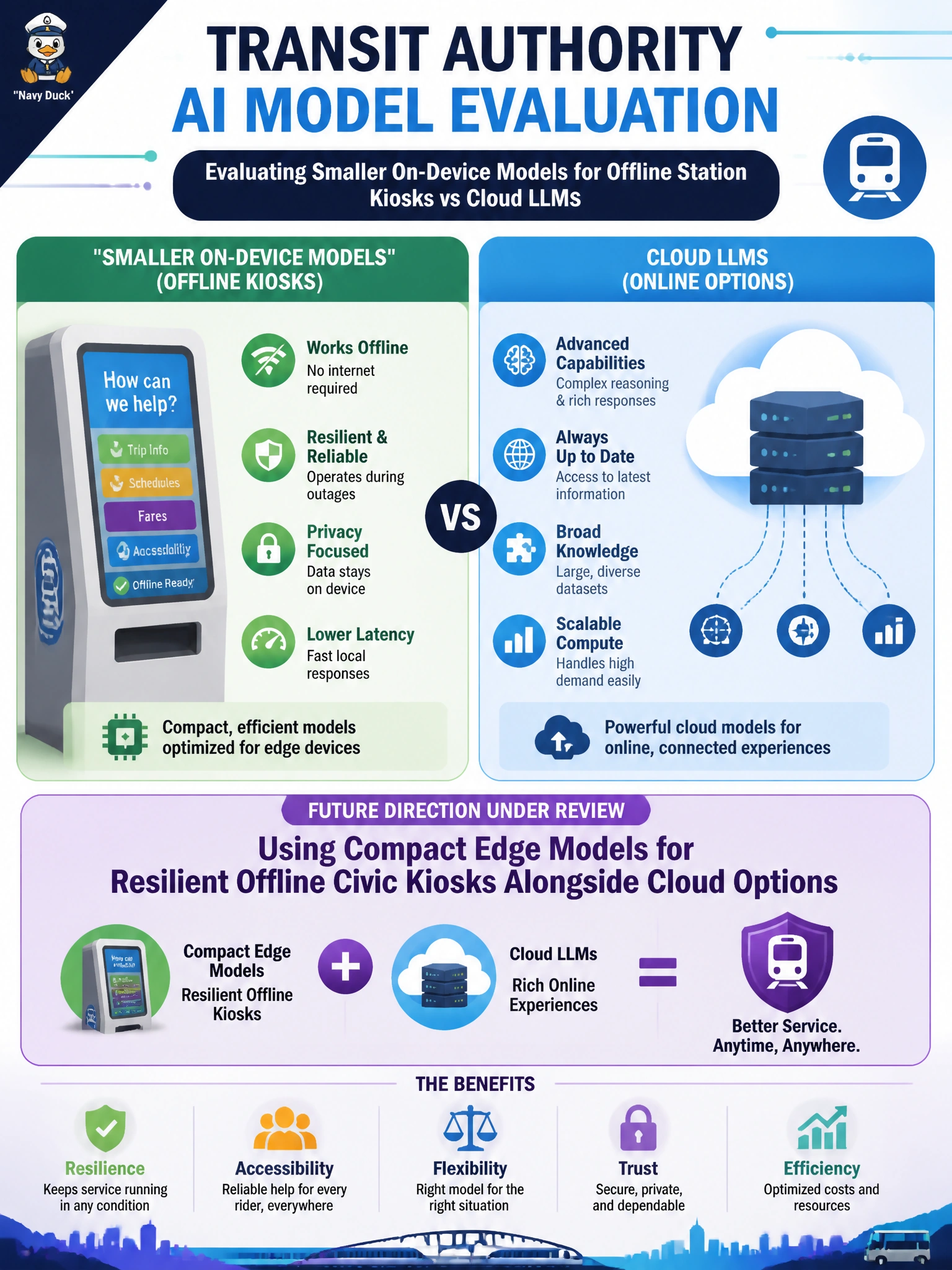
When the station Wi-Fi drops, you still want a tiny on-device model that can answer “next train?” without calling the cloud. That’s the edge-versus-cloud tradeoff transit is sizing up — you’ll use kiosks for simple offline answers while complex reasoning stays with the cloud option alongside.
Full Explanation
Evaluating smaller on-device models for offline station kiosks versus cloud LLMs reviews a resilient future architecture for transit: compact edge models can answer rider questions when connectivity drops, while cloud models remain available when bandwidth and policy allow richer responses. That dual-path direction improves civic continuity at stations rather than assuming perfect networks. Assigning compact edge models for complex reasoning tasks alongside cloud options misplaces heavy workloads on constrained devices, since compact edge models are meant for simple resilient FAQs offline while complex reasoning remains a cloud job when connectivity allows. Running compact edge models with full-precision weights alongside cloud options ignores edge constraints, since resilient offline civic kiosks need quantized and efficient models to fit limited memory and power, not bloated full-precision weights. Training compact edge models from scratch for offline kiosks alongside cloud options confuses inference with development, since offline kiosks deploy pre-trained compact models and lack the data, compute, and connectivity needed for from-scratch training. Exam caveat: edge-versus-cloud questions for civic kiosks favor compact offline-capable models alongside cloud options, not assigning compact models for complex reasoning tasks alongside cloud options, insisting on full-precision weights alongside cloud options, or training models from scratch for offline kiosks alongside cloud options. Operational check: define which FAQs must work offline on the kiosk model, sync approved content packs on a schedule, fall back gracefully when the edge model is unsure, and document privacy differences between on-device inference and cloud calls for transit riders.
Prefer to study offline? Printable PDF study book + test engine ($7.50, unofficial). These questions stay free here.