
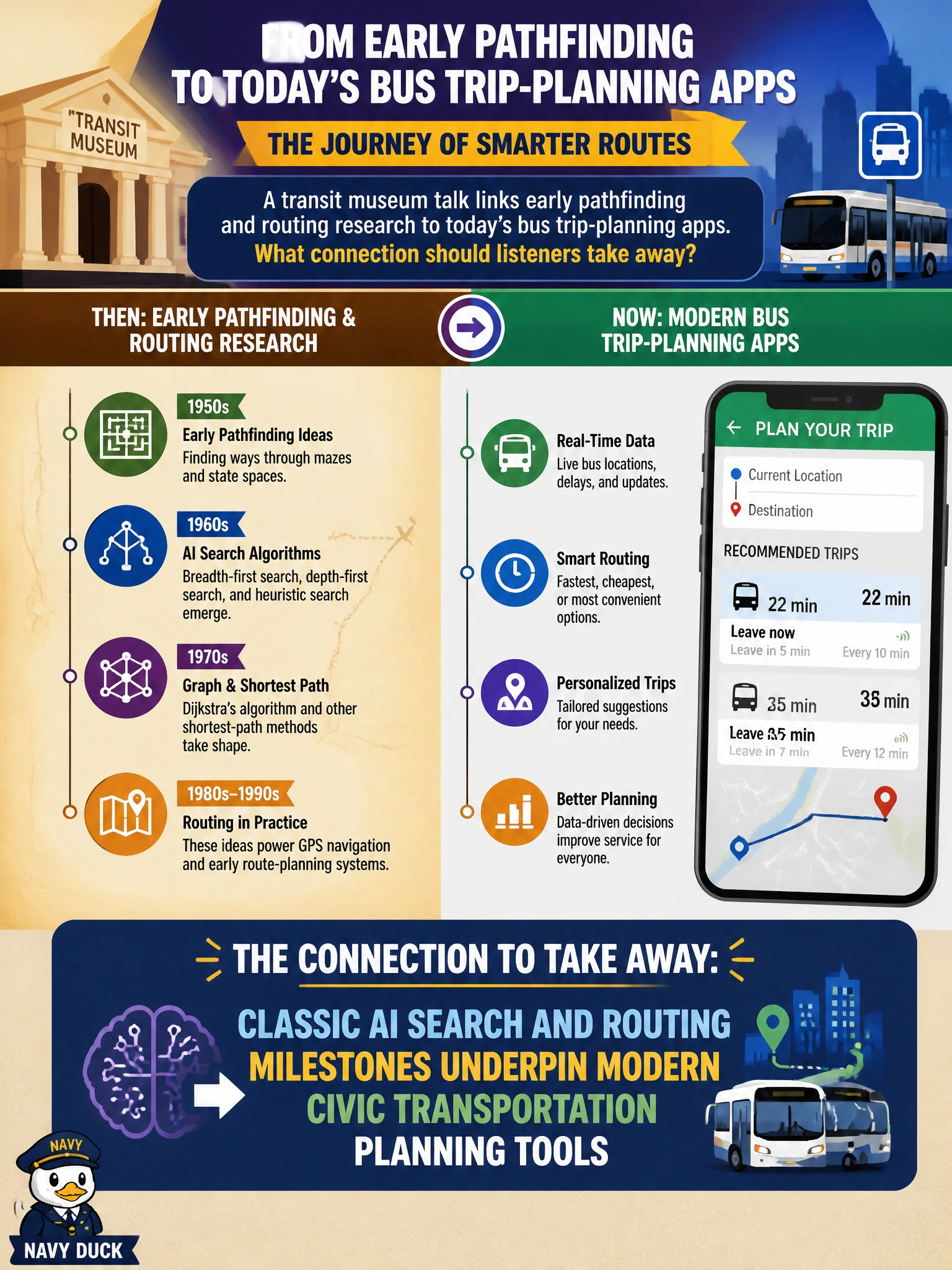
A transit museum talk links early pathfinding and routing research to today’s bus trip-planning apps. What connection should listeners take away?
Select an answer to reveal the explanation.
Short Explanation
Those old shortest-path puzzles did not stay in textbooks—they grew up into the app that tells you which bus to catch. Classic search and routing are grandparents of today’s trip planners. The museum line is heritage, not coincidence.
Full Explanation
Listeners should take away that classic AI search and routing milestones underpin modern civic transportation planning tools. Early AI and algorithms research on pathfinding, shortest paths, and routing—not merely games—created the conceptual and mathematical toolkit behind trip planners that optimize bus and multimodal journeys. Today’s apps wrap those ideas with live GTFS feeds, mobile UX, and cloud scale, but the heritage is classical search and routing. Museum talks connect that lineage so staff and the public see modern civic tools as descendants of foundational AI methods rather than inexplicable magic. Claiming classic AI search and routing milestones forecast passenger demand in civic planning tools confuses route computation with demand modeling; classic pathfinding finds optimal itineraries over schedule-constrained networks, while passenger demand forecasting comes from statistical and machine-learning models of ridership, demographics and events, not from search and routing alone. Saying classic AI search and routing milestones simulate vehicle dynamics in civic planning tools mistakes routing mathematics for physical modeling; search and routing optimize bus and multimodal journeys over weighted schedule-constrained networks, while vehicle dynamics simulation comes from mechanical engineering models of acceleration, braking and handling, not from pathfinding milestones. Asserting classic AI search and routing milestones optimize fuel efficiency in civic planning tools mistakes itinerary optimization for energy optimization; classic search finds fastest or fewest-transfer trips accounting for travel times and schedules, while fuel-efficiency optimization comes from powertrain, driving-cycle and fleet-operations analysis, not from routing milestones alone. Exam caveat: connect classic search/routing milestones to modern transit trip planning. Distractors invoke related functions like forecast passenger demand, simulate vehicle dynamics, or optimize fuel efficiency rather than underpinning trip-planning tools. Operational check: when procuring or explaining trip-planning systems, ask vendors which routing/search methods and constraints they use, validate results against known network disruptions, keep GTFS quality high because algorithms cannot compensate for bad schedule data, and document fallbacks when real-time feeds fail.
Prefer to study offline? Printable PDF study book + test engine ($7.50, unofficial). These questions stay free here.