
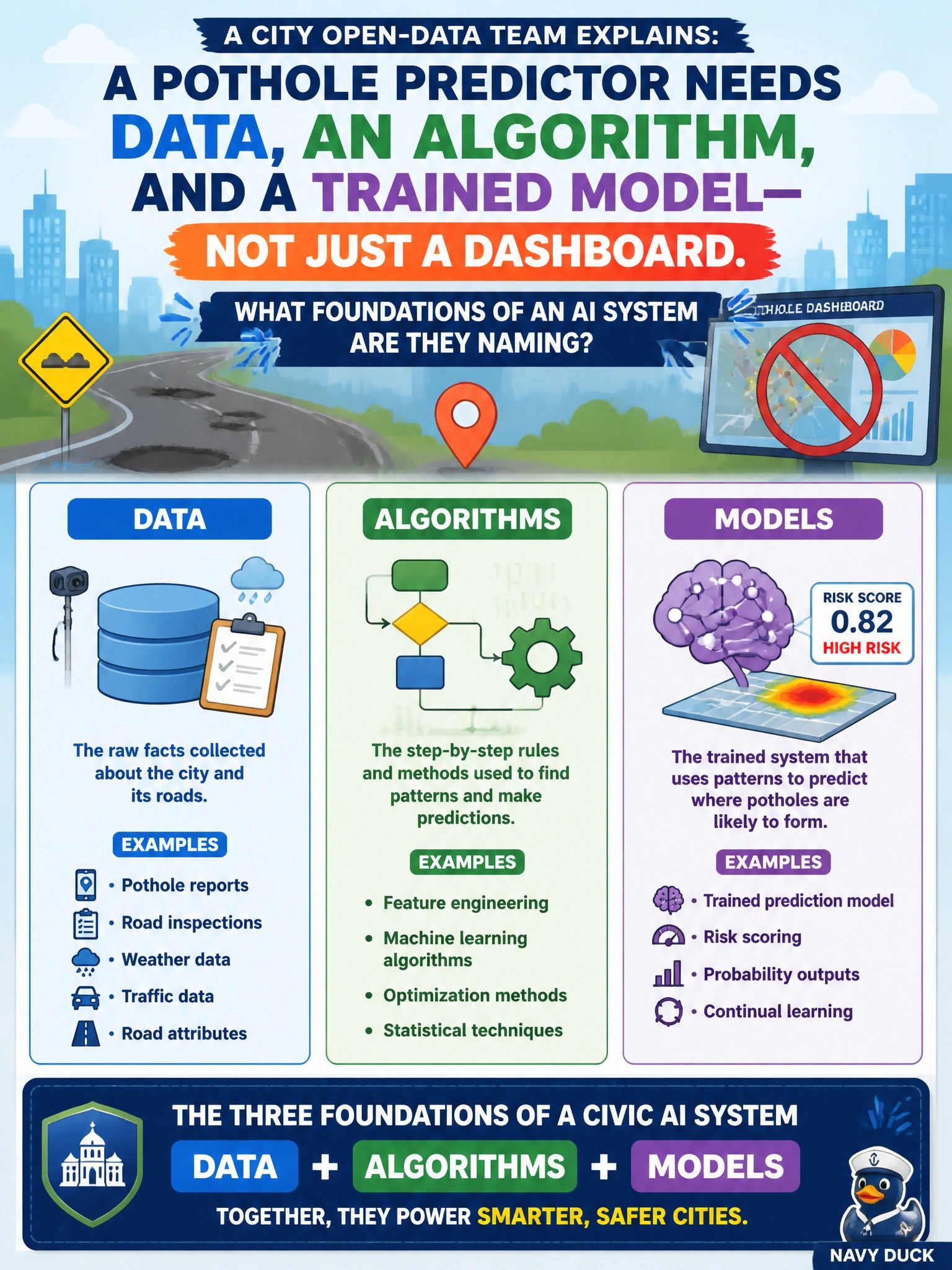
A city open-data team explains that a pothole predictor needs data, an algorithm, and a trained model—not just a dashboard. What foundations of an AI system are they naming?
Select an answer to reveal the explanation.
Short Explanation
A dashboard is the shop window; the AI shop behind it still needs ingredients, a recipe, and a baked cake. Those three are data, algorithm, and model. Without them you are just staring at charts that do not learn.
Full Explanation
The open-data team is naming data, algorithms, and models as the three foundations of the civic AI system. A pothole predictor does not magically appear from a public dashboard. It needs data (work orders, 311 complaints, street imagery, pavement scores), an algorithm (the learning or scoring method), and a trained model (the fitted artifact that maps inputs to predictions). Dashboards are presentation layers; without those three foundations, there is nothing trustworthy to display. Teaching this triad helps non-technical stakeholders stop equating ‘we built a map’ with ‘we built AI.’ Data, algorithm parameters, and models as the three foundations fails because algorithm parameters are tunable settings or learned values inside a method, not the algorithm or learning method itself needed to turn data into predictions. Datasets, algorithms, and model outputs as the three foundations fails because datasets cover the data foundation and algorithms are correct, but model outputs are the predictions produced when you run the model, not the trained model artifact that maps inputs to predictions. Data, algorithms, and model evaluations as the three foundations fails because model evaluations are testing activities and performance scores, not the trained model artifact needed to turn data into predictions. Exam caveat: remember the triad as data + algorithm + model. Exams often tempt you with UI/dashboard distractors. A dashboard can report model outputs; it does not replace the foundations. Operational check: for each civic AI use case, inventory the data sources and quality controls, document the algorithm/method chosen, version the trained model and training window, and refuse to call a visualization project ‘AI’ until those three elements are identified and owned.
Prefer to study offline? Printable PDF study book + test engine ($7.50, unofficial). These questions stay free here.